When you feel overstimulated, your mind and body are receiving more sensory or emotional information than they can comfortably handle.
Loud sounds, bright lights, crowds, constant notifications, stress, or too many tasks can all leave someone feeling overstimulated.
Finding the right overstimulated synonyms can help you describe these feelings more accurately.
Some words emphasize mental exhaustion, while others describe sensory overload, emotional pressure, nervousness, or difficulty concentrating.
This guide explains 30 alternatives to “overstimulated” in simple English.
It is useful for students, ESL learners, writers, bloggers, and content creators who want to choose words that match the exact situation and tone.
What Does “Overstimulated” Mean?
Simple meaning
Overstimulated means receiving too much sensory, mental, or emotional input at once.
For example, a person may feel overstimulated after spending several hours in a noisy, crowded place while receiving many phone notifications and trying to complete several tasks.
Example:
“I felt overstimulated after the busy meeting, loud music, and constant phone calls.”
The word is commonly used for situations involving too much activity, noise, information, emotion, or sensory input.
Tone and usage
“Overstimulated” is a neutral and modern word. It is especially common in everyday conversation, psychology-related writing, parenting discussions, lifestyle content, and descriptions of busy environments.
Depending on the situation, you may want a synonym that sounds more formal, emotional, physical, or conversational.
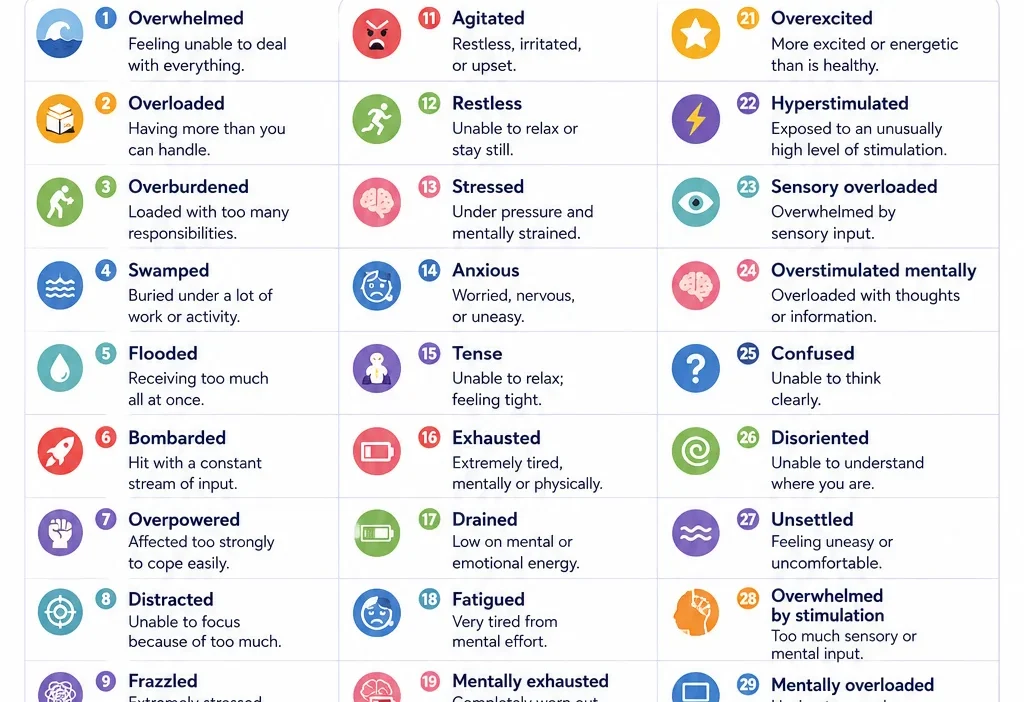
30 Overstimulated Synonyms
1. Overwhelmed
Meaning: Feeling unable to comfortably deal with everything happening at once.
Example: “She felt overwhelmed by the amount of work she had to finish.”
Best usage: General situations involving too many responsibilities, emotions, or demands.
2. Overloaded
Meaning: Having more information, work, or stimulation than you can handle.
Example: “My brain feels overloaded after studying for six hours.”
Best usage: Work, information, technology, or mental demands.
3. Overburdened
Meaning: Having too many responsibilities or problems to manage comfortably.
Example: “He became overburdened with work and family responsibilities.”
Best usage: Formal writing about responsibilities, duties, or pressure.
4. Swamped
Meaning: Having so much work or activity that it is difficult to manage.
Example: “I’m completely swamped with assignments this week.”
Best usage: Informal English, especially for work or school.
5. Flooded
Meaning: Receiving or experiencing a very large amount of something at once.
Example: “Her mind was flooded with information after the lecture.”
Best usage: Information, memories, thoughts, or emotions.
6. Bombarded
Meaning: Being exposed to a large amount of information, noise, questions, or demands.
Example: “We were bombarded with notifications throughout the day.”
Best usage: Strong descriptions of continuous or excessive input.
7. Overpowered
Meaning: Being affected so strongly by something that it becomes difficult to respond normally.
Example: “He felt overpowered by the noise and activity around him.”
Best usage: Strong sensory or emotional situations.
8. Distracted
Meaning: Unable to focus because something else is demanding your attention.
Example: “I was too distracted by the constant noise to study.”
Best usage: Difficulty concentrating rather than complete sensory overload.
9. Frazzled
Meaning: Feeling nervous, tired, confused, or stressed because of too much activity.
Example: “After a hectic morning, she felt completely frazzled.”
Best usage: Informal, conversational English.
10. Flustered
Meaning: Confused, nervous, or upset because of sudden pressure or too much happening at once.
Example: “He became flustered when several people asked him questions at once.”
Best usage: Short-term confusion or nervousness.
11. Agitated
Meaning: Feeling restless, upset, or unable to remain calm.
Example: “The constant noise left him feeling agitated.”
Best usage: Emotional or physical restlessness.
12. Restless
Meaning: Unable to relax or stay still because you feel uncomfortable or mentally active.
Example: “I felt restless after spending the entire day in a crowded office.”
Best usage: Physical uneasiness or difficulty relaxing.
13. Stressed
Meaning: Feeling worried or under too much pressure.
Example: “She felt stressed by the constant deadlines.”
Best usage: General emotional pressure and everyday English.
14. Anxious
Meaning: Feeling worried, nervous, or uneasy.
Example: “The busy environment made him feel anxious.”
Best usage: Situations where overstimulation causes worry or nervousness.
15. Tense
Meaning: Feeling nervous, uncomfortable, or unable to relax.
Example: “After hours of noise, I felt tense and exhausted.”
Best usage: Physical or emotional tension.
16. Exhausted
Meaning: Extremely tired and lacking energy.
Example: “After the crowded event, she was mentally exhausted.”
Best usage: When overstimulation results in strong tiredness.
17. Drained
Meaning: Having very little mental or emotional energy left.
Example: “The constant conversations left me emotionally drained.”
Best usage: Mental, emotional, or social fatigue.
18. Fatigued
Meaning: Very tired, especially after prolonged effort or activity.
Example: “He felt mentally fatigued after processing so much information.”
Best usage: Formal or academic writing.
19. Mentally exhausted
Meaning: Extremely tired because your mind has been working too hard.
Example: “After a full day of meetings, I was mentally exhausted.”
Best usage: Clearly describing cognitive overload.
20. Emotionally drained
Meaning: Having little emotional energy because of difficult or intense experiences.
Example: “The constant arguments left her emotionally drained.”
Best usage: Emotional situations rather than purely sensory ones.
21. Overexcited
Meaning: More excited or energetic than is comfortable or appropriate.
Example: “The children became overexcited during the noisy celebration.”
Best usage: High levels of positive excitement or energy.
22. Hyperstimulated
Meaning: Experiencing an unusually high level of stimulation.
Example: “After hours of gaming and screen time, he felt hyperstimulated.”
Best usage: Modern discussions of sensory or digital stimulation.
23. Sensory overloaded
Meaning: Experiencing too much sensory information to process comfortably.
Example: “The bright lights and loud music made her feel sensory overloaded.”
Best usage: Noise, lights, crowds, smells, textures, and other sensory input.
24. Overstimulated mentally
Meaning: Having more thoughts, information, or mental activity than you can comfortably process.
Example: “I felt overstimulated mentally after reading so many articles.”
Best usage: Information-heavy or thought-heavy situations.
25. Confused
Meaning: Unable to think clearly or understand what is happening.
Example: “The amount of information left me confused.”
Best usage: When excessive input causes a lack of clarity.
26. Disoriented
Meaning: Feeling confused about what is happening or where you are.
Example: “The flashing lights and loud sounds left him disoriented.”
Best usage: Stronger than “confused,” especially in intense environments.
27. Unsettled
Meaning: Feeling uncomfortable, worried, or unable to relax.
Example: “The constant noise made me feel unsettled.”
Best usage: Mild emotional discomfort or uneasiness.
28. Overwhelmed by stimulation
Meaning: Unable to comfortably process the amount of sensory or mental input around you.
Example: “She became overwhelmed by stimulation at the crowded festival.”
Best usage: A precise phrase when sensory input is the main problem.
29. Mentally overloaded
Meaning: Having too much information or mental work to process effectively.
Example: “I was mentally overloaded after answering emails all afternoon.”
Best usage: Work, studying, technology, and information-heavy situations.
30. On edge
Meaning: Nervous, tense, or easily bothered.
Example: “After hours of traffic and noise, I was completely on edge.”
Best usage: Informal English when overstimulation creates tension or irritability.
Comparison Guide for Overstimulated Synonyms
Different synonyms emphasize different parts of the experience. Choosing the right word depends on what you want to communicate.
| Synonym | Main idea | Tone | Common context |
|---|---|---|---|
| Overwhelmed | Too much to handle | Neutral | General |
| Overloaded | Too much input or work | Neutral | Mental/work |
| Bombarded | Too much coming continuously | Strong | Information/sensory |
| Frazzled | Stressed and confused | Informal | Everyday situations |
| Flustered | Nervous and confused | Neutral | Sudden pressure |
| Agitated | Restless or upset | Neutral | Emotional/sensory |
| Restless | Unable to relax | Neutral | Physical/mental |
| Stressed | Under pressure | Neutral | Work/life |
| Anxious | Worried or nervous | Neutral | Emotional |
| Drained | Low mental or emotional energy | Neutral | Social/emotional |
| Exhausted | Extremely tired | Neutral | Physical/mental |
| Hyperstimulated | Excessively stimulated | Modern/technical | Sensory/digital |
| Sensory overloaded | Too much sensory input | Specific | Noise/light/crowds |
| Mentally overloaded | Too much mental input | Specific | Study/work |
| On edge | Tense and easily irritated | Informal | Everyday situations |
How to Choose the Right Synonym
Use “overwhelmed” for general situations
Choose overwhelmed when you simply mean that something feels like too much to handle.
Example:
“I’m overwhelmed by everything I need to do.”
This is one of the most flexible alternatives to “overstimulated.”
Use “sensory overloaded” for the five senses
Choose sensory overloaded when the problem involves sounds, lights, smells, textures, crowds, or other sensory information.
Example:
“The bright lights and loud music left me sensory overloaded.”
Use “mentally overloaded” for information
Choose mentally overloaded when someone has too many thoughts, tasks, decisions, or pieces of information to process.
Example:
“After three hours of studying, I felt mentally overloaded.”
Use “drained” or “exhausted” for tiredness
If the main result of overstimulation is tiredness, drained or exhausted may be better choices.
Example:
“After the party, I felt completely drained.”
Use “anxious” when worry is important
If overstimulation produces fear, worry, or nervousness, anxious can communicate that emotional response more clearly.
Example:
“The crowded station made him feel anxious.”
Use “agitated” when someone becomes restless
When excessive stimulation causes irritation, restlessness, or difficulty staying calm, agitated may be more precise.
Example:
“The constant interruptions made her increasingly agitated.”
Use “frazzled” in casual conversation
Frazzled is useful when someone feels mentally tired, stressed, confused, and disorganized.
Example:
“I’ve had such a busy day that I’m completely frazzled.”
Use “bombarded” when input keeps coming
Choose bombarded when information, messages, sounds, questions, or demands arrive continuously.
Example:
“Consumers are bombarded with advertisements every day.”
Overstimulated Synonyms by Intent and Tone
For formal writing
Use:
- Overburdened
- Fatigued
- Mentally overloaded
- Sensory overloaded
- Overwhelmed
These choices work well in essays, reports, educational content, and professional writing.
For casual conversation
Use:
- Frazzled
- Swamped
- Stressed
- On edge
- Drained
These words sound natural in everyday speech.
For sensory situations
Use:
- Sensory overloaded
- Hyperstimulated
- Overpowered
- Bombarded
- Overwhelmed
These are useful when discussing noise, light, crowds, screens, or busy environments.
For mental pressure
Use:
- Mentally overloaded
- Overloaded
- Distracted
- Confused
- Mentally exhausted
These words are especially useful for studying, working, multitasking, and processing information.
For emotional pressure
Use:
- Anxious
- Agitated
- Tense
- Unsettled
- Emotionally drained
These synonyms work best when emotions are the main part of the experience
Overwhelmed has a broader meaning. It can describe having too many responsibilities, emotions, problems, or demands.
Compare:
“I felt overstimulated by the loud music, bright lights, and crowded room.”
“I felt overwhelmed by my exams, work, and personal responsibilities.”
The first sentence focuses on excessive stimulation. The second focuses on having too many things to manage.
Overstimulated vs. Overloaded
These words are also similar.
Overstimulated suggests excessive stimulation from the environment or internal experience.
Overloaded often suggests having too much work, information, data, or responsibility.
Example:
“The children became overstimulated by the noisy party.”
“My brain feels overloaded with information.”
Both are useful, but the surrounding context determines which sounds more natural.
Overstimulated vs. Stressed
Being stressed means feeling pressure or worry. Being overstimulated means experiencing more input than you can comfortably process.
A person can be overstimulated without being particularly worried.
For example, a noisy shopping center may make someone overstimulated even if nothing is going wrong.
Overstimulated vs. Exhausted
Overstimulated describes the experience of too much input.
Exhausted describes the resulting lack of energy.
For example:
“The loud concert left me overstimulated.”
“After the concert, I was exhausted.”
Using these words correctly makes your writing more precise.
Why Use Synonyms for “Overstimulated”?
They make writing more precise
Using the same word repeatedly can make writing sound repetitive. Synonyms allow you to explain exactly what a person is experiencing.
Instead of writing:
“I was overstimulated by the noise. I felt overstimulated at work. The party was overstimulating.”
You can write:
“I was overwhelmed by the noise. I felt mentally overloaded at work. The party left me frazzled.”
They help express different emotions
Not every form of overstimulation feels the same.
One person may feel anxious, another may feel agitated, while someone else may feel drained.
Choosing the right synonym gives readers a clearer picture.
They improve vocabulary
For ESL learners and students, learning related words is an effective way to expand vocabulary.
Understanding the difference between words such as overwhelmed, anxious, drained, and sensory overloaded can make both speaking and writing more natural.
Common Phrases Related to Overstimulation
Here are some natural phrases you may see in everyday English:
- Feeling overwhelmed by noise
- Mentally overloaded
- Sensory overload
- Emotionally drained
- Bombarded with information
- Feeling on edge
- Too much going on
- Unable to concentrate
- Mentally exhausted
- Needing some quiet time
- Needing a break from stimulation
- Having difficulty processing information
These phrases can sometimes sound more natural than using a single synonym.
Frequently Asked Questions About Overstimulated Synonyms
What is the best synonym for overstimulated?
Overwhelmed is one of the closest general synonyms. However, the best choice depends on the situation. Use sensory overloaded for excessive sensory input and mentally overloaded for too much information or mental work.
What is a simple word for overstimulated?
Simple alternatives include overwhelmed, stressed, distracted, tired, and restless. The correct word depends on the exact feeling.
Is “overwhelmed” the same as “overstimulated”?
Not exactly. “Overwhelmed” is broader and can refer to responsibilities, emotions, or problems. “Overstimulated” specifically emphasizes excessive stimulation or input.
What is a synonym for sensory overload?
Useful alternatives include sensory overwhelmed, sensory overloaded, hyperstimulated, and overwhelmed by stimulation.
What is a synonym for mentally overstimulated?
Good choices include mentally overloaded, mentally exhausted, overwhelmed, cognitively overloaded, and flooded with information.
What is the opposite of overstimulated?
Depending on the context, possible opposites include calm, relaxed, settled, unbothered, focused, and understimulated.
Conclusion
The best overstimulated synonyms depend on what kind of experience you want to describe. Overwhelmed works well as a broad alternative, while sensory overloaded is more specific to sounds, lights, crowds, and other sensory input.
For mental pressure, consider mentally overloaded, overloaded, or mentally exhausted. For emotional effects, words such as anxious, agitated, tense, and emotionally drained may be more accurate. In casual conversation, frazzled, swamped, and on edge can sound especially natural.
Learning these differences can help students and ESL learners build stronger vocabulary while helping writers choose words that communicate feelings with greater precision. Instead of simply saying someone is “overstimulated,” choose the synonym that best explains why they feel that way and how the experience affects them.