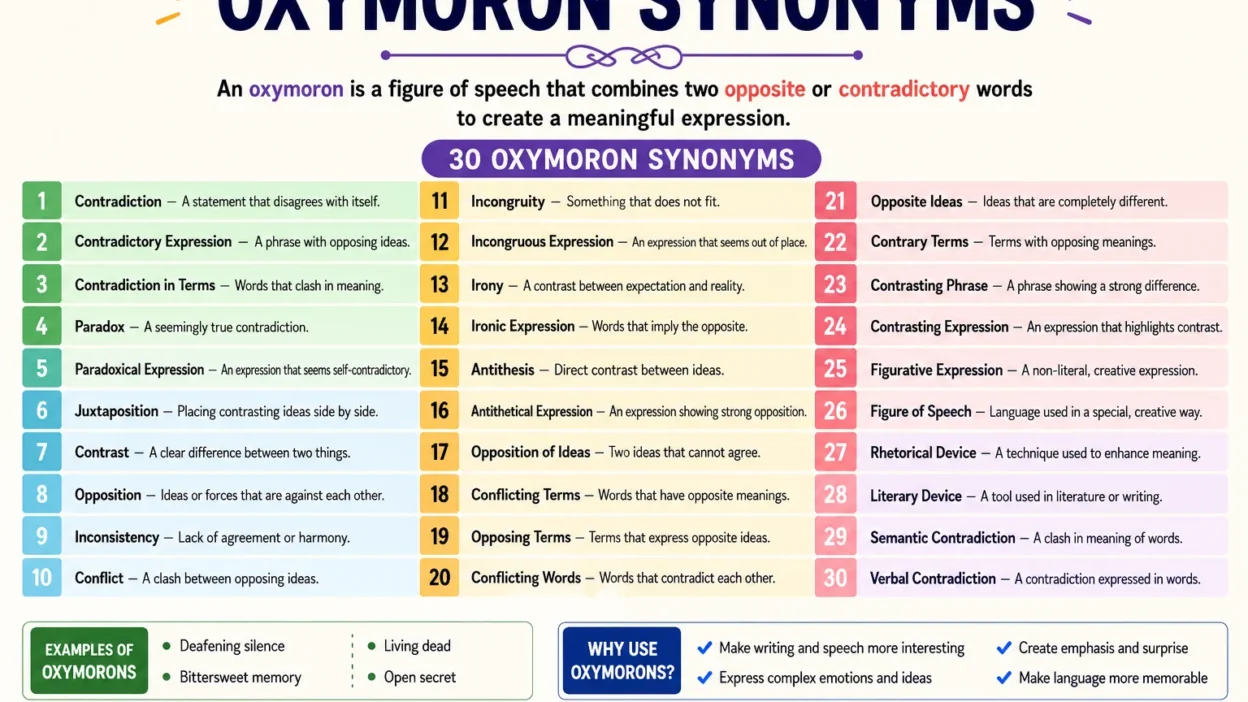
An oxymoron is a figure of speech in which two words or ideas with seemingly opposite or contradictory meanings are placed together to create a meaningful expression.
The word itself comes from the Greek words oxys, meaning “sharp,” and moros, meaning “dull” or “foolish.”
Thus, an oxymoron is essentially a combination of apparently contradictory ideas.
Oxymorons are commonly used in literature, everyday speech, advertising, journalism, and creative writing.
They can make language more interesting, memorable, and thought-provoking.
Synonyms and Related Terms for Oxymoron
Although “oxymoron” does not have many exact synonyms, several terms are closely related to its meaning. These include:
- Contradictory expression
- Contradictory phrase
- Paradoxical expression
- Contradiction in terms
- Opposing terms
- Conflicting words
- Juxtaposition
- Paradox
- Figure of speech
- Ironic expression
It is important to note that paradox and oxymoron are related but not identical. An oxymoron usually combines two contradictory words in a short phrase, while a paradox is generally a larger statement or idea that appears contradictory but may reveal a deeper truth.
Common Examples of Oxymorons
There are many oxymorons that people use in everyday language. Some common examples include:
- Deafening silence — silence that feels extremely powerful or noticeable.
- Bittersweet — something that is both pleasant and painful.
- Clearly confused — someone who is obviously uncertain or confused.
- Seriously funny — something that is genuinely humorous while being treated seriously.
- Living dead — something described as both alive and dead.
- Awfully good — something that is extremely good.
- Alone together — being physically together while feeling emotionally separate.
- Original copy — a copy presented as the original version.
- Pretty ugly — something that is noticeably unattractive.
- Virtual reality — an artificial environment designed to feel real.
These expressions work because the contradiction attracts attention and encourages the listener or reader to think about the intended meaning.
Oxymoron in Literature
Writers frequently use oxymorons to express complicated emotions and ideas. Human experiences are not always simple; people can feel happiness and sadness at the time, or love and anger the same person.
Oxymorons allow writers to communicate these complex feelings in a concise and memorable way.
For example, the phrase “bittersweet” can describe an experience that brings both happiness and sadness.
A graduation ceremony may be bittersweet because a student is proud of completing school but sad about leaving friends behind.
Similarly, “deafening silence” can describe a situation in which there is no sound, yet the silence feels emotionally overwhelming.
Oxymoron vs. Paradox
Oxymoron and paradox are sometimes confused because both involve contradiction. However, there is an important difference.
An oxymoron is usually a short combination of contradictory words:
“Deafening silence.”
A paradox, on the other hand, is a statement or situation that appears contradictory but may contain a logical or meaningful idea:
“The more you learn, the more you realize how little you know.”
Therefore, an oxymoron is generally a compact contradiction, while a paradox is usually a broader contradictory idea.
Why Are Oxymorons Used?
Oxymorons serve several purposes in communication and writing. They can:
- Create emphasis — Contradictory words naturally attract attention.
- Express complex emotions — They can describe feelings that contain opposing elements.
- Make language memorable — Unusual combinations are easier to remember.
- Create humor — Some oxymorons are deliberately funny.
- Encourage deeper thinking — They make readers consider how two seemingly opposite ideas can coexist.
- Add creativity to writing — They make ordinary descriptions more vivid and interesting.
Oxymorons in Everyday Communication
Oxymorons are not limited to poetry or literature. People use them in everyday conversations without always realizing it. Expressions such as “pretty ugly,” “small crowd,” “old news,” and “virtual reality” appear regularly in speech and writing.
Businesses and advertisers also use contradictory expressions because they can make slogans and messages more memorable. A surprising combination of words can encourage people to stop, think, and remember the message.
Conclusion
An oxymoron is a powerful figure of speech that combines seemingly contradictory words or ideas to create a specific meaning.
Related terms include contradictory expression, paradoxical expression, contradiction in terms, opposing terms, and conflicting words.
Although oxymorons are often short, they can communicate complex emotions, create humor, emphasize ideas, and make language more memorable.
Understanding oxymorons can improve both reading and writing skills. They show that language does not always have to be straightforward: sometimes, putting two opposites together can express an idea more effectively than using ordinary words.