
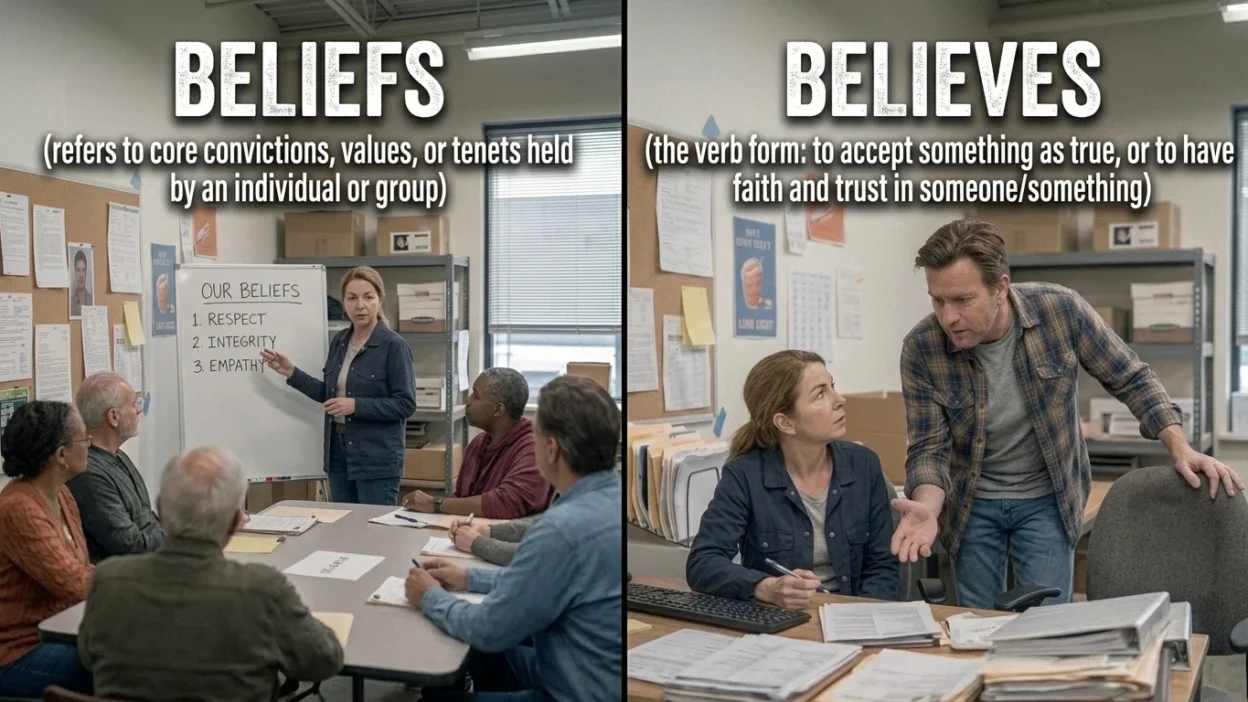
Have you ever wondered whether to write beliefs or believes?
These two words look similar and come from the same root word, believe, but they have different meanings and grammatical uses.
Choosing the wrong one can make your sentence sound incorrect or confusing.
The main difference is that beliefs is a plural noun, while believes is a verb used with singular third-person subjects such as he, she, and it.
For example, you can say, “Her beliefs are important to her,” or “She believes in herself.”
Both sentences are correct, but the words serve different purposes. Understanding this distinction will help you improve your grammar, write more clearly, and speak more naturally.
In this guide, you will learn the meaning of each word, see how to use it correctly, explore common mistakes, and practice with plenty of real life examples.
Quick Answer: Beliefs vs. Believes
Beliefs refers to ideas, opinions, or principles that someone accepts as true. It is the plural form of the noun belief. Believes is the third-person singular form of the verb believe, meaning to accept something as true or to trust someone or something.
- Beliefs: Her beliefs shape her decisions.
- Believes: She believes in her abilities.
Remember: beliefs names ideas, while believes describes what someone thinks or accepts as true.
Why Do People Confuse Beliefs and Believes?
People often confuse beliefs and believes because both words are formed from believe and have similar spellings. They also relate to the same general idea: accepting something as true.
However, English uses them for different grammatical purposes. Beliefs is a noun that names ideas or principles. Believes is a verb that describes what a person thinks or accepts as true.
For example:
- Incorrect: She beliefs in herself.
- Correct: She believes in herself.
- Correct: Her beliefs give her confidence.
The easiest way to avoid confusion is to identify whether your sentence needs a noun or a verb.
What Does Beliefs Mean?
Beliefs is the plural form of the noun belief. It refers to ideas, opinions, values, or principles that a person or group accepts as true.
Beliefs can relate to religion, culture, politics, personal values, science, relationships, or everyday life. They may be based on experience, education, tradition, evidence, or personal understanding.
Examples of Beliefs
- Her beliefs are important to her.
- Our beliefs influence the decisions we make.
- Different cultures have different beliefs.
- His beliefs changed after years of experience.
- They respect each other’s beliefs.
How to Use Beliefs in a Sentence
Use beliefs when you are talking about more than one idea, principle, or conviction.
Common patterns:
- Personal beliefs: My beliefs guide my choices.
- Religious beliefs: Their religious beliefs are deeply meaningful to them.
- Political beliefs: Our political beliefs are different.
- Cultural beliefs: Cultural beliefs can vary from one community to another.
- Strong beliefs: She has strong beliefs about honesty.
Remember that belief is singular, while beliefs is plural.
- Singular: His belief is important to him.
- Plural: His beliefs are important to him.
The verb in the sentence usually agrees with the noun: “His belief is important,” but “His beliefs are important.”
What Does Believes Mean?
Believes is the third-person singular form of the verb believe. It is used with subjects such as he, she, and it, as well as singular nouns and names.
The verb believe means to accept something as true, trust someone, or have confidence in a person or idea.
Examples of Believes
- She believes in herself.
- He believes your story.
- My teacher believes that practice improves performance.
- Sarah believes in helping others.
- The child believes that the story is real.
How to Use Believes in a Sentence
Use believes when the subject is a singular third-person person, animal, or thing.
Common patterns:
- Believes in: He believes in hard work.
- Believes that: She believes that everyone deserves respect.
- Believes someone: My friend believes me.
- Believes something: He believes the explanation is correct.
Compare the verb forms:
| Subject | Correct verb |
|---|---|
| I | believe |
| You | believe |
| We | believe |
| They | believe |
| He | believes |
| She | believes |
| It | believes |
For example, say “They believe in teamwork,” but “She believes in teamwork.”
Beliefs vs. Believes: Comparison Table
| Feature | Beliefs | Believes |
|---|---|---|
| Part of speech | Noun | Verb |
| Base word | Belief | Believe |
| Meaning | Ideas or principles accepted as true | Accepts something as true or trusts |
| Grammatical form | Plural noun | Third-person singular verb |
| Typical subject or use | Her beliefs, their beliefs | He believes, she believes |
| Example | Their beliefs are different. | She believes in kindness. |
The key difference is simple: beliefs names ideas, while believes describes an action or state of thinking.
When to Use Beliefs
Use beliefs when you need a noun to describe the ideas, values, or principles someone holds.
1. When Talking About Personal Values
- His beliefs influence the way he treats others.
- My beliefs help me make difficult decisions.
2. When Discussing Religion
- People have different religious beliefs.
- Her beliefs are an important part of her life.
3. When Comparing Opinions
- Their beliefs about education are different.
- We respect people with different beliefs.
4. When Describing Cultural Traditions
- Traditional beliefs vary across communities.
- Some cultural beliefs have been passed down for generations.
5. When Talking About More Than One Conviction
- She explained her beliefs during the discussion.
- His beliefs about success changed over time.
Quick test: If you can replace the word with ideas, values, or principles, you probably need beliefs.
When to Use Believes
Use believes when the subject is he, she, it, or another singular third-person noun, and you want to describe what that subject accepts as true or trusts.
1. When Expressing an Opinion or Conviction
- She believes that honesty is essential.
- He believes hard work leads to improvement.
2. When Expressing Trust
- She believes her friend.
- The manager believes the employee’s explanation.
3. When Talking About Confidence
- He believes in his abilities.
- Maria believes she can achieve her goals.
4. When Describing Someone’s Viewpoint
- My father believes that education opens doors.
- The scientist believes the results need further testing.
5. When Talking About Faith or Principles
- She believes in treating everyone fairly.
- He believes in giving people another chance.
Quick test: If the subject is he, she, or it, ask whether you need a verb meaning “accepts as true.” If so, believes may be correct.
Beliefs vs. Believes: 15 Example Sentences
Here are 15 examples showing how to use both words correctly.
- Beliefs: Her beliefs help guide her decisions.
- Believes: She believes that hard work pays off.
- Beliefs: Their religious beliefs are different.
- Believes: He believes in treating everyone fairly.
- Beliefs: Our beliefs can change as we learn.
- Believes: My sister believes me when I tell the truth.
- Beliefs: The teacher respects the students’ beliefs.
- Believes: Daniel believes he can solve the problem.
- Beliefs: Personal beliefs may influence our choices.
- Believes: She believes that kindness matters.
- Beliefs: Their beliefs about success differ.
- Believes: My grandfather believes in keeping promises.
- Beliefs: Different communities may have different beliefs.
- Believes: The child believes the story is real.
- Beliefs: We should listen respectfully to other people’s beliefs.
Notice how beliefs names ideas, while believes tells us what someone thinks or accepts as true.
Common Mistakes With Beliefs and Believes
These mistakes are common among English learners. The following examples show how to correct them.
Mistake 1: Using Beliefs Instead of Believes
Incorrect: She beliefs in herself.
Correct: She believes in herself.
Why? The sentence needs a verb. Believes is the correct verb form for she.
Mistake 2: Using Believes Instead of Beliefs
Incorrect: His believes are important to him.
Correct: His beliefs are important to him.
Why? The sentence needs a plural noun to describe his ideas or principles.
Mistake 3: Forgetting the -s With He or She
Incorrect: He believe in honesty.
Correct: He believes in honesty.
Why? In the simple present tense, a third-person singular subject normally takes a verb ending in -s or -es.
Mistake 4: Adding -s After a Plural Subject
Incorrect: They believes in teamwork.
Correct: They believe in teamwork.
Why? The verb does not take -s with plural subjects such as they.
Mistake 5: Confusing Belief With Believe
Incorrect: I believe is strong.
Correct: My belief is strong.
Also correct: I believe in myself.
Why? Belief is a noun, while believe is a verb. Choose the form that fits the sentence.
Easy Memory Trick: Beliefs vs. Believes
Use these simple tips to remember the difference.
- Beliefs = Ideas: Her beliefs are important.
- Believes = Thinks: She believes in herself.
- Belief = One idea: His belief is strong.
- Believe = Base verb: I believe you.
Here is another useful trick:
If you can ask “What ideas?” use beliefs. If you can ask “What does he or she think?” use believes.
For example:
- What does she think? She believes in herself.
- What ideas does she hold? Her beliefs guide her.
This simple method can help you choose the right word quickly.
Beliefs vs. Believes in American and British English
The difference between beliefs and believes is the same in American and British English. Both varieties use beliefs as the plural noun and believes as the third-person singular verb.
Examples in both varieties include:
- Her beliefs are important to her.
- He believes in working hard.
- They respect each other’s beliefs.
There is no major regional spelling difference between these two forms. The important point is to use the correct part of speech and match the verb to its subject.
Similar Words: Belief, Believe, Beliefs, and Believes
These four forms are related, but each has a different grammatical function.
| Word | Part of speech | Meaning | Example |
|---|---|---|---|
| Belief | Noun, singular | An idea accepted as true | Her belief is strong. |
| Believe | Verb, base form | To accept something as true | I believe you. |
| Beliefs | Noun, plural | Multiple ideas accepted as true | Their beliefs differ. |
| Believes | Verb, third-person singular | Accepts something as true | She believes you. |
Belief vs. Believe
Use belief when naming an idea and believe when describing the act of accepting something as true.
- My belief is important to me.
- I believe in myself.
Beliefs vs. Believes
Use beliefs for multiple ideas and believes for a singular third-person subject.
- Her beliefs shape her choices.
- She believes in her choices.
Believe vs. Believes
Use believe with I, you, we, and they. Use believes with he, she, and it in the simple present tense.
- They believe in teamwork.
- He believes in teamwork.
Frequently Asked Questions
1. What is the difference between beliefs and believes?
Beliefs is the plural form of the noun belief, meaning ideas or principles accepted as true. Believes is the third-person singular form of the verb believe. For example, “Her beliefs are strong” and “She believes in herself.”
2. Is beliefs a noun or a verb?
Beliefs is a noun. It refers to more than one belief, such as religious beliefs, personal beliefs, or political beliefs.
3. Is believes a correct word?
Yes. Believes is the correct verb form used with singular third-person subjects in the simple present tense. For example, “He believes the story.”
4. Should I write “she believes” or “she beliefs”?
Write “she believes.” The subject she requires the verb believes in the simple present tense. Beliefs is a noun, so “she beliefs” is grammatically incorrect in standard English.
5. What is the singular form of beliefs?
The singular form is belief. For example, “Her belief is important” refers to one belief, while “Her beliefs are important” refers to multiple beliefs.
6. What is the base form of believes?
The base form is believe. Use believe with subjects such as I, you, we, and they. Use believes with he, she, and it in the simple present tense.
7. Can I say “I believes”?
No. In standard English, say “I believe.” The form believes is used with singular third-person subjects such as he, she, and it, not with I.
8. Is “their beliefs” or “their believes” correct?
“Their beliefs” is correct when you mean the ideas or principles held by a group of people. For example, “Their beliefs are different.” The word believes is a verb and does not fit this noun phrase.
Remember This
- Beliefs is a plural noun: “Their beliefs are important.”
- Believes is a verb: “She believes in herself.”
- Belief is the singular noun.
- Believe is the base form of the verb.
- Use believes with he, she, and it in the simple present tense.
- Use believe with I, you, we, and they.
Conclusion
The difference between beliefs and believes becomes easy to understand when you focus on their grammatical roles. Beliefs refers to ideas, values, or principles that people accept as true. Believes describes what a person thinks, trusts, or accepts as true. Although the words look similar, they cannot be used interchangeably in a sentence.
To choose the correct word, check whether your sentence needs a noun or a verb. If you are talking about someone’s ideas, use beliefs. If you are describing what a person thinks or accepts as true, use believes with a singular third-person subject. Practicing these simple patterns will help you write more accurately and communicate with greater confidence.