The word noob is one of the most common slang terms used online. You can hear it in video gamesand everyday conversations.
While it usually describes someone who is new or inexperienced, it can sound either playful or insulting depending on the situation.
Learning different noob synonyms helps students, ESL learners, writers, , and content choose the right word for different situations.
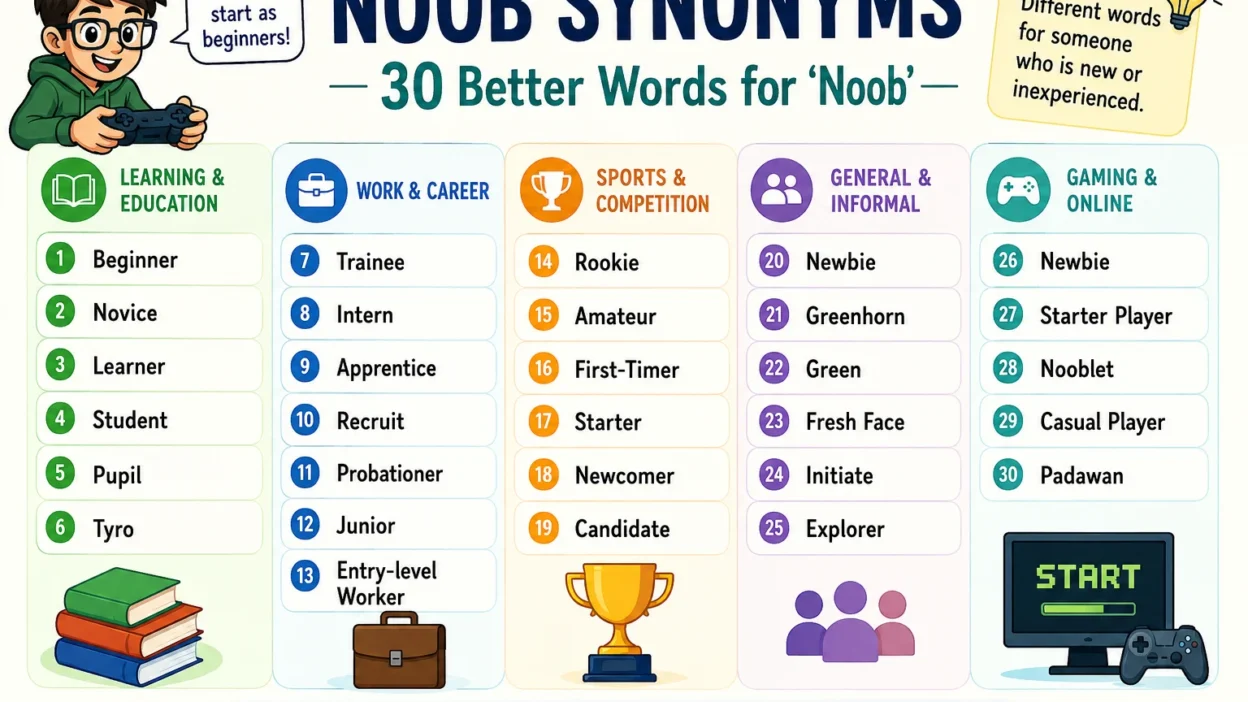
Some alternatives are formal, while others are casual or humorous. In this guide, you’ll discover 30 easy-to-understand synonyms, their meanings, example sentences, and the best situations to use them.
What Does “Noob” Mean?
The word noob (also spelled newb or n00b) is an informal slang word that describes someone who lacks experience or skill in a particular activity. It is commonly used in online gaming, technology, sports, and hobbies.
Sometimes noob simply means a beginner who is still learning. However, in some conversations, it may be used as an insult for someone who repeatedly makes basic mistakes.
Example:
- I’m still a noob at graphic design, but I’m learning every day.
30 Noob Synonyms with Meanings and Examples
1. Beginner
Meaning: A person who has just started learning something.
Example: Sarah is a beginner at photography.
Best Usage Context: Formal and educational settings.
2. Novice
Meaning: Someone with little experience.
Example: The novice driver practiced every weekend.
Best Usage Context: Professional and academic writing.
3. Newcomer
Meaning: A person who recently joined a group or activity.
Example: Every newcomer received a welcome guide.
Best Usage Context: Workplaces, clubs, and communities.
4. Rookie
Meaning: Someone in their first year or first experience.
Example: The rookie player impressed everyone.
Best Usage Context: Sports and workplaces.
5. Learner
Meaning: A person who is gaining knowledge or skills.
Example: Every learner improves with practice.
Best Usage Context: Schools and online courses.
6. Amateur
Meaning: Someone who is not yet a professional.
Example: She entered the competition as an amateur.
Best Usage Context: Arts, sports, and hobbies.
7. Trainee
Meaning: Someone receiving training.
Example: Every trainee completed the safety course.
Best Usage Context: Business and job training.
8. Apprentice
Meaning: A person learning a trade from an expert.
Example: The apprentice learned from an experienced carpenter.
Best Usage Context: Skilled professions.
9. Freshman
Meaning: A first-year student or beginner.
Example: The freshman joined the debate club.
Best Usage Context: Schools and universities.
10. Greenhorn
Meaning: Someone with very little experience.
Example: The greenhorn asked many questions.
Best Usage Context: Informal conversations.
11. Tyro
Meaning: A beginner in a particular field.
Example: Every tyro needs time to improve.
Best Usage Context: Formal writing.
12. Initiate
Meaning: Someone newly introduced to a subject.
Example: Every initiate attended orientation.
Best Usage Context: Organizations and groups.
13. Probationer
Meaning: A person being tested during an initial period.
Example: The probationer completed all assigned tasks.
Best Usage Context: Employment.
14. Intern
Meaning: A student or beginner gaining work experience.
Example: The intern assisted the marketing team.
Best Usage Context: Professional workplaces.
15. Candidate
Meaning: Someone preparing for a role or qualification.
Example: Every candidate attended the interview.
Best Usage Context: Exams and recruitment.
16. Starter
Meaning: Someone who has just begun.
Example: This guide is perfect for starters.
Best Usage Context: Casual learning.
17. First-Timer
Meaning: Someone doing something for the first time.
Example: The race welcomed many first-timers.
Best Usage Context: Everyday conversation.
18. Green
Meaning: Inexperienced or lacking knowledge.
Example: He is still green in project management.
Best Usage Context: Informal and workplace discussions.
19. Inexperienced Person
Meaning: Someone with little practical experience.
Example: Every inexperienced person makes mistakes.
Best Usage Context: Formal writing.
20. Recruit
Meaning: A newly joined member.
Example: The recruit began military training.
Best Usage Context: Military and organizations.
21. Student
Meaning: A person learning a subject.
Example: Every student starts somewhere.
Best Usage Context: Education.
22. Pupil
Meaning: A learner, especially in school.
Example: Every pupil completed the assignment.
Best Usage Context: Schools.
23. Disciple
Meaning: A person learning from a teacher.
Example: The disciple followed the mentor’s advice.
Best Usage Context: Religious or philosophical contexts.
24. Explorer
Meaning: Someone discovering a new subject.
Example: Every explorer learns through curiosity.
Best Usage Context: Creative learning.
25. Starter Player
Meaning: A person beginning a game.
Example: The starter player watched the tutorial.
Best Usage Context: Gaming.
26. Newbie
Meaning: A friendly word for someone new.
Example: Every newbie asks questions at first.
Best Usage Context: Online communities and gaming.
27. Fresh Face
Meaning: Someone who is completely new.
Example: The company hired several fresh faces.
Best Usage Context: Informal workplace conversations.
28. Entry-Level Worker
Meaning: A beginner employee.
Example: She accepted an entry-level position.
Best Usage Context: Careers and employment.
29. Junior
Meaning: A less experienced member of a team.
Example: The junior developer learned quickly.
Best Usage Context: Business and technology.
30. Learner Driver
Meaning: Someone learning to drive.
Example: Every learner driver needs practice.
Best Usage Context: Driving education.
Comparison Guide: When to Use Different Noob Synonyms
| Synonym | Tone | Best For |
|---|---|---|
| Beginner | Neutral | Learning, education |
| Novice | Formal | Professional writing |
| Rookie | Casual | Sports, jobs |
| Newbie | Friendly | Gaming, online communities |
| Amateur | Neutral | Hobbies and competitions |
| Greenhorn | Humorous | Informal conversations |
| Apprentice | Formal | Skilled trades |
| Trainee | Professional | Workplace training |
| Intern | Professional | Office environments |
| First-Timer | Friendly | Everyday conversations |
How to Choose the Right Synonym
For Formal Writing
Use words like:
- Novice
- Beginner
- Trainee
- Apprentice
- Intern
- Inexperienced person
These sound professional and respectful.
For Casual Conversation
Choose:
- Newbie
- Rookie
- First-timer
- Green
- Fresh face
These are common in everyday English.
For Gaming
The best options include:
- Newbie
- Rookie
- Beginner
- Starter player
These fit gaming communities without sounding overly formal.
For School or Learning
Use:
- Learner
- Student
- Pupil
- Beginner
These are simple, polite, and widely understood.
For Workplace Settings
Good choices are:
- Trainee
- Intern
- Recruit
- Junior
- Entry-level worker
These describe people who are new to a job or profession.
Tips for Using Noob Synonyms Correctly
- Consider your audience before choosing a synonym.
- Use formal words in professional writing.
- Choose friendly alternatives when encouraging beginners.
- Avoid using noob as an insult.
- Match the word to the situation for clear communication.
Frequently Asked Questions
Is “noob” a bad word?
Not always. It can simply mean someone who is new. However, it may sound rude if used to criticize someone.
What is the most polite synonym for noob?
Beginner is usually the safest and most polite choice.
Is “newbie” the same as “noob”?
They are similar, but newbie is generally friendlier and less insulting.
Which synonym is best for professional writing?
Words like novice, beginner, trainee, and apprentice are more appropriate in professional contexts.
Can I use “rookie” outside sports?
Yes. It is commonly used for anyone who is new to a job, hobby, or activity.
Conclusion
Understanding different noob synonyms allows you to communicate more clearly and respectfully.
While noob is a popular slang term, alternatives such as beginner, novice, newbie, rookie, and trainee often fit different audiences and situations better.
if you’re writing an article, improving your English vocabulary, creating content, or simply looking for a more suitable word, choosing the right synonym makes your communication stronger and more natural.
Keep practicing these words, and you’ll quickly build a richer and more versatile vocabulary.