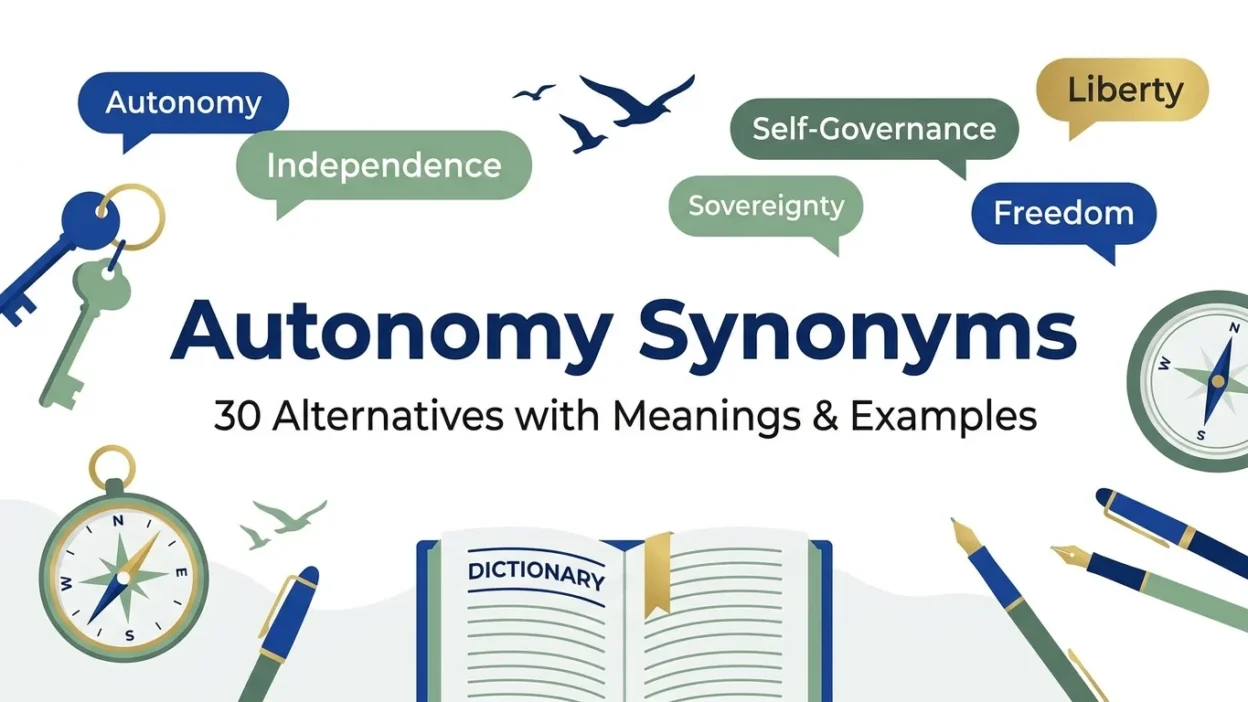
Finding the right autonomy synonyms can make your writing clearer, more precise, and more natural.
if you are a student writing an essay, an ESL learner building vocabulary, or a content creator looking for better word choices, understanding the small differences between similar words is important.
The word autonomy usually describes the freedom or ability to make your own decisions without being controlled by someone else.
However, the best synonym depends on the situation. In some contexts, you may want to emphasize freedom, while in others, independence, self rule, or personal choice may be more accurate.
This guide explains 30 useful alternatives to autonomy in simple English.
Each word includes a meaning, example sentence, and usage context so you can choose the right word with confidence.
What Does Autonomy Mean?
Simple Meaning of Autonomy
Autonomy means having the freedom and ability to make your own decisions or control your own actions.
Example:
“Employees value autonomy because they can decide how to complete their work.”
The word is often used in education, politics, psychology, workplaces, organizations, and everyday discussions about personal freedom.
Tone and Usage
“Autonomy” is usually a neutral to formal word. It works well in academic writing, professional communication, essays, and discussions about independence.
30 Autonomy Synonyms
1. Independence
Meaning: The ability to live, act, or make decisions without relying on others.
Example: “Moving away from home gave her greater independence.”
Best usage: Everyday, academic, and professional contexts.
2. Freedom
Meaning: The ability to act or choose without unnecessary control or restrictions.
Example: “Everyone should have the freedom to express their opinions.”
Best usage: General and everyday situations.
3. Self-Reliance
Meaning: The ability to depend on yourself rather than others.
Example: “The program teaches students self-reliance and problem-solving skills.”
Best usage: Personal development and education.
4. Self-Government
Meaning: The ability to govern or control yourself without outside authority.
Example: “The region demanded greater self-government.”
Best usage: Political and governmental contexts.
5. Self-Rule
Meaning: The ability of a person, group, or country to govern itself.
Example: “The movement called for greater self-rule.”
Best usage: Political and historical contexts.
6. Self-Determination
Meaning: The right or ability to decide your own future and make your own choices.
Example: “The community wanted self-determination over its local affairs.”
Best usage: Politics, human rights, and personal development.
7. Sovereignty
Meaning: Complete authority to govern yourself or your territory.
Example: “The country fought to protect its sovereignty.”
Best usage: Countries, governments, and international relations.
8. Liberty
Meaning: Freedom from unnecessary control or restrictions.
Example: “The constitution protects individual liberty.”
Best usage: Formal, legal, political, and philosophical writing.
9. Agency
Meaning: The ability to make choices and take action based on your own decisions.
Example: “Students need agency in their learning.”
Best usage: Psychology, education, sociology, and academic writing.
10. Self-Determination
Meaning: The power to make important decisions about your own life or future.
Example: “Personal self-determination is important when making career choices.”
Best usage: Personal, social, political, and academic contexts.
11. Self-Sufficiency
Meaning: The ability to meet your own needs without depending heavily on others.
Example: “The project aims to increase the community’s self-sufficiency.”
Best usage: Economics, lifestyle, communities, and development.
12. Empowerment
Meaning: Having the confidence, authority, or ability to make decisions and take action.
Example: “Education can lead to greater empowerment.”
Best usage: Social, educational, workplace, and personal contexts.
13. Free Will
Meaning: The ability to make choices without being completely controlled by outside forces.
Example: “Philosophers have debated the meaning of free will for centuries.”
Best usage: Philosophy, religion, psychology, and everyday discussion.
14. Volition
Meaning: The power to make a conscious choice or decision.
Example: “She left the organization of her own volition.”
Best usage: Formal, legal, psychological, and academic writing.
15. Choice
Meaning: The opportunity or ability to select between different possibilities.
Example: “Customers should have a choice about how their information is used.”
Best usage: Everyday and general writing.
16. Self-Control
Meaning: The ability to control your own behavior, emotions, or actions.
Example: “Good self-control helped him remain focused.”
Best usage: Personal behavior and psychology.
17. Self-Management
Meaning: The ability to organize and control your own activities and responsibilities.
Example: “Remote work requires strong self-management.”
Best usage: Work, education, productivity, and personal development.
18. Self-Direction
Meaning: The ability to decide what to do and guide your own actions.
Example: “The course encourages self-direction among learners.”
Best usage: Education, careers, and professional development.
19. Personal Freedom
Meaning: The ability to make decisions about your own life.
Example: “Personal freedom allows people to choose their own lifestyles.”
Best usage: General, social, legal, and philosophical contexts.
20. Personal Independence
Meaning: The ability to manage your life and decisions without unnecessary dependence on others.
Example: “Financial skills can support personal independence.”
Best usage: Personal development and everyday writing.
21. Sovereignty
Meaning: Independent authority or supreme power over one’s own affairs.
Example: “The nation defended its sovereignty.”
Best usage: Government, politics, and international affairs.
22. Self-Authority
Meaning: The ability to have authority over your own decisions and actions.
Example: “The program encourages learners to develop self-authority.”
Best usage: Personal development and specialized discussions.
23. Discretion
Meaning: The freedom or power to decide what should be done in a particular situation.
Example: “Managers have discretion when handling unusual cases.”
Best usage: Workplace, legal, administrative, and professional writing.
24. Nondependence
Meaning: A state of not depending on another person or organization.
Example: “The policy aims to promote economic nondependence.”
Best usage: Formal and specialized writing.
25. Self-Governance
Meaning: The process of managing or governing yourself without external control.
Example: “The organization encourages self-governance among its members.”
Best usage: Organizations, communities, politics, and education.
26. Autarchy
Meaning: Complete self-rule or independence.
Example: “The political theory focused on national autarchy.”
Best usage: Formal, historical, economic, or political writing.
27. Self-Determining Power
Meaning: The ability to decide your own direction or future.
Example: “The group wanted greater self-determining power.”
Best usage: Explanatory, political, and academic contexts.
28. Independence of Action
Meaning: The freedom to act without being controlled by another person or organization.
Example: “The role gives researchers a high degree of independence of action.”
Best usage: Professional and academic writing.
29. Decision-Making Freedom
Meaning: The ability to make decisions without unnecessary outside influence.
Example: “Employees appreciate decision-making freedom in creative roles.”
Best usage: Workplace, education, and organizational contexts.
30. Personal Agency
Meaning: The ability to make choices and influence what happens in your life.
Example: “Young people develop personal agency when they are trusted with meaningful responsibilities.”
Best usage: Psychology, education, sociology, and personal development.
Autonomy Synonyms Comparison Table
| Synonym | Main Idea | Tone | Best Context |
|---|---|---|---|
| Independence | Not depending on others | Neutral | General |
| Freedom | Lack of restrictions | Neutral | Everyday |
| Self-reliance | Depending on yourself | Neutral | Personal development |
| Self-government | Governing yourself | Formal | Politics |
| Self-rule | Governing yourself | Formal | Politics/history |
| Self-determination | Choosing your own future | Formal | Politics/social issues |
| Sovereignty | Supreme authority | Formal | Countries/government |
| Liberty | Freedom from restrictions | Formal | Law/philosophy |
| Agency | Ability to make choices | Academic | Psychology/education |
| Empowerment | Gaining power or confidence | Positive | Social/workplace |
| Volition | Conscious choice | Formal | Psychology/legal |
| Discretion | Freedom to decide | Professional | Work/legal |
| Self-management | Managing yourself | Neutral | Work/education |
| Self-direction | Guiding yourself | Neutral | Education/careers |
| Personal freedom | Control over personal choices | Neutral | General |
| Self-sufficiency | Meeting your own needs | Neutral | Economics/lifestyle |
Autonomy vs Independence
What Is the Difference?
Autonomy and independence are closely related, but they are not always interchangeable.
Independence focuses on not needing or relying on others. Autonomy focuses more specifically on having the power or freedom to make your own decisions.
Example:
“She gained financial independence after finding a job.”
“She has autonomy over how she completes her work.”
A person can be dependent on someone for support while still having autonomy over certain decisions.
Autonomy vs Freedom
When Should You Use Each Word?
Freedom is broader and more common. It can mean the absence of restrictions in many situations.
Autonomy is more specific and often describes control over one’s own decisions or actions.
Example:
“Citizens value their freedom.”
“Employees want more autonomy in their roles.”
Use freedom for broad ideas and autonomy when you want to emphasize self-directed decision-making.
Autonomy vs Agency
Understanding the Difference
Agency emphasizes a person’s ability to act intentionally and influence outcomes.
Autonomy emphasizes freedom from external control.
For example, a student may have agency because they actively choose how to approach a project. They may have autonomy if they are also free to make those choices without excessive restrictions.
How to Choose the Right Synonym
For General Writing
Use:
- Freedom
- Independence
- Choice
- Personal freedom
These words are easy to understand and work well in everyday writing.
For Academic Writing
Use:
- Agency
- Self-determination
- Volition
- Self-direction
These words are useful when discussing psychology, education, sociology, or human behavior.
For Political Writing
Use:
- Self-government
- Self-rule
- Sovereignty
- Self-determination
- Liberty
These words are especially suitable for government, history, law, and political discussions.
For Workplace Writing
Use:
- Self-management
- Discretion
- Decision-making freedom
- Independence
- Empowerment
These choices work well when discussing employees, leadership, responsibility, and organizational culture.
For Personal Development
Use:
- Self-reliance
- Self-sufficiency
- Personal independence
- Personal agency
- Empowerment
These words highlight confidence, responsibility, and control over personal decisions.
Why Using the Right Synonym Matters
It Makes Writing More Precise
Using a synonym is not simply about avoiding repetition. Different words can communicate slightly different ideas.
For example, sovereignty suggests political authority, while self-reliance suggests personal ability to depend on yourself.
It Makes Your Vocabulary Stronger
Learning related words helps ESL learners and students express complex ideas more naturally.
Instead of repeatedly using “autonomy,” you can choose a more precise word based on the context.
It Improves Academic Writing
Academic writing often requires precise vocabulary. Words such as agency, self-determination, and volition can make an explanation more specific when they accurately match the intended meaning.
Example Sentences Using Autonomy Synonyms
Everyday Example
“Living alone gave Maya greater independence.”
Academic Example
“Students develop agency when they are encouraged to make meaningful choices.”
Workplace Example
“Employees perform better when they have autonomy over their daily tasks.”
Political Example
“The region demanded greater self-government.”
Personal Development Example
“Learning practical skills can increase self-reliance.”
Legal or Professional Example
“The manager has discretion to approve reasonable exceptions.”
Common Mistakes When Using Autonomy Synonyms
Treating Every Synonym as Identical
Not every synonym can replace “autonomy” in every sentence. Always consider the specific meaning you want to communicate.
Using Formal Words in Casual Writing
Words such as sovereignty, volition, and autarchy may sound too formal in everyday conversation.
Confusing Independence With Autonomy
Independence usually means not relying on others, while autonomy emphasizes control over one’s own decisions.
Using Political Terms for Personal Situations
Sovereignty and self-rule are normally associated with governments, territories, or political groups. For personal situations, independence, agency, or personal freedom may be better.
Frequently Asked Questions
What is the best synonym for autonomy?
The best general synonym is independence, but the ideal choice depends on context. Agency, freedom, self-determination, and self-government can be better in specific situations.
Is independence the same as autonomy?
They are closely related but not exactly the same. Independence means not relying on others, while autonomy emphasizes the freedom to make your own decisions.
What is a simple synonym for autonomy?
Freedom or independence are simple alternatives that most readers can easily understand.
What is a formal synonym for autonomy?
Depending on the context, formal alternatives include self-determination, self-government, sovereignty, agency, and volition.
What is the opposite of autonomy?
Common opposites include dependence, control, restriction, subordination, and lack of independence.
Which autonomy synonym is best for academic writing?
Agency, self-determination, self-direction, and volition can work well in academic writing, provided they match the intended meaning.
Conclusion
Understanding autonomy synonyms helps you choose words that express exactly what you mean. While independence and freedom are useful general alternatives, words such as agency, self-determination, self-government, sovereignty, and self-reliance carry more specific meanings.
The best synonym depends on your audience and context. For everyday writing, choose simple words such as freedom or independence. For academic writing, agency or self-determination may be more precise. In political contexts, self-rule or sovereignty can be appropriate.
Learning these distinctions will make your vocabulary richer, your writing more natural, and your ideas easier to communicate.