When you want to describe a situation with confusion, disorder, or a complete lack of control, the word chaos is often the first word that comes to mind.
However, using the same word repeatedly can make your writing feel less varied.
Learning chaos synonyms can help students, ESL learners, writers, and content creators express different levels and types of disorder more accurately.
The word chaos can describe anything from a messy room to a confusing situation, a noisy crowd, or a completely disorganized system.
Its synonyms are not always interchangeable, though. Some words describe physical mess, while others focus on confusion, noise, instability, or a lack of organization.
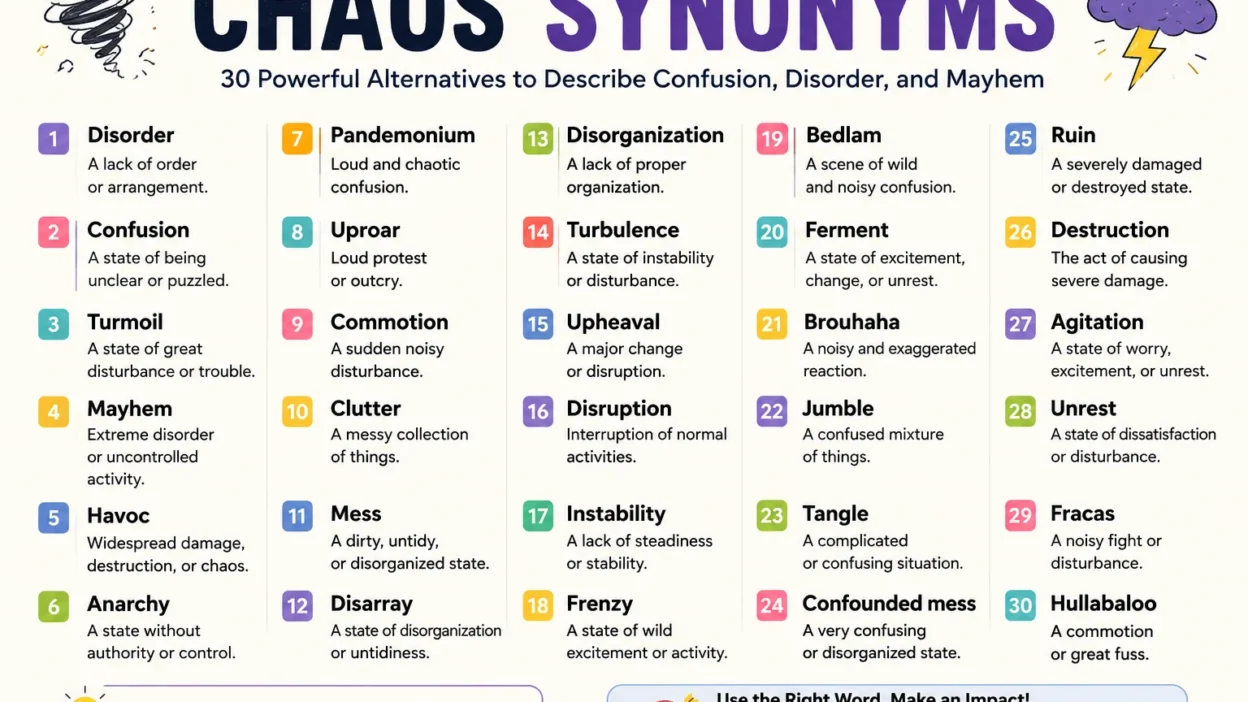
This guide explains 30 synonyms for chaos in simple English. Each word includes its meaning, an example sentence, and the best context in which to use it.
What Does “Chaos” Mean?
Simple meaning of chaos
Chaos means a state of complete disorder, confusion, or lack of control. When things are not organized and it is difficult to understand what is happening, you can describe the situation as chaotic.
Example:
The office was in chaos after the computer system stopped working.
Tone and usage
“Chaos” is a common and flexible word. It can be used in everyday conversations, academic writing, journalism, fiction, and professional communication.
For example:
- Everyday: The children’s room was complete chaos.
- Professional: The unexpected changes caused chaos in the project.
- Creative: The city descended into chaos as the storm approached.
30 Chaos Synonyms
1. Disorder
Meaning: A situation in which things are not organized or arranged properly.
Example: The documents were scattered around the office in complete disorder.
Best usage: Use disorder when emphasizing a lack of organization or arrangement.
2. Confusion
Meaning: A state in which people do not understand what is happening.
Example: The sudden announcement caused confusion among the students.
Best usage: Best for situations involving misunderstanding or uncertainty.
3. Turmoil
Meaning: A state of great confusion, trouble, or emotional disturbance.
Example: The country experienced political turmoil after the election.
Best usage: Useful for serious political, social, or emotional situations.
4. Mayhem
Meaning: Extreme disorder, confusion, or uncontrolled activity.
Example: The unexpected cancellation caused mayhem at the airport.
Best usage: Good for situations that are noisy, uncontrolled, and highly disruptive.
5. Havoc
Meaning: Great damage, destruction, or confusion caused by an event.
Example: The powerful storm caused havoc across the city.
Best usage: Often used when chaos results in damage or disruption.
6. Anarchy
Meaning: A situation where there is little or no effective control or government.
Example: The collapse of the government left the region close to anarchy.
Best usage: Best for political or social situations involving a breakdown of authority.
7. Pandemonium
Meaning: A situation filled with extreme noise, confusion, and excitement.
Example: Pandemonium broke out when the concert tickets went on sale.
Best usage: Strong choice for extremely noisy and uncontrolled situations.
8. Uproar
Meaning: A lot of noise, excitement, anger, or protest.
Example: The new rule caused an uproar among employees.
Best usage: Use when people are loudly reacting to something.
9. Commotion
Meaning: Sudden noisy confusion or activity.
Example: A loud commotion came from the hallway.
Best usage: Suitable for smaller, temporary disturbances.
10. Clutter
Meaning: A collection of things in an untidy or crowded space.
Example: There was so much clutter on her desk that she could not find her notebook.
Best usage: Best for physical objects and messy spaces.
11. Mess
Meaning: A dirty, untidy, or disorganized situation.
Example: The kitchen was a complete mess after the party.
Best usage: Very common in everyday English and informal writing.
12. Confusion
Meaning: A lack of understanding or clarity.
Example: There was considerable confusion about the new schedule.
Best usage: Use when the main problem is misunderstanding rather than physical disorder.
13. Disarray
Meaning: A state in which things are untidy, badly organized, or out of order.
Example: The files were left in complete disarray.
Best usage: Useful in formal or professional writing.
14. Disorganization
Meaning: A lack of proper planning, structure, or organization.
Example: The project’s failure was partly caused by poor disorganization.
Best usage: Best for workplaces, projects, systems, and processes.
15. Turbulence
Meaning: A state of instability, disturbance, or rapid change.
Example: The company went through a period of financial turbulence.
Best usage: Useful for unstable economic, political, social, or organizational situations.
16. Upheaval
Meaning: A major change that causes confusion or disruption.
Example: The technological revolution created major upheaval in the industry.
Best usage: Best for large-scale changes that disturb an existing system.
17. Disruption
Meaning: Something that interrupts normal activity or prevents something from working normally.
Example: The train strike caused major disruption to commuters.
Best usage: Excellent for transportation, business, technology, and everyday interruptions.
18. Instability
Meaning: A lack of steadiness, security, or consistency.
Example: Political instability affected the country’s economy.
Best usage: Best when describing uncertain or unreliable conditions.
19. Confoundedness
Meaning: A state of being confused or unable to understand something clearly.
Example: His confoundedness was obvious after hearing the complicated instructions.
Best usage: Rare and formal; generally better replaced by confusion in everyday English.
20. Frenzy
Meaning: A state of extreme excitement, activity, or emotion.
Example: Fans went into a frenzy when the singer appeared on stage.
Best usage: Use when chaos is driven by intense excitement or emotion.
21. Bedlam
Meaning: A place or situation filled with extreme noise and confusion.
Example: The school cafeteria became bedlam during lunchtime.
Best usage: Informal and vivid; good for noisy, uncontrolled environments.
22. Ferment
Meaning: A state of excitement, discussion, change, or unrest.
Example: There was considerable social ferment among young people.
Best usage: More literary or formal; often used for social or political change.
23. Brouhaha
Meaning: A lot of noisy excitement or public discussion about something.
Example: The minor mistake created a huge brouhaha online.
Best usage: Informal and often humorous; useful when the reaction seems exaggerated.
24. Jumble
Meaning: A confused mixture or collection of things.
Example: My thoughts were a jumble after the stressful meeting.
Best usage: Good for mixed objects, ideas, thoughts, or information.
25. Tangle
Meaning: A complicated or confusing situation.
Example: The investigation became a tangle of conflicting information.
Best usage: Useful when problems become complicated and difficult to separate.
26. Confounded mess
Meaning: A very confusing or badly organized situation.
Example: The paperwork had become a confounded mess.
Best usage: Informal and expressive; useful when emphasizing frustration.
27. Ruin
Meaning: A severely damaged or destroyed state.
Example: The flood left the neighborhood in ruin.
Best usage: Use when chaos has resulted in serious physical destruction.
28. Destruction
Meaning: The act or result of damaging or completely destroying something.
Example: The earthquake caused widespread destruction.
Best usage: Best when the focus is on physical damage rather than simple confusion.
29. Agitation
Meaning: A state of worry, excitement, disturbance, or unrest.
Example: The announcement caused considerable agitation among the workers.
Best usage: Useful when people are emotionally disturbed or upset.
30. Unrest
Meaning: A state of dissatisfaction, conflict, or disturbance among people.
Example: The government struggled to control growing social unrest.
Best usage: Best for political, social, or public situations involving dissatisfaction or conflict.
Chaos Synonyms Comparison Guide
Not every synonym for chaos has exactly the same meaning. Choosing the right word depends on what kind of disorder you want to describe.
| Synonym | Main idea | Tone | Common context |
|---|---|---|---|
| Disorder | Lack of order | Neutral | General |
| Confusion | Lack of understanding | Neutral | Instructions, information |
| Turmoil | Serious disturbance | Strong | Politics, emotions |
| Mayhem | Extreme uncontrolled activity | Strong | Crowds, accidents |
| Havoc | Damage and disruption | Strong | Storms, disasters |
| Anarchy | Lack of authority | Strong/Formal | Politics, government |
| Pandemonium | Extreme noise and confusion | Strong | Crowds, events |
| Uproar | Loud reaction | Neutral | Public reactions |
| Commotion | Sudden disturbance | Neutral | Everyday events |
| Clutter | Untidy objects | Neutral | Rooms, desks |
| Mess | Untidy condition | Informal | Everyday situations |
| Disarray | Poor organization | Formal | Work, documents |
| Disorganization | Lack of structure | Formal | Projects, systems |
| Turbulence | Instability | Formal | Business, politics |
| Upheaval | Major disruptive change | Formal | Society, industries |
| Disruption | Interruption | Neutral | Work, travel, technology |
| Instability | Lack of security | Formal | Economy, politics |
| Frenzy | Extreme excitement | Informal | Fans, shopping |
| Bedlam | Extreme noise and confusion | Informal | Crowds, busy places |
| Jumble | Mixed-up condition | Neutral | Thoughts, objects |
| Tangle | Complicated situation | Neutral | Problems, information |
| Ruin | Severe damage | Strong | Buildings, places |
| Destruction | Complete or serious damage | Strong | Disasters |
| Unrest | Public dissatisfaction | Formal | Politics, society |
How to Choose the Right Synonym
For general disorder
Use disorder, mess, disarray, or disorganization when you simply want to say that something is not properly organized.
Example:
The office was in disarray.
For lack of understanding
Choose confusion when people do not understand information, instructions, or events.
Example:
The unclear instructions caused confusion.
For serious social or political problems
Words such as turmoil, unrest, instability, anarchy, and upheaval work well when describing major social or political situations.
Example:
The country experienced political turmoil.
For noise and uncontrolled activity
Choose mayhem, pandemonium, bedlam, commotion, or uproar when a situation is loud, busy, or difficult to control.
Example:
Pandemonium broke out after the final announcement.
For damage and destruction
Use havoc, destruction, or ruin when chaos causes physical damage or serious consequences.
Example:
The hurricane caused widespread havoc.
For excitement and emotional intensity
Words such as frenzy, agitation, and ferment can describe strong emotions, excitement, or social activity.
Example:
The announcement sent fans into a frenzy.
For complicated situations
Use jumble or tangle when different pieces of information, thoughts, or problems become mixed together.
Example:
His thoughts were a confusing jumble.
Chaos Synonyms for Different Writing Styles
Casual English
For conversations and informal writing, mess, commotion, frenzy, bedlam, and brouhaha can sound natural.
Example:
The party was complete chaos.
You could also say:
The party was complete mayhem.
Academic and professional English
For formal writing, consider disorder, disarray, disruption, instability, turmoil, or disorganization.
Example:
The unexpected policy change created significant disruption within the organization.
Creative writing
Writers can choose stronger and more vivid words such as pandemonium, mayhem, upheaval, frenzy, or havoc.
Example:
As the alarm sounded, pandemonium swept through the crowded building.
Common Mistakes When Using Chaos Synonyms
Using every synonym in the same way
Many words related to chaos have slightly different meanings. For example, clutter usually describes physical objects, while confusion describes a lack of understanding.
It would sound natural to say:
The desk was covered in clutter.
But:
The instructions caused confusion.
Choosing a word that is too strong
Not every messy situation is mayhem or pandemonium. These words suggest a high level of disorder.
For a simple untidy room, mess or clutter is usually better.
Using informal words in formal writing
Words such as brouhaha and bedlam can sound informal or dramatic. In academic or professional writing, disruption, disorder, instability, or turmoil may be more appropriate.
Why Learning Chaos Synonyms Matters
Learning synonyms is more than simply memorizing alternative words. It helps you understand the small differences between similar ideas.
For ESL learners, these distinctions can make spoken and written English more natural.
For students, using precise vocabulary can improve essays and assignments.
Writers can use synonyms to create stronger descriptions, while content creators can avoid repetitive language.
Instead of writing:
The situation was chaotic. The chaotic environment created more chaos.
You can write:
The situation was chaotic. The growing confusion created further disruption.
This sounds more varied and communicates the situation more precisely.
Final Thoughts on Chaos Synonyms
There are many useful chaos synonyms, but the best choice depends on the exact situation.
Disorder and disarray are useful for a lack of organization. Confusion focuses on a lack of understanding.
Mayhem and pandemonium describe extreme activity and noise, while turmoil and upheaval are stronger choices for serious social, political, or organizational problems.
The key is not to replace chaos with a random synonym. Instead, think about the meaning you want to communicate.
Ask whether you are describing mess, confusion, noise, instability, excitement, disruption, or destruction.
Once you understand that difference, choosing the right word becomes much easier.
Learning these 30 words can make your vocabulary more flexible, precise, and expressive.
if you are an ESL learner, student, writer, or content creator, understanding the nuances between synonyms will help you communicate your ideas more clearly.

Liam Henry is a content author at Synonymed, specializing in vocabulary enrichment and synonym guides. He creates clear, engaging resources that help learners improve English word knowledge and language fluency.