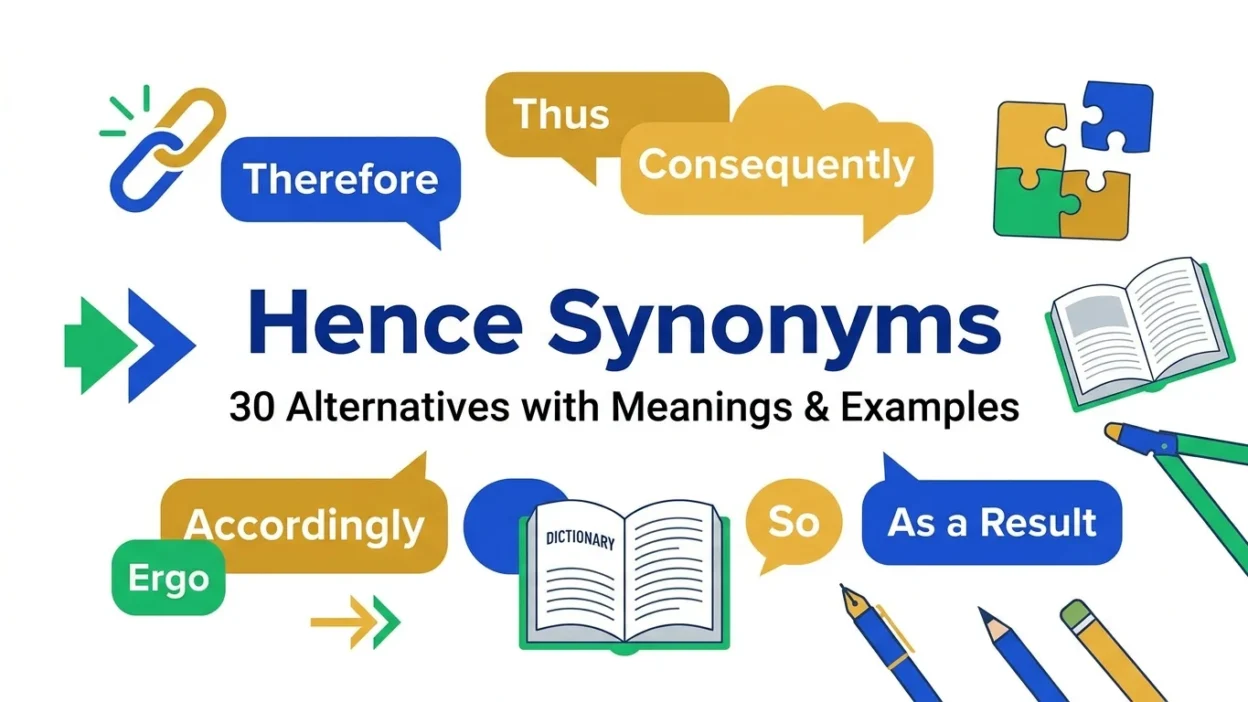
The word hence is a useful English adverb that can show a result, explain a reason, or indicate a point in time. It is especially common in formal, academic, literary, and professional writing.
Learning hence synonyms can help you avoid repetition and choose words that match the tone of your sentence. Although several alternatives have similar meanings, they are not always interchangeable. For example, therefore usually introduces a logical result, while from now can describe a future point in time.
For students, ESL learners, writers, and content creators, understanding these small differences can make writing clearer and more natural.
The goal is not simply to find another word for hence, but to choose the alternative that expresses your exact meaning.
What Does “Hence” Mean?
Simple Meaning of Hence
Hence generally means “for this reason,” “as a result,” or “from this time.”
It has two main uses:
- To show a result or conclusion:
The roads were flooded; hence, the school was closed.Here, hence means as a result. - To refer to a future time:
The project will be completed two years hence.Here, hence means from now or two years from now.
Tone and Usage of Hence
Hence is usually formal. It is common in academic writing, formal reports, legal language, literature, and professional communication.
In casual conversation, people usually prefer simpler expressions such as so, therefore, or because of this.
For example:
Formal:
The evidence was insufficient; hence, the case was dismissed.
More conversational:
There wasn’t enough evidence, so the case was dismissed.
30 Hence Synonyms and Alternatives
Not every word below is an exact replacement for hence. Some work as synonyms when hence means “therefore”, while others are useful when it means “from now.”
1. Therefore
Meaning: For that reason; as a result.
Example sentence:
The weather was severe; therefore, the flight was delayed.
Best usage context: Formal, academic, professional, and logical writing.
2. Thus
Meaning: In this way or as a result.
Example sentence:
The experiment produced consistent results, thus supporting the original theory.
Best usage context: Academic, technical, and formal writing.
3. Consequently
Meaning: As a result of something that happened before.
Example sentence:
The company lost several major clients and consequently reduced its expenses.
Best usage context: Formal writing when emphasizing a direct result.
4. Accordingly
Meaning: In a way that is appropriate because of a particular situation or fact.
Example sentence:
The requirements changed, and we adjusted the plan accordingly.
Best usage context: Professional, academic, and formal contexts.
5. So
Meaning: For that reason; as a result.
Example sentence:
It was raining, so we stayed indoors.
Best usage context: Everyday speech and informal writing.
6. As a Result
Meaning: Because of something that happened previously.
Example sentence:
The factory closed. As a result, many workers lost their jobs.
Best usage context: General writing, explanations, essays, and reports.
7. Because of This
Meaning: For this reason.
Example sentence:
The road was unsafe. Because of this, the drivers were asked to take another route.
Best usage context: Clear, simple English, especially for ESL learners.
8. For This Reason
Meaning: Because of the situation just mentioned.
Example sentence:
The evidence was incomplete. For this reason, the researchers repeated the study.
Best usage context: Essays, explanations, and formal or semi-formal writing.
9. As Such
Meaning: Because of what has just been described or established.
Example sentence:
The product is still in development and, as such, is not available to customers.
Best usage context: Formal and professional writing.
10. Thereupon
Meaning: Immediately or as a result of something that happened.
Example sentence:
The judge announced the decision, and thereupon the hearing ended.
Best usage context: Formal, literary, or historical writing.
11. Thereby
Meaning: By that action or as a result of that action.
Example sentence:
The company reduced waste, thereby lowering its operating costs.
Best usage context: Formal, academic, legal, and technical writing.
12. Thusly
Meaning: In this way.
Example sentence:
The instructions were presented thusly to avoid confusion.
Best usage context: Rare and often unnecessary. Thus is usually more natural.
13. Ergo
Meaning: Therefore; for that reason.
Example sentence:
The evidence was unreliable; ergo, the conclusion was questionable.
Best usage context: Formal, philosophical, humorous, or deliberately intellectual writing.
14. Wherefore
Meaning: For what reason; why.
Example sentence:
Wherefore did they reject the proposal?
Best usage context: Archaic, biblical, literary, or dramatic language.
15. Thence
Meaning: From that place or from that point.
Example sentence:
The travelers went to the village and thence continued toward the mountains.
Best usage context: Formal, literary, or historical writing.
16. From There
Meaning: Starting from that place or point.
Example sentence:
We walked to the station and from there took a train.
Best usage context: Everyday English and straightforward descriptions.
17. From Then
Meaning: Starting at that time.
Example sentence:
From then, she focused entirely on her studies.
Best usage context: Narratives and explanations of events over time.
18. From Now
Meaning: Starting at the present time and moving into the future.
Example sentence:
The final exam is three weeks from now.
Best usage context: Everyday speech and future time references.
19. From This Point On
Meaning: Starting at this moment and continuing into the future.
Example sentence:
From this point on, all applications must be submitted online.
Best usage context: Rules, announcements, instructions, and professional communication.
20. From This Time
Meaning: Starting from the current or previously mentioned time.
Example sentence:
From this time forward, the organization will use a new system.
Best usage context: Formal or historical writing.
21. Going Forward
Meaning: From now on; in the future.
Example sentence:
Going forward, the team will meet every Monday.
Best usage context: Business, workplace, planning, and professional communication.
22. From Now On
Meaning: Beginning now and continuing in the future.
Example sentence:
From now on, please save your work before closing the program.
Best usage context: Everyday English, instructions, and conversations.
23. Subsequently
Meaning: After something else happened.
Example sentence:
The company initially rejected the proposal but subsequently accepted it.
Best usage context: Formal writing, reports, academic work, and chronological descriptions.
24. Thereafter
Meaning: After that time or event.
Example sentence:
The contract was signed, and thereafter the project officially began.
Best usage context: Formal, legal, historical, and professional writing.
25. Following This
Meaning: After or as a result of the event just mentioned.
Example sentence:
The first test revealed several errors. Following this, the team changed its approach.
Best usage context: Reports, essays, explanations, and professional writing.
26. In Consequence
Meaning: As a result.
Example sentence:
The supply was limited and, in consequence, prices increased.
Best usage context: Formal and somewhat old-fashioned writing.
27. In View of This
Meaning: Considering the situation or information just mentioned.
Example sentence:
The deadline cannot be extended. In view of this, applicants should submit their forms early.
Best usage context: Formal, professional, and administrative writing.
28. For That Reason
Meaning: Because of the reason already explained.
Example sentence:
The material is highly sensitive. For that reason, access is restricted.
Best usage context: Clear explanations, essays, reports, and formal communication.
29. On That Account
Meaning: Because of that particular reason or situation.
Example sentence:
The road was closed, and on that account we had to change our route.
Best usage context: Formal or literary writing; less common in everyday English.
30. In Light of This
Meaning: Considering the information or situation that has just been mentioned.
Example sentence:
The research revealed serious limitations. In light of this, further testing is necessary.
Best usage context: Academic, professional, analytical, and formal writing.
Comparison Guide for Hence Synonyms
When Should You Use Each Alternative?
| Word or Phrase | Main Meaning | Tone | Best Use |
|---|---|---|---|
| Hence | Therefore/from now | Formal | Academic and formal writing |
| Therefore | For that reason | Formal | Logic, essays, reports |
| Thus | As a result/in this way | Formal | Academic and technical writing |
| Consequently | As a direct result | Formal | Reports and analysis |
| Accordingly | In response to a situation | Formal | Business and professional writing |
| So | For that reason | Informal | Conversation |
| As a result | Because of this | Neutral | General writing |
| Thereby | By that action/result | Formal | Academic and technical writing |
| Ergo | Therefore | Formal/playful | Philosophy or rhetorical writing |
| Thereafter | After that | Formal | Legal and historical writing |
| Subsequently | Later/afterward | Formal | Reports and timelines |
| From now on | Starting now | Informal/neutral | Everyday English |
| Going forward | From now on | Professional | Business communication |
| Thence | From that point/place | Literary/formal | Historical or literary writing |
| In light of this | Considering this | Formal | Analysis and recommendations |
How to Choose the Right Synonym
For Showing a Logical Result
Use:
- therefore
- thus
- consequently
- hence
- as a result
Example:
The data was incomplete; therefore, the researchers repeated the experiment.
These choices are particularly useful in academic essays because they clearly connect a cause with its result.
For Everyday Conversation
Use:
- so
- because of this
- for that reason
- from now on
These expressions are easy to understand and sound natural in casual communication.
Example:
I was tired, so I went home early.
Using hence here would sound unusually formal.
For Academic Writing
Choose:
- therefore
- thus
- consequently
- hence
- thereby
- in light of this
Example:
The sample size was small; hence, the findings should be interpreted cautiously.
For Business Writing
Useful options include:
- accordingly
- therefore
- consequently
- going forward
- in light of this
Example:
Demand has declined; accordingly, the company will reduce production.
For Historical or Literary Writing
Consider:
- thereafter
- thence
- thereupon
- wherefore
- in consequence
These words can create an older, formal, or literary tone.
When “Hence” Means “From Now”
When hence refers to future time, use:
- from now
- from now on
- going forward
- from this point on
For example:
The examination will begin three days hence.
A natural modern version is:
The examination will begin three days from now.
Hence vs. Therefore
What Is the Difference?
Hence and therefore can both mean “for this reason” or “as a result.”
However, therefore is more common in modern formal English, while hence can sound more formal, literary, or concise.
Hence:
The evidence was insufficient; hence, the decision was postponed.
Therefore:
The evidence was insufficient; therefore, the decision was postponed.
Both sentences are correct.
Hence vs. Thus
Which One Should You Choose?
Thus can mean “in this way” as well as “as a result.” Hence is more strongly associated with a result or conclusion.
Thus:
She arranged the pieces thus.
Here, thus means in this way.
Hence:
The roads were blocked; hence, we could not continue.
Here, hence means as a result.
Hence vs. Consequently
Understanding the Difference
Both words can introduce a result.
Consequently strongly emphasizes that something happened as a consequence of an earlier event.
Example:
The company ignored customer complaints. Consequently, its reputation suffered.
Hence is often shorter and can sound more formal or literary.
Hence vs. So
Formal vs. Informal English
The simplest distinction is tone.
Formal:
The deadline has passed; hence, applications are no longer accepted.
Informal:
The deadline has passed, so we can’t accept applications anymore.
For everyday conversations, so is usually the better choice.
Common Mistakes With Hence
Using Hence in Every Situation
Not every sentence that contains so should be changed to hence.
I was hungry, so I made lunch.
This sounds natural.
I was hungry, hence I made lunch.
Although understandable, it sounds much more formal and less natural in everyday conversation.
Forgetting the Two Main Meanings
Remember that hence can refer to:
Result:
The evidence was weak; hence, the conclusion was rejected.
Future time:
The meeting will begin two hours hence.
These meanings require different synonyms.
Confusing Hence and Thence
Hence can mean from now or for this reason.
Thence generally refers to from that place or point.
Example:
Three years hence = three years from now.
They traveled from London to Paris and thence to Rome = from there to Rome.
Quick Tips for ESL Learners
Start With the Most Common Words
If you are learning English, focus first on:
- therefore
- so
- as a result
- because of this
- from now on
These are easier to use naturally.
Learn Formal Alternatives Gradually
Once you understand the basic expressions, add:
- thus
- consequently
- accordingly
- thereby
- subsequently
- thereafter
This will help you write stronger academic and professional English.
Always Check the Meaning
Before replacing hence, ask:
Does it mean “therefore”?
If yes, consider therefore, thus, consequently, or as a result.
Does it mean “from now”?
If yes, consider from now, from this point on, or going forward.
This simple check prevents many vocabulary mistakes.
Frequently Asked Questions About Hence Synonyms
What is the best synonym for hence?
Therefore is one of the closest and most useful synonyms when hence means “for this reason” or “as a result.”
Is “so” a synonym for hence?
Yes. So can replace hence when hence means “as a result,” but so is much more common in informal English.
Is hence formal or informal?
Hence is generally formal. It is especially common in academic, professional, legal, technical, and literary writing.
What is a simple synonym for hence?
So and because of this are simple alternatives when hence means “as a result.”
What does “three years hence” mean?
Three years hence means three years from now.
Can therefore replace hence?
Yes, when hence means “therefore” or “as a result.” However, therefore cannot replace hence when hence means “from now.”
Is thus the same as hence?
They overlap when both mean “as a result,” but thus also means “in this way.” Their meanings are therefore not identical in every context.
Conclusion
Understanding hence synonyms is about more than finding replacement words. The important skill is recognizing which meaning of hence you need and selecting an alternative that matches your sentence.
For results and conclusions, therefore, thus, consequently, and as a result are excellent choices.
For everyday English, so and because of this are more natural. When hence refers to future time, expressions such as from now, from now on, and from this point on are usually clearer.
For formal and academic writing, words such as thereby, accordingly, subsequently, thereafter, and in light of this can provide greater precision. However, the most sophisticated word is not always the best one.
The strongest vocabulary choice is the one that makes your meaning clear, fits your audience, and matches the tone of your writing.
By learning these differences, students, ESL learners, writers, and content creators can use hence and its alternatives with greater confidence.