
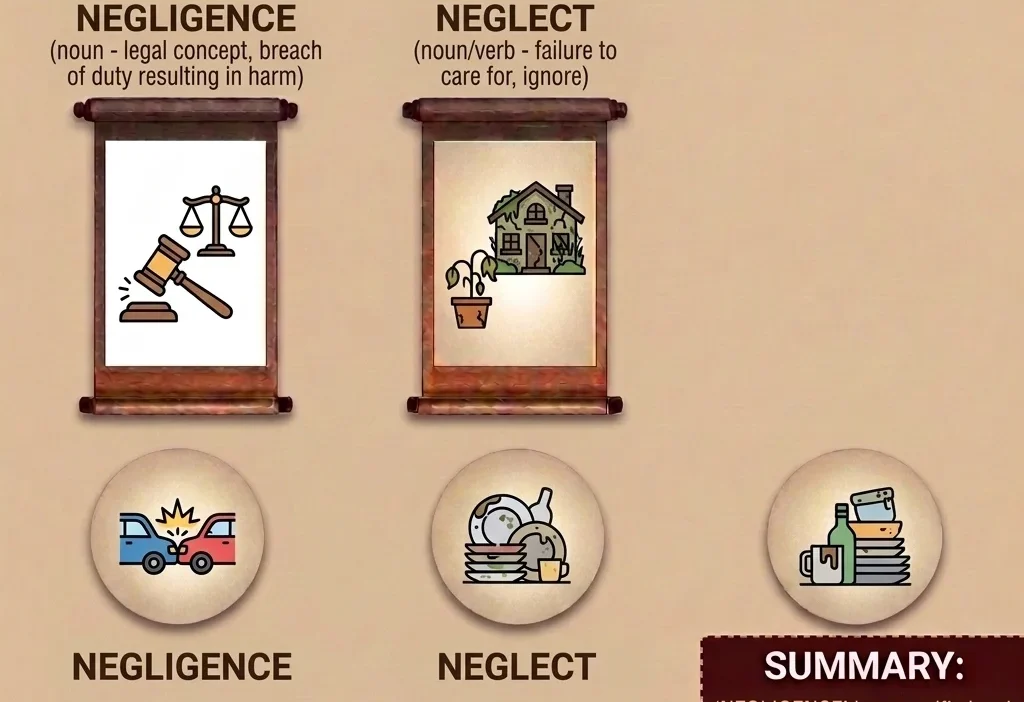
Negligence and neglect are closely related words because both can describe a failure to give proper care, attention, or responsibility.
However, they are not interchangeable in every situation. Negligence usually refers to a failure to take reasonable care, especially when that failure causes harm or creates a risk of harm.
Neglect generally means failing to give someone or something the care, attention, or treatment they need.
For example, “The accident was caused by negligence” focuses on careless behavior, while “The child suffered from neglect” focuses on a failure to provide necessary care.
The two words also differ in grammar and context. Negligence is a noun and is especially common in legal, professional, medical, and safety contexts.
Neglect can be a noun or a verb and is often used for people, responsibilities, duties, property, and needs.
Understanding the distinction can help you choose the right word when describing carelessness, failure of duty, lack of attention, or inadequate care.
Quick Answer
Negligence means failing to use reasonable care, often resulting in harm or risk. Neglect means failing to give necessary care, attention, or treatment. Negligence often focuses on careless conduct or a breach of responsibility, while neglect emphasizes something or someone being left without proper care.
Why People Confuse It
People confuse negligence and neglect because both involve failing to do what should reasonably be done.
They can overlap, but their emphasis is different:
- Negligence → lack of reasonable care or carelessness
- Neglect → failure to provide needed care or attention
- Negligence → often used in legal, professional, and safety contexts
- Neglect → commonly used for children, elderly people, animals, duties, property, and responsibilities
Compare:
The doctor was accused of negligence.
This suggests the doctor failed to provide the expected standard of care.
The child suffered from neglect.
This emphasizes that the child did not receive the necessary care or attention.
First Word: Negligence
Negligence is a noun meaning failure to take reasonable care or to do what a responsible person would normally do in a particular situation.
It often involves careless behavior that causes or contributes to harm.
Negligence in everyday English
You can use negligence when someone fails to take reasonable care.
His negligence caused serious damage to the equipment.
The sentence suggests that he failed to act carefully enough.
Negligence in legal contexts
Negligence has a more specific meaning in law. Generally, a negligence claim involves a failure to meet an applicable standard of reasonable care that results in legally recognized harm or loss.
For example:
The patient filed a claim alleging medical negligence.
Legal rules about negligence vary by jurisdiction, so the exact requirements depend on the applicable law.
Common phrases with “negligence”
- medical negligence
- professional negligence
- gross negligence
- negligence claim
- negligence lawsuit
- negligence at work
- negligence in handling equipment
Second Word: Neglect
Neglect means failing to give someone or something the care, attention, or treatment they need.
Unlike negligence, neglect can be both a noun and a verb.
Neglect as a noun
The animal suffered from neglect.
This means the animal did not receive proper care.
Years of neglect damaged the building.
Here, the building was not properly maintained.
Neglect as a verb
He neglected his responsibilities.
This means he failed to give his responsibilities the attention they required.
She neglected to lock the door.
Here, neglected to means failed to do something that should have been done.
Common situations involving neglect
- child neglect
- animal neglect
- neglect of duties
- neglect of responsibilities
- neglect of property
- self-neglect
- neglecting someone’s needs
Comparison Table
| Word | Part of Speech | Main Meaning | Typical Context | Example |
|---|---|---|---|---|
| Negligence | Noun | Failure to take reasonable care | Legal, professional, safety, medical | The accident resulted from negligence. |
| Neglect | Noun / Verb | Failure to provide needed care or attention | People, animals, duties, property | The building suffered from neglect. |
| Neglect | Verb | Fail to give proper attention or care | Responsibilities, needs, tasks | He neglected his duties. |
When to Use Each
Use “negligence” when focusing on careless conduct
Choose negligence when the main idea is that someone failed to exercise reasonable care.
Examples:
The company was accused of negligence.
The accident may have resulted from negligence.
The investigation examined possible negligence.
The word is particularly useful when discussing professional duties, safety, medical treatment, or legal responsibility.
Use “neglect” when focusing on lack of care or attention
Use neglect when someone or something does not receive the care or attention it needs.
Examples:
The child suffered from neglect.
The garden has fallen into neglect.
He neglected his responsibilities.
Use “neglect” for something that has been left unattended
This is especially natural for:
- buildings
- gardens
- pets
- duties
- responsibilities
- relationships
- personal needs
For example:
The old house fell into neglect.
14 Examples of Negligence and Neglect
- The accident was caused by negligence.
The sentence focuses on a failure to take reasonable care. - The company was accused of negligence.
The company allegedly failed to meet an expected standard of care. - The driver’s negligence caused the crash.
The driver’s careless conduct contributed to the accident. - The nurse was investigated for possible negligence.
The investigation concerns whether appropriate care was provided. - The child suffered from neglect.
The child did not receive adequate care or attention. - The dog was rescued after years of neglect.
The dog had not received proper care. - The house deteriorated because of neglect.
The property was not properly maintained. - He neglected his responsibilities.
He failed to give his duties the attention they required. - She neglected to call her parents.
She failed to call them. - The garden suffered from neglect.
The garden was not properly cared for. - The manager’s negligence created a safety risk.
The manager failed to take reasonable care. - The report found evidence of serious neglect.
The report found that necessary care or attention had been lacking. - Years of neglect damaged the historic building.
The building was not properly maintained. - The employee was warned not to neglect important safety procedures.
The employee was told not to ignore or fail to follow necessary procedures.
Common Mistakes
Mistake 1: Treating the words as exact synonyms
Although they overlap, negligence and neglect do not always mean exactly the same thing.
❌ The child suffered from professional negligence.
✅ The child suffered from neglect.
For a failure to provide necessary care to a child, neglect is generally the more natural word.
Mistake 2: Using “negligence” as a verb
Negligence is a noun.
❌ He negligenced his duties.
There is no standard verb negligence.
Use neglect as the verb:
✅ He neglected his duties.
You can also use was negligent:
✅ He was negligent in carrying out his duties.
Mistake 3: Confusing “negligent” with “neglectful”
Negligent is the adjective related to negligence.
The company was negligent.
Neglectful is related to neglect.
The owner was neglectful of the animal’s needs.
The adjectives are related but are not always interchangeable.
Mistake 4: Assuming every failure is negligence
Not every mistake or failure to act automatically amounts to negligence, especially in a legal sense.
Legal negligence has specific requirements that can differ by jurisdiction.
Mistake 5: Forgetting that “neglect” can be a verb
You can say:
He neglected his duties.
But you cannot use negligence in the same way.
Memory Trick
Use this simple distinction:
Negligence = not careful enough.
Neglect = not caring or attending enough.
Think of negligence as focusing on careless conduct and neglect as focusing on missing care or attention.
A quick example:
The driver’s negligence caused the accident.
The child suffered from neglect.
American vs British English
Negligence and neglect have essentially the same basic meanings in American and British English.
Both varieties commonly use:
- medical negligence
- professional negligence
- child neglect
- animal neglect
- neglect of duties
- negligent behavior
- neglectful behavior
The main differences you may encounter are related to legal terminology or local legal systems, not the ordinary meanings of the words.
Similar Words
Carelessness
Carelessness means failing to give enough attention or caution.
His carelessness caused the mistake.
It is often less formal and less specific than negligence.
Inattention
Inattention means a lack of attention.
The accident was caused by inattention.
It focuses on not paying attention rather than necessarily failing to provide care.
Irresponsibility
Irresponsibility means failing to behave responsibly or fulfill responsibilities.
His irresponsibility caused problems for the team.
Abandonment
Abandonment means leaving someone or something and failing to provide the expected support or care.
The animal was rescued after being abandoned.
Abandonment can be more extreme than ordinary neglect.
Misconduct
Misconduct means improper or unacceptable behavior, especially in a professional or official setting.
The employee was investigated for professional misconduct.
It is broader than negligence and does not necessarily involve a lack of care.
Final Verdict
Negligence and neglect both describe failures, but they emphasize different ideas. Negligence usually means failing to exercise reasonable care and is especially common in legal, medical, professional, and safety contexts. Neglect means failing to give someone or something the necessary care, attention, or treatment.
A useful distinction is careless conduct vs. missing care. If the focus is on whether someone acted with reasonable care, negligence is often the better word. If the focus is on someone or something being left without necessary care or attention, neglect is usually more natural.
Frequently Asked Questions
What is the main difference between negligence and neglect?
Negligence focuses on a failure to take reasonable care, while neglect focuses on failing to provide necessary care, attention, or treatment.
Is neglect a form of negligence?
They can overlap, but they are not automatically the same. Neglect can involve negligent behavior, but the exact relationship depends on the context, especially in legal settings.
Is negligence a noun or a verb?
Negligence is a noun. The related adjective is negligent.
The accident resulted from negligence.
The driver was negligent.
Can “neglect” be used as a verb?
Yes. Neglect can be both a noun and a verb.
The property suffered from neglect.
He neglected his duties.
What is the difference between negligent and neglectful?
Negligent means failing to take reasonable care, while neglectful generally means failing to give proper care or attention.
Is child neglect the same as negligence?
Not necessarily. Child neglect specifically refers to a failure to provide necessary care for a child. Negligence is a broader concept involving failure to exercise reasonable care and can have a specific legal meaning.
Which word is better for a legal situation?
Negligence is generally the more appropriate term when discussing a legal claim based on a failure to exercise reasonable care. However, the precise legal meaning depends on the jurisdiction and circumstances.
Remember This
- Negligence = failure to take reasonable care.
- Neglect = failure to provide needed care or attention.
- Negligence is a noun.
- Neglect can be a noun or a verb.
- Negligent is the adjective related to negligence.
- Neglectful is related to neglect.
- Child neglect focuses on inadequate care.
- Professional or medical negligence focuses on failure to meet an expected standard of care.
- Not every mistake or failure automatically constitutes legal negligence.
Conclusion
The difference between negligence vs neglect becomes clearer when you focus on what is missing. Negligence generally describes a failure to use reasonable care, especially when discussing professional duties, safety, accidents, or legal responsibility. Neglect describes a failure to provide needed care, attention, maintenance, or treatment and can be used for people, animals, property, duties, and responsibilities.
For an easy memory aid, think “negligence = careless” and “neglect = uncared for.” The words can overlap in some situations, but choosing between them depends on whether you are emphasizing careless conduct or the absence of necessary care and attention.