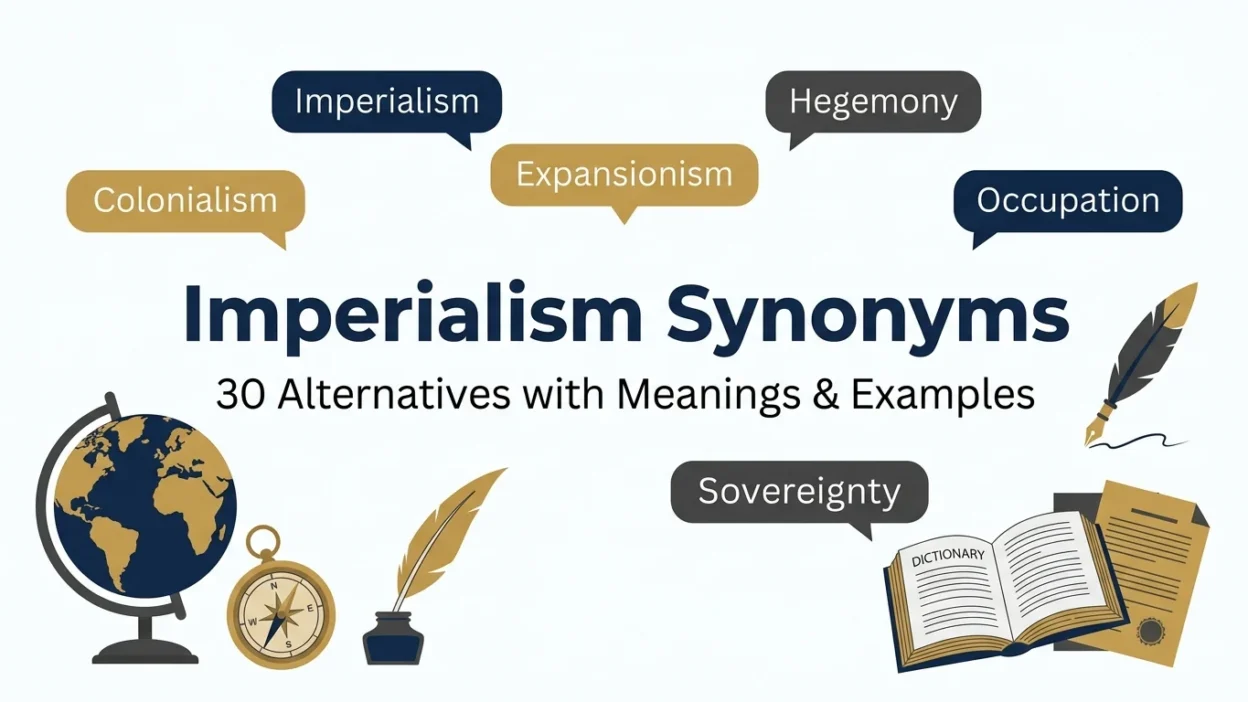
Imperialism is a term used to describe the practice of extending a country’s power or influence over other countries, territories, or peoples.
It is common in history, politics, international relations, and academic writing. However, using the same word repeatedly can make writing feel limited or unclear.
Learning imperialism synonyms helps students, ESL learners, writers, and content creators express ideas more precisely.
Different words can emphasize different aspects of imperialism, such as territorial expansion, political control, economic influence, or domination.
Some alternatives are direct synonyms, while others are closely related words. Understanding these differences is important because a word such as colonialism may be appropriate in one context but inaccurate in another. This guide explains 30 useful alternatives in simple English.
What Does Imperialism Mean?
Simple definition
Imperialism means a policy or practice in which a powerful country extends its control or influence over another country, territory, or group of people.
This control can be political, military, economic, or cultural. Imperialism can involve direct rule, but it can also happen through strong economic or political influence.
Example:
European imperialism changed the political and economic structure of many regions during the nineteenth century.
Tone and usage
The word imperialism is usually used in historical, political, academic, and critical discussions. It often has a negative meaning because it is associated with unequal power and the control of weaker societies.
When choosing an alternative, consider exactly what you want to emphasize: territory, power, money, military force, political influence, or cultural control.
30 Imperialism Synonyms and Related Words
1. Colonialism
Meaning: A system in which a powerful country establishes control over another territory and often settles people there.
Example sentence:
Colonialism shaped the languages and political systems of many countries.
Best usage context: Best for discussions of colonies, settlement, and historical foreign rule.
2. Expansionism
Meaning: A policy of trying to increase a country’s territory, power, or influence.
Example sentence:
The government’s expansionism led it to seek control of neighboring territories.
Best usage context: Useful when focusing on territorial or political growth.
3. Domination
Meaning: Having strong control or power over another person, group, or country.
Example sentence:
The empire’s domination of the region lasted for several decades.
Best usage context: Good when emphasizing control rather than the process of acquiring territory.
4. Conquest
Meaning: Taking control of a country or territory by force, especially through war.
Example sentence:
The conquest of the region changed its political leadership.
Best usage context: Use when military victory or force is central to the situation.
5. Subjugation
Meaning: Bringing people or a country under complete control, often by force.
Example sentence:
The population resisted years of subjugation by the foreign government.
Best usage context: Strong choice for academic writing about forced control and loss of independence.
6. Hegemony
Meaning: Dominance or strong influence by one country, group, or power over others.
Example sentence:
The country maintained regional hegemony through economic and political influence.
Best usage context: Useful when control is based on influence rather than direct occupation.
7. Supremacy
Meaning: A position of being more powerful or influential than others.
Example sentence:
The empire fought to maintain military supremacy in the region.
Best usage context: Best when discussing superior power or status.
8. Aggression
Meaning: Hostile or forceful behavior intended to gain an advantage or achieve control.
Example sentence:
The invasion was widely viewed as an act of aggression.
Best usage context: Appropriate when military hostility is an important part of the situation.
9. Occupation
Meaning: Control of a place by a foreign military or government.
Example sentence:
The city remained under foreign occupation for several years.
Best usage context: Use for military control of a territory, especially during or after war.
10. Annexation
Meaning: The formal addition of one territory to another country.
Example sentence:
The annexation of the territory was strongly opposed by neighboring states.
Best usage context: Precise for the legal or political incorporation of territory.
11. Territorial Expansion
Meaning: The process of increasing the amount of land controlled by a country.
Example sentence:
Territorial expansion became a major goal of the growing empire.
Best usage context: Useful when the main focus is gaining land.
12. Empire-Building
Meaning: The process of creating or expanding an empire by gaining territory, power, or influence.
Example sentence:
Empire-building was a major feature of the ruler’s foreign policy.
Best usage context: Helpful in historical writing and general explanations.
13. Foreign Domination
Meaning: Control or strong influence over a country by an outside power.
Example sentence:
The movement demanded independence from foreign domination.
Best usage context: Good when discussing resistance to external control.
14. Political Control
Meaning: The ability to direct the government or political decisions of another area.
Example sentence:
The occupying power established political control over the territory.
Best usage context: Use when the main issue is government and decision-making.
15. Economic Domination
Meaning: Strong control over another country or region through money, trade, investment, or resources.
Example sentence:
Economic domination allowed the stronger nation to influence local industries.
Best usage context: Appropriate when imperial influence is mainly financial or commercial.
16. Economic Exploitation
Meaning: Using another country’s people, labor, or resources unfairly for economic benefit.
Example sentence:
Critics argued that the system resulted in economic exploitation of local workers.
Best usage context: Best when focusing on unequal economic benefits.
17. Exploitation
Meaning: The unfair use of people, resources, or situations for personal or political advantage.
Example sentence:
The exploitation of natural resources became a major source of conflict.
Best usage context: Useful when emphasizing unfair economic or resource use.
18. Militarism
Meaning: A strong emphasis on military power and the use of armed forces.
Example sentence:
Growing militarism encouraged the government to increase its military presence abroad.
Best usage context: Related to imperialism when military power drives foreign expansion.
19. Interventionism
Meaning: A policy of becoming involved in the affairs of another country.
Example sentence:
The government’s interventionism attracted criticism from neighboring states.
Best usage context: Useful for political or military involvement without necessarily taking full control.
20. Colonial Expansion
Meaning: The process of creating or enlarging colonies under a country’s control.
Example sentence:
Colonial expansion accelerated during the nineteenth century.
Best usage context: Best for historical discussions involving colonies.
21. Empire Expansion
Meaning: The growth of an empire through additional territory, political power, or influence.
Example sentence:
Empire expansion brought new territories under the ruler’s authority.
Best usage context: Simple and accessible wording for historical writing.
22. Power Projection
Meaning: The ability to use political, economic, or military strength beyond a country’s own borders.
Example sentence:
The country’s navy increased its ability for power projection overseas.
Best usage context: Particularly useful in modern political and military discussions.
23. Political Expansion
Meaning: The growth of a country’s political influence or control beyond its existing borders.
Example sentence:
Political expansion allowed the government to influence neighboring states.
Best usage context: Good when discussing influence rather than direct territorial rule.
24. Cultural Domination
Meaning: The situation in which one culture becomes highly influential over another, sometimes at the expense of local traditions.
Example sentence:
The spread of the dominant language was seen as a form of cultural domination.
Best usage context: Use when discussing language, traditions, education, media, or cultural influence.
25. Cultural Imperialism
Meaning: The spread or imposition of one culture, values, or lifestyle over another culture.
Example sentence:
Some scholars use the term cultural imperialism to describe the global influence of powerful media industries.
Best usage context: Best when imperial influence involves culture rather than direct political rule.
26. Colonial Rule
Meaning: Government or control of a territory by a foreign colonial power.
Example sentence:
The region experienced major social changes under colonial rule.
Best usage context: Precise for historical periods when a territory was governed as a colony.
27. Subordination
Meaning: A condition in which one group or country is placed in a lower or dependent position.
Example sentence:
The policy created long-term political subordination of local communities.
Best usage context: Useful for formal academic discussions of unequal power relationships.
28. Coercion
Meaning: Using threats, pressure, or force to make someone do something.
Example sentence:
The agreement was criticized because it appeared to have been obtained through coercion.
Best usage context: Use when pressure or force is the central idea.
29. Geopolitical Dominance
Meaning: Strong control or influence over political affairs in a particular region.
Example sentence:
The state sought geopolitical dominance through alliances and military strength.
Best usage context: Useful in modern international relations and political analysis.
30. Power Expansion
Meaning: The process of increasing a country’s authority, influence, or ability to affect others.
Example sentence:
The nation’s power expansion changed the balance of influence in the region.
Best usage context: A broad, accessible phrase for general discussions of growing influence.
Imperialism Synonyms: Quick Comparison Guide
Not every synonym for imperialism means exactly the same thing. The best choice depends on the idea you want to communicate.
| Word or phrase | Main idea | Best context |
|---|---|---|
| Colonialism | Control through colonies | History and colonial studies |
| Expansionism | Seeking greater territory or influence | Politics and history |
| Domination | Strong control | General or academic writing |
| Conquest | Taking territory by force | Military history |
| Subjugation | Forced control over people | Human rights and history |
| Hegemony | Dominance through influence | International relations |
| Occupation | Military control of a place | War and politics |
| Annexation | Formal addition of territory | Law and geopolitics |
| Economic exploitation | Unfair economic benefit | Economics and history |
| Cultural imperialism | Cultural influence or imposition | Culture and media |
| Interventionism | Involvement in another country’s affairs | Foreign policy |
| Power projection | Extending power beyond borders | Military and geopolitics |
How to Choose the Right Synonym
For historical writing
Choose colonialism, colonial rule, colonial expansion, conquest, or empire-building when discussing historical empires and colonies.
Example:
Instead of writing, “Imperialism changed the region,” you could write, “Colonial rule changed the region’s political institutions.”
The second sentence is more specific because it tells readers what kind of imperial control was involved.
For political and academic writing
Use hegemony, domination, subordination, expansionism, or geopolitical dominance when analyzing power relationships.
These words work especially well in essays, research papers, and discussions of international relations.
For military contexts
Words such as conquest, occupation, aggression, militarism, and power projection are often more suitable.
They highlight military force, territorial control, or the ability to use military strength abroad.
For economic contexts
Choose economic domination, economic exploitation, or exploitation when money, resources, trade, labor, or markets are the main concern.
These terms make the economic dimension of imperial power clearer.
For cultural contexts
Use cultural imperialism or cultural domination when discussing language, entertainment, education, traditions, media, or lifestyles.
These terms are particularly useful in sociology, media studies, and cultural studies.
Imperialism vs. Colonialism: Are They the Same?
The key difference
Imperialism is the broader idea. It describes the extension of power or influence over other peoples or territories.
Colonialism is a specific form of imperialism that commonly involves establishing colonies and exercising direct control over them.
In simple terms:
- Imperialism = extending power or influence.
- Colonialism = controlling another territory, often as a colony.
- Expansionism = seeking to increase territory or influence.
- Hegemony = maintaining dominance mainly through influence or leadership.
- Conquest = gaining control through force.
Knowing these differences can make your writing more accurate.
Common Mistakes When Using Imperialism Synonyms
Treating every synonym as identical
Words such as colonialism, occupation, and hegemony are related to imperialism, but they describe different situations.
Choose the word that matches the exact meaning you want.
Using strong words without evidence
Terms such as subjugation, aggression, and exploitation carry strong meanings. Use them when the context supports those meanings.
Using historical terms for modern situations
A modern political relationship may involve influence or economic pressure without being colonialism.
In such cases, hegemony, economic domination, interventionism, or power projection may be more accurate.
Ignoring tone
Some alternatives sound neutral, while others are strongly critical.
For example, territorial expansion can sound relatively neutral, while subjugation emphasizes forced control.
Why Learning Imperialism Synonyms Matters
For students
A strong vocabulary helps students write clearer essays and avoid repeating the same word. It also makes historical and political arguments more precise.
For ESL learners
Learning related words together makes it easier to understand differences in meaning and tone. It also helps learners recognize these terms in books, news articles, and academic texts.
For writers and content creators
Using precise vocabulary makes content more natural and informative. Instead of repeating imperialism several times, writers can select a related term that explains the specific type of power being discussed.
Frequently Asked Questions About Imperialism Synonyms
What is the closest synonym for imperialism?
Expansionism, colonialism, and domination can be close alternatives, but none is identical in every context. The best choice depends on whether the focus is territory, colonies, or control.
What is a simple word for imperialism?
A simple explanation is the control or influence of one country over another. Depending on the context, domination can also be a simple alternative.
Is colonialism a synonym for imperialism?
Colonialism is closely related to imperialism but is more specific. Colonialism generally involves establishing and controlling colonies, while imperialism is a broader concept involving the extension of power or influence.
What is the opposite of imperialism?
Depending on the context, possible contrasting ideas include independence, self-determination, sovereignty, and non-intervention.
Which imperialism synonym is best for an essay?
For a general academic essay, expansionism, domination, or hegemony may work well. However, choose the word that accurately describes the particular situation rather than simply replacing imperialism.
Final Takeaway
Learning imperialism synonyms is about more than finding different words for the same idea.
Each term can highlight a different aspect of power, including territorial expansion, colonial rule, military force, economic influence, political control, or cultural influence.
For beginners, start with common words such as domination, expansionism, colonialism, and conquest.
As your vocabulary grows, learn more precise terms such as hegemony, annexation, subjugation, power projection, and cultural imperialism.
The most effective writers do not simply replace one word with another. They choose the word that communicates their exact meaning. Understanding these differences will help students, ESL learners, writers, and content creators produce clearer, more accurate, and more engaging writing.