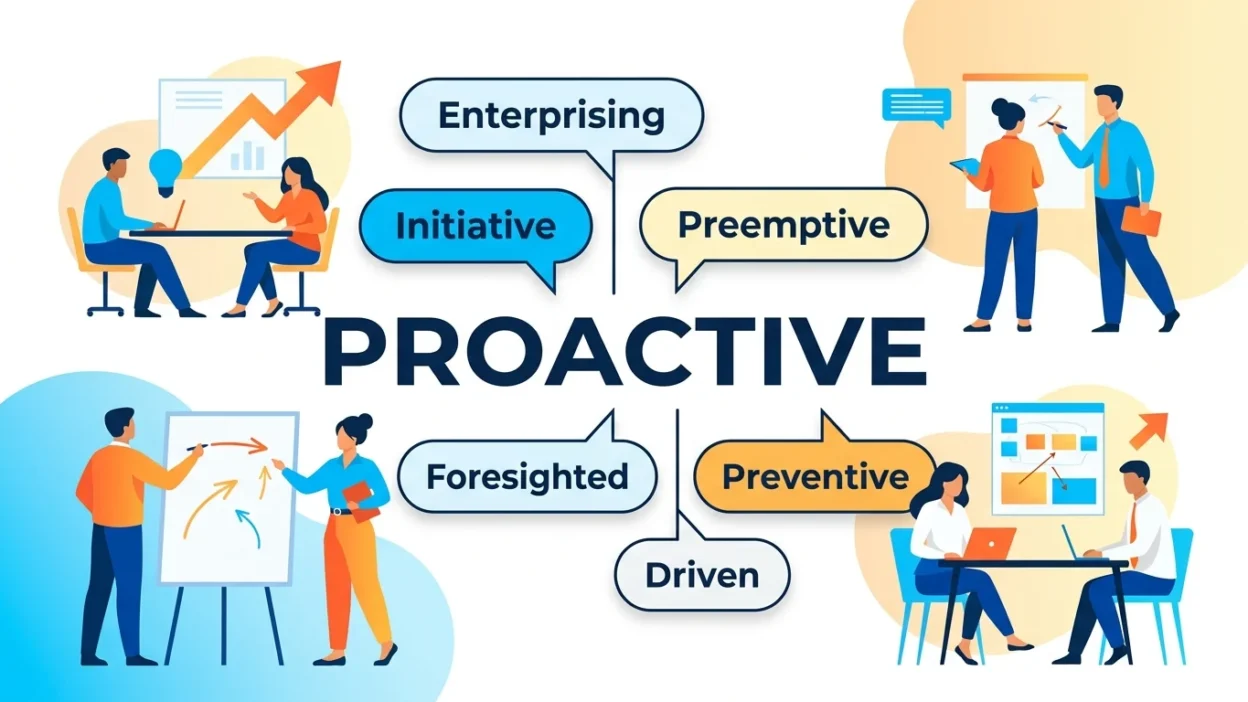
Being proactive means taking action before a problem happens or before someone tells you what to do.
A proactive person does not simply wait for events to unfold. Instead, they notice what may happen and take useful steps in advance.
Learning proactive synonyms can help students, ESL learners, writers, and content creators express this idea more precisely.
While words such as initiative-taking, prepared, and forward-thinking are related to proactive, each one has a slightly different meaning or tone.
What Does “Proactive” Mean?
Simple definition
Proactive means taking action early to prevent problems, achieve a goal, or prepare for the future.
For example:
She was proactive and started studying weeks before the exam.
Here, proactive shows that she did not wait until the last minute. She acted early because she understood what was coming.
Tone and usage
Proactive is a positive and useful word in everyday English, education, business, professional writing, and personal development.
It often describes someone who:
- Takes action without being asked
- Plans ahead
- Prevents problems
- Looks for opportunities
- Takes responsibility
- Thinks about future results
30 Proactive Synonyms
1. Initiative-taking
Meaning: Willing to act independently instead of waiting for instructions.
Example: Maria is initiative-taking and often finds ways to improve the class project.
Best usage context: Use it when emphasizing independent action and responsibility.
2. Forward-thinking
Meaning: Thinking about the future and planning for what may happen.
Example: The company used a forward-thinking approach to prepare for changing customer needs.
Best usage context: Excellent for business, strategy, education, and professional writing.
3. Prepared
Meaning: Ready for something before it happens.
Example: He was prepared for the interview because he had researched the company in advance.
Best usage context: Use it when the focus is on readiness rather than taking action.
4. Anticipatory
Meaning: Done in expectation of a future event or problem.
Example: The hospital took anticipatory measures before the expected increase in patients.
Best usage context: More formal; useful in academic, medical, technical, and professional writing.
5. Preventive
Meaning: Intended to stop a problem before it occurs.
Example: Regular maintenance is a preventive measure that can reduce costly repairs.
Best usage context: Best when the proactive action specifically aims to prevent a problem.
6. Preventative
Meaning: Designed to prevent something undesirable from happening.
Example: The school introduced preventative measures to improve student safety.
Best usage context: Common in general and professional English, although preventive is often preferred in formal writing.
7. Enterprising
Meaning: Showing energy and creativity when looking for opportunities or solutions.
Example: The enterprising student created a website to help classmates study.
Best usage context: Useful when proactive behavior involves ambition, creativity, or opportunity-seeking.
8. Self-starting
Meaning: Able to begin tasks independently without needing encouragement or instructions.
Example: We need a self-starting employee who can manage projects independently.
Best usage context: Common in job descriptions, resumes, and workplace conversations.
9. Self-motivated
Meaning: Able to motivate yourself to work toward a goal.
Example: She is self-motivated and completes her assignments without reminders.
Best usage context: Particularly useful for resumes, interviews, education, and professional writing.
10. Energetic
Meaning: Having a lot of energy and enthusiasm for taking action.
Example: His energetic approach helped the team finish the project early.
Best usage context: Use when proactive behavior is connected with enthusiasm and energy.
11. Resourceful
Meaning: Good at finding practical solutions, especially when facing difficulties.
Example: The resourceful manager found a way to solve the supply problem before it affected customers.
Best usage context: Use when someone takes action by making good use of available resources.
12. Diligent
Meaning: Careful, hardworking, and consistent in completing responsibilities.
Example: Her diligent preparation helped her succeed in the examination.
Best usage context: Good for academic and professional writing when effort and consistency matter.
13. Industrious
Meaning: Hardworking and willing to put significant effort into a task.
Example: The industrious student completed the research project ahead of schedule.
Best usage context: More formal than hardworking; useful in essays and descriptive writing.
14. Alert
Meaning: Paying close attention so you can notice and respond to something quickly.
Example: The security team remained alert to possible problems throughout the event.
Best usage context: Best when proactive behavior involves awareness and quick response.
15. Vigilant
Meaning: Carefully watching for possible danger, mistakes, or problems.
Example: Employees must remain vigilant when handling sensitive information.
Best usage context: Stronger and more serious than alert; common in safety and security contexts.
16. Conscientious
Meaning: Careful and responsible about doing things properly.
Example: A conscientious employee checks the details before submitting a report.
Best usage context: Useful when proactive behavior comes from a strong sense of responsibility.
17. Responsible
Meaning: Willing to accept duties and take appropriate action.
Example: A responsible student asks for help before falling too far behind.
Best usage context: A broad, everyday alternative when responsibility is the main idea.
18. Assertive
Meaning: Confidently expressing your needs, ideas, or decisions without being aggressive.
Example: She was assertive and suggested a solution before the disagreement became serious.
Best usage context: Use when proactive behavior involves confident communication or decision-making.
19. Decisive
Meaning: Able to make decisions quickly and confidently.
Example: The decisive manager acted immediately when the project faced a major delay.
Best usage context: Best when taking action requires making a clear decision.
20. Ambitious
Meaning: Strongly interested in achieving success or reaching challenging goals.
Example: His ambitious plan included completing the entire course before the summer.
Best usage context: Use when proactive action is driven by goals and achievement.
21. Strategic
Meaning: Carefully planned to achieve a particular long-term result.
Example: The team took a strategic approach to reducing future costs.
Best usage context: Excellent for business, management, academic, and analytical writing.
22. Foresighted
Meaning: Able to understand possible future situations and prepare for them.
Example: Her foresighted planning helped the organization handle the unexpected demand.
Best usage context: Useful in formal writing when emphasizing good judgment about the future.
23. Prescient
Meaning: Showing an unusually accurate understanding of what will happen in the future.
Example: His prescient decision to invest in digital services proved valuable several years later.
Best usage context: Formal and advanced; use when someone’s anticipation of the future turns out to be accurate.
24. Preemptive
Meaning: Done before something happens, usually to prevent an unwanted result.
Example: The company took preemptive action to avoid a shortage of supplies.
Best usage context: Strong choice for business, security, politics, technology, and formal writing.
25. Opportunistic
Meaning: Ready to take advantage of a favorable opportunity.
Example: The opportunistic entrepreneur noticed a gap in the market and developed a new service.
Best usage context: Useful when proactive action focuses on opportunities, although the word can sometimes have a negative meaning.
26. Active
Meaning: Involved and willing to take action rather than remaining passive.
Example: Students should take an active role in their own learning.
Best usage context: Simple and beginner-friendly; useful when contrasting action with passivity.
27. Dynamic
Meaning: Energetic, active, and able to adapt to change.
Example: The dynamic team quickly responded to changing customer expectations.
Best usage context: Common in business, workplace, and descriptive writing.
28. Responsive
Meaning: Quick to react appropriately when something happens or when someone needs help.
Example: The responsive support team solved the customer’s problem within minutes.
Best usage context: Use when the emphasis is on quick reaction, rather than acting before an event.
29. Action-oriented
Meaning: Focused on taking practical steps and getting things done.
Example: She has an action-oriented approach to solving workplace problems.
Best usage context: Excellent for professional, business, leadership, and self-development writing.
30. Future-focused
Meaning: Concentrating on future goals, possibilities, and challenges.
Example: The organization adopted a future-focused strategy for sustainable growth.
Best usage context: Useful in modern business, education, strategy, and personal development content.
Proactive Synonyms: Quick Comparison Guide
Choosing by meaning
| Synonym | Main idea | Tone | Best use |
|---|---|---|---|
| Initiative-taking | Acts independently | Positive | Work and education |
| Forward-thinking | Plans for the future | Professional | Strategy and business |
| Prepared | Ready in advance | Neutral | Everyday English |
| Preventive | Stops problems | Formal/neutral | Health, safety, maintenance |
| Self-starting | Begins without instruction | Professional | Jobs and resumes |
| Self-motivated | Creates own motivation | Positive | Education and careers |
| Resourceful | Finds solutions | Positive | Problems and challenges |
| Strategic | Plans for results | Professional | Business and management |
| Preemptive | Acts before a problem | Formal | Security and risk management |
| Action-oriented | Focuses on doing | Professional | Leadership and workplace |
| Responsive | Reacts quickly | Neutral | Customer service and support |
| Vigilant | Watches for danger | Serious | Security and safety |
How to Choose the Right Synonym
For everyday English
Choose prepared, active, or responsible when you want simple and easy-to-understand language.
For example:
She was prepared for the meeting.
This is more natural for everyday conversation than a formal word such as anticipatory.
For academic writing
Use forward-thinking, strategic, preventive, foresighted, or conscientious, depending on the exact meaning.
For example:
A forward-thinking education system prepares students for future changes.
These words can make academic writing more precise without relying on proactive repeatedly.
For business and professional writing
Good choices include initiative-taking, self-starting, self-motivated, strategic, action-oriented, and future-focused.
For example:
We are looking for a self-motivated candidate who can identify problems and act independently.
This communicates a specific workplace quality more clearly than simply saying the candidate is proactive.
For preventing problems
Use preventive, preventative, or preemptive.
The difference is subtle:
- Preventive focuses on stopping a problem.
- Preventative has the same basic meaning and is widely used.
- Preemptive often suggests acting before another event or action occurs.
For example:
The company introduced preventive maintenance to reduce equipment failures.
For future planning
Use forward-thinking, future-focused, foresighted, or strategic.
These words are especially useful when the person or organization is thinking beyond the immediate situation.
For solving problems
Choose resourceful, action-oriented, decisive, or enterprising.
These words highlight different strengths. A resourceful person finds creative solutions, while a decisive person makes clear choices and acts on them.
Proactive vs. Reactive
What is the difference?
Proactive and reactive describe two different approaches to action.
A proactive person acts before a problem occurs or before they are forced to respond.
A reactive person usually acts after an event or problem has already happened.
Compare these examples:
Proactive: The student started preparing for the exam one month early.
Reactive: The student began studying only after receiving a warning about poor grades.
Neither word is automatically negative in every situation. Sometimes a quick reaction is exactly what a situation requires. However, proactive emphasizes preparation, anticipation, and early action.
Common Mistakes When Using Proactive Synonyms
Treating every synonym as exactly the same
Synonyms often share a general meaning but are not interchangeable in every sentence.
For example, vigilant emphasizes careful watching, while ambitious emphasizes strong goals. Both can describe positive qualities, but they do not mean the same thing.
Using formal words in casual situations
Words such as prescient, foresighted, and anticipatory can sound too formal in everyday conversation.
Instead of:
I took an anticipatory approach to my weekend plans.
A natural speaker might say:
I planned ahead for the weekend.
Confusing proactive with responsive
Being proactive usually means acting before something happens.
Being responsive means reacting effectively after something happens or after someone makes a request.
For example:
The company was proactive and fixed the issue before customers complained.
The company was responsive and quickly helped customers who reported the issue.
Frequently Asked Questions About Proactive Synonyms
What is the best synonym for proactive?
There is no single best synonym because the right choice depends on context. Forward-thinking, initiative-taking, self-motivated, preventive, and action-oriented are strong alternatives in different situations.
What is a simple synonym for proactive?
Prepared, active, and responsible are simple alternatives, although they do not contain every meaning of proactive.
What is a professional synonym for proactive?
Forward-thinking, strategic, self-starting, self-motivated, and action-oriented work well in professional writing.
What is the opposite of proactive?
The most common opposite is reactive. Other possible contrasts include passive, unprepared, or inactive, depending on the sentence.
Is proactive a positive word?
Yes. Proactive is generally positive because it suggests responsibility, preparation, initiative, and willingness to act.
Final Takeaways
Use synonyms to make your writing more precise
Learning proactive synonyms is not simply about replacing one word with another. The goal is to choose a word that communicates your exact meaning.
Use forward-thinking when you want to emphasize the future. Choose preventive when the goal is to stop a problem.
Use self-motivated when someone acts without needing encouragement, and choose resourceful when someone finds practical solutions.
For students and ESL learners, understanding these small differences can make vocabulary more natural and writing more accurate.
For writers and content creators, using the right synonym also prevents repetitive language and gives readers a clearer picture of the idea.
The key is simple: do not search for the most complicated synonym—choose the word that best matches your meaning, audience, and tone.