If you have ever heard someone say “turn to port” or “move to starboard,” you may have wondered which side of a boat or ship they mean.
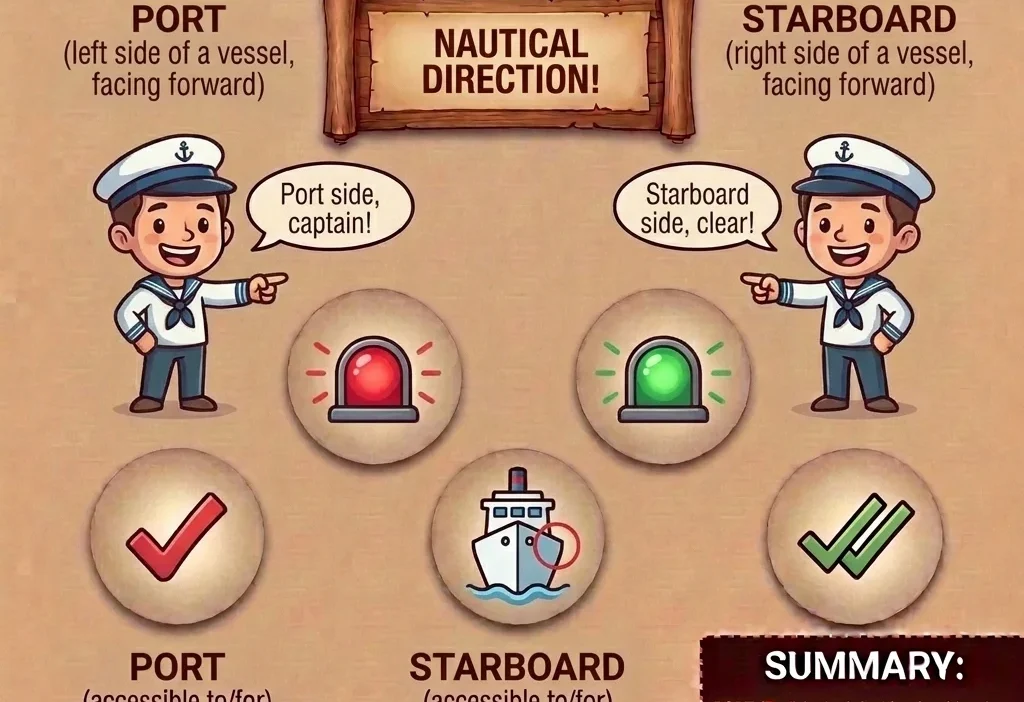
Port means the left side of a vessel when you are facing forward toward the bow, while starboard means the right side.
These terms are used instead of left and right because a vessel can be viewed from different directions.
Understanding port vs starboard is important for sailors, boat passengers, maritime students, and anyone interested in ships.
The words are also common in navigation instructions, safety announcements, nautical maps, and aviation-related contexts.
Once you understand the basic rule and learn a simple memory trick, it becomes much easier to remember which side is which.
Quick Answer
Port is the left side of a boat or ship when you are facing the bow, or front. Starboard is the right side. These nautical terms remain fixed to the vessel, unlike “left” and “right,” which can change depending on which direction a person is facing.
Why People Confuse It
People often confuse port and starboard because both words describe the sides of a vessel, but neither word directly means “left” or “right.”
The difficulty becomes greater when you are standing on a moving boat and facing backward. Your personal left and right may be opposite to the vessel’s port and starboard sides.
Another reason is that port has many other meanings. It can refer to a harbor, a computer connection, or the act of carrying something. Starboard, however, is mainly associated with the right side of a vessel.
The key is to think about the vessel’s direction of travel, not your own position.
First Word: Port
Port means the left side of a boat or ship when you are facing forward toward the bow.
The bow is the front of the vessel, while the stern is the back.
For example:
- “The lifeboats are on the port side.”
- “Turn to port.”
- “The port engine has stopped.”
- “The vessel moved toward the port side.”
A useful point is that port always refers to the vessel’s left side when viewed from the direction of the bow.
Why Is It Called Port?
The term port became associated with the left side because ships were traditionally brought alongside a harbor or port with this side facing the shore for loading and unloading.
The word eventually became the standard nautical term for the left side of a vessel.
Second Word: Starboard
Starboard means the right side of a boat or ship when you are facing forward toward the bow.
Examples include:
- “The passenger deck is on the starboard side.”
- “Turn to starboard.”
- “The starboard engine is running normally.”
- “A light is visible on the starboard side.”
Unlike port, starboard is a more specialized nautical word and is strongly associated with ships and boats.
Why Is It Called Starboard?
The word starboard comes from an older term meaning the side where the steering oar was located.
Early vessels commonly used a large steering oar rather than a modern central rudder. Because of the position of this steering oar, the term developed into starboard.
Port vs Starboard: Comparison Table
| Feature | Port | Starboard |
|---|---|---|
| Meaning | Left side of a vessel | Right side of a vessel |
| Reference point | Facing the bow | Facing the bow |
| Opposite | Starboard | Port |
| Common use | Nautical language | Nautical language |
| Navigation | Turn or move left | Turn or move right |
| Standard light | Red | Green |
| Example | “Move to port.” | “Move to starboard.” |
One important detail is the navigation light system: port is associated with red, while starboard is associated with green. This helps vessels identify each other’s orientation, especially at night.
When to Use Each
Use port when you need to describe the left side of a vessel.
Use starboard when you need to describe the right side.
Use “port” for:
- The left side of a boat or ship
- A left turn while navigating a vessel
- Equipment located on the vessel’s left
- The port-side navigation light
- Instructions involving the vessel’s left side
Use “starboard” for:
- The right side of a boat or ship
- A right turn while navigating
- Equipment located on the vessel’s right
- The starboard navigation light
- Instructions involving the vessel’s right side
You can use ordinary left and right in everyday conversation. However, port and starboard are preferred in maritime communication because they provide fixed references.
Port vs Starboard: 10+ Examples
Here are practical examples showing how these words are used.
- The captain ordered the crew to turn to port.
The vessel was instructed to turn left. - The lifeboat is on the port side.
The lifeboat is located on the vessel’s left side. - A small boat appeared on our starboard side.
Another boat appeared on the right side. - The starboard engine needs maintenance.
The engine on the vessel’s right side needs attention. - Passengers should remain on the port side of the deck.
Passengers should stay on the vessel’s left side. - The ship changed course toward starboard.
The ship turned toward its right. - The port light was clearly visible at night.
The red navigation light on the vessel’s left side could be seen. - There was another vessel off our starboard bow.
Another vessel was positioned toward the front-right area of the ship. - The crew inspected the starboard railing.
They inspected the railing on the right side. - The cargo was loaded through the port side.
The cargo was loaded using the vessel’s left side. - The officer noticed damage to the starboard hull.
The damage was on the right side of the vessel. - Keep the other boat on your port side.
Keep the other boat on your left side.
Common Mistakes
1. Thinking port means the back of the ship
It does not.
Port means the left side, not the rear. The rear of a vessel is called the stern.
2. Thinking starboard means the front
It does not.
Starboard means the right side. The front is called the bow.
3. Using your own left and right
This can cause confusion.
If you turn around and face the stern, your personal left side may point toward the vessel’s starboard side.
Always imagine yourself facing the bow.
4. Forgetting which color belongs to port
The standard navigation-light association is:
- Port = red
- Starboard = green
5. Assuming port and harbor are unrelated
The nautical term port and the word for a harbor are historically connected in the development of maritime terminology.
Memory Trick
A very common memory trick is:
Port = Left
Both port and left have four letters.
So remember:
PORT = LEFT
Then starboard is automatically the opposite:
STARBOARD = RIGHT
You can also remember the navigation lights:
Port = red
Starboard = green
Another useful phrase is:
“Port wine is red.”
That can help you connect port with the red navigation light.
American vs British English
There is essentially no difference between American and British English when it comes to the basic meanings of port and starboard.
Both varieties use:
- Port = left side of a vessel
- Starboard = right side of a vessel
These are standard nautical terms used internationally.
You may encounter the words in sailing, shipping, navigation, maritime safety, cruise travel, and naval contexts regardless of whether the speaker uses American or British English.
Similar Words
Several nautical terms are closely related to port and starboard.
Bow
The bow is the front part of a boat or ship.
Example:
“The boat is heading toward the bow.”
Stern
The stern is the rear part of a boat or ship.
Example:
“The crew gathered near the stern.”
Abeam
Abeam means roughly beside or perpendicular to the vessel’s centerline.
Example:
“The island was abeam of the ship.”
Forward
Forward means toward the front or bow of a vessel.
Aft
Aft means toward the rear or stern.
These terms work together to describe position and direction clearly on a vessel.
Final Verdict
Port means the left side of a boat or ship when facing the bow. Starboard means the right side.
The easiest way to remember the difference is:
Port = left
Starboard = right
If you also remember port = red and starboard = green, you have two useful clues for identifying the sides of a vessel.
FAQs
Is port left or right?
Port is the left side of a boat or ship when you are facing forward toward the bow.
Is starboard left or right?
Starboard is the right side of a boat or ship when you are facing toward the bow.
Why do ships say port and starboard instead of left and right?
Port and starboard provide fixed references on a vessel. A person’s left and right can change depending on which direction they are facing.
Is port red or green?
Port is red. The standard navigation-light system uses a red light on the port side and a green light on the starboard side.
Is starboard red or green?
Starboard is green.
How can I easily remember port and starboard?
Remember “port” and “left” both have four letters. Therefore, port = left, and starboard = right.
What are the front and back of a ship called?
The front is the bow, and the back is the stern.
Are port and starboard used in British and American English?
Yes. Both British and American English use port for the vessel’s left side and starboard for its right side.
Remember This
Port = left
Starboard = right
Bow = front
Stern = back
Port light = red
Starboard light = green
The most important rule is to imagine yourself facing the bow. From that position, the vessel’s left side is port and its right side is starboard.
Conclusion
Understanding port vs starboard is simple once you stop thinking about your own left and right. Port always identifies the left side of a vessel when facing its bow, while starboard identifies the right side. These fixed terms make communication clearer and safer on boats and ships.
For a quick memory aid, think “Port = left” because both words have four letters. Then remember that starboard is the right side. Add red for port and green for starboard, and you have an easy system for remembering the difference.