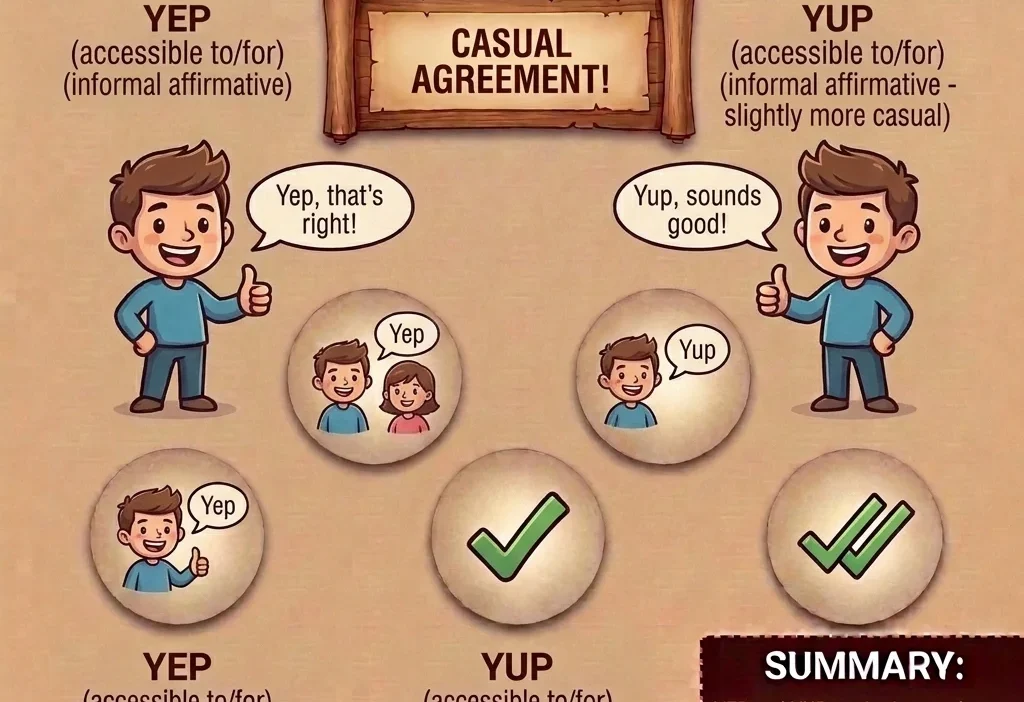
Yep and yup are both informal ways to say “yes.”
They are very similar in meaning, and in most casual conversations, you can use either one.
Yep is often perceived as a little more neutral or straightforward, while yup can sound more relaxed, casual, or conversational. Neither is appropriate for most formal writing.
The difference is mainly one of tone, style, and personal preference, rather than grammar or meaning.
You might see yep and yup in text messages, online chats, social media, casual emails, and everyday conversations. Their exact tone can also depend on context and the speaker.
For example, “Yep, I’ll be there” can sound simple and confident, while “Yup, I’ll be there” may feel slightly more laid-back.
Understanding these small differences can help you choose the response that best fits the situation.
Quick Answer
Yep and yup both mean “yes” and are informal. Yep often sounds slightly more neutral or matter-of-fact, while yup can sound more relaxed and conversational. Both are suitable for casual speech and texting, but yes is the better choice for formal or professional communication.
Why People Confuse It
People confuse yep and yup because they have essentially the same basic meaning and are often interchangeable.
Both are informal affirmative responses. They can answer a question, confirm information, or show agreement.
For example:
“Are you ready?”
“Yep.”
or:
“Are you ready?”
“Yup.”
Both responses mean yes.
The main difference is how they sound, not what they literally mean. The choice can depend on the speaker’s personal style, the conversation, and the desired tone.
First Word: Yep
Yep is an informal form of yes.
It is commonly used in casual conversation and often sounds straightforward, friendly, or matter-of-fact.
Examples:
“Did you finish the assignment?”
“Yep.”
“Are we meeting at six?”
“Yep, that’s right.”
Yep can also be used as part of a longer response:
- Yep, I agree.
- Yep, that’s correct.
- Yep, I’ll do it.
- Yep, we’re ready.
It is especially common in spoken English and informal writing such as text messages.
Second Word: Yup
Yup is another informal form of yes.
It has the same basic meaning as yep, but it can sound particularly relaxed, casual, or conversational.
Examples:
“Did you get my message?”
“Yup.”
“Is this your bag?”
“Yup, that’s mine.”
Like yep, it can appear in longer informal responses:
- Yup, I’m coming.
- Yup, that’s what I meant.
- Yup, you’re right.
- Yup, everything is ready.
There is no strict grammatical rule that makes yup more correct than yep, or vice versa.
Comparison Table
| Word | Meaning | Typical Tone | Common Use |
|---|---|---|---|
| Yep | Yes | Informal, straightforward, friendly | Casual conversation, texts, chats |
| Yup | Yes | Informal, relaxed, conversational | Casual conversation, texts, chats |
| Yes | Yes | Neutral to formal | Almost all situations |
When to Use Each
Use “yep” in casual conversations
Yep works well when you want a short, natural confirmation.
“Are you coming with us?”
“Yep.”
It can also sound slightly more direct:
“Did you send the email?”
“Yep, I sent it.”
Use “yup” for a relaxed tone
Yup is also useful for casual conversations, especially when you want your response to feel relaxed.
“Do you want pizza?”
“Yup!”
It is common in informal digital communication.
Use “yes” in formal situations
If you are writing a professional email, academic assignment, formal letter, or official document, yes is usually the better choice.
Instead of:
Yep, I agree with the proposal.
write:
Yes, I agree with the proposal.
The issue is not that yep or yup is grammatically wrong. They are simply informal.
12 Examples
- “Are you ready?” — Yep!
- “Did you lock the door?” — Yup.
- “Do you understand the instructions?” — Yep, I understand.
- “Is this your phone?” — Yup, that’s mine.
- “Are we still meeting tonight?” — Yep, at seven.
- “Did she call you?” — Yup, she called earlier.
- “Can you help me with this?” — Yep, no problem.
- “Did you enjoy the movie?” — Yup, it was great.
- “Is everything ready?” — Yep, we’re good to go.
- “Do you want some coffee?” — Yup!
- “Did you receive the file?” — Yep, I got it.
- “Are you sure about that?” — Yup, absolutely.
Common Mistakes
Mistake 1: Using “yep” or “yup” in formal writing
These words are informal.
Instead of writing:
Yep, I have reviewed your application.
in a formal professional message, use:
Yes, I have reviewed your application.
Mistake 2: Thinking one is grammatically correct and the other is wrong
Both yep and yup are established informal forms of yes.
The choice usually depends on personal preference and tone.
Mistake 3: Assuming “yup” always sounds friendlier
Tone depends heavily on context. A one-word “yup” can sound relaxed, but it can also seem brief or uninterested depending on the conversation.
Similarly, “yep” can sound friendly or simply factual.
Mistake 4: Thinking “yep” and “yup” have different meanings
They generally do not. Both are informal affirmative responses meaning yes.
Memory Trick
Use this simple rule:
Yep = yes.
Yup = yes.
Both are casual.
If you need a more formal response, simply return to the original word:
Yes.
Think of it as three levels:
Yes → neutral/formal
Yep → casual
Yup → casual/relaxed
American vs British English
Yep and yup are both used in American and British English.
There is no strict American-British rule that assigns one spelling to one variety. Both forms can appear in casual speech, texting, online conversations, and informal writing.
Usage and personal preference can vary from speaker to speaker. Neither yep nor yup is limited exclusively to American or British English.
Similar Words
Yes
Yes is the standard affirmative word.
Yes, I understand.
It works in formal, neutral, and informal situations.
Yeah
Yeah is a very common informal form of yes.
Yeah, I’ll come with you.
It is generally more conversational than yes.
Yep
Yep is another casual form of yes.
Yep, that’s right.
Yup
Yup is also a casual form of yes.
Yup, I agree.
Uh-huh
Uh-huh can express agreement or confirmation in conversation.
“Did you hear me?”
“Uh-huh.”
Its meaning can depend strongly on tone and context.
Absolutely
Absolutely is a stronger affirmative response.
“Do you agree?”
“Absolutely.”
It can be informal or professional depending on the context.
Final Verdict
Yep and yup both mean yes, and neither is inherently more correct than the other. Yep often feels slightly more neutral or matter-of-fact, while yup can feel more relaxed and conversational.
For casual texts, chats, and everyday conversations, either one is fine. For formal, academic, or professional writing, choose yes instead.
FAQs
Is “yep” or “yup” more correct?
Neither is more grammatically correct. Both are informal forms of yes. The choice mainly depends on personal preference and tone.
Is “yep” more formal than “yup”?
Yep can sometimes feel slightly more neutral, but both are informal. Neither should generally be considered formal English.
Is “yup” a real word?
Yes. Yup is an established informal word meaning yes.
Can I use “yep” in a professional email?
You can, but it may sound too casual depending on the situation. Yes is usually a better choice for professional emails.
Can “yep” and “yup” be used interchangeably?
Usually, yes. Both commonly express agreement or confirmation and can replace each other in casual conversations.
Is “yep” rude?
No, yep is not inherently rude. However, a very short response can sometimes sound abrupt depending on the context and tone.
Is “yup” rude or dismissive?
Not inherently. Yup is normally casual, but a one-word response can sound dismissive in some contexts. The surrounding conversation matters.
Remember This
- Yep = yes
- Yup = yes
- Both are informal.
- Yep may sound slightly more straightforward.
- Yup may sound slightly more relaxed.
- Use yes in formal or professional situations.
- Context and tone matter more than the spelling difference.
Conclusion
Yep and yup are both informal ways to say yes. They can usually be used in the same situations, especially in casual conversations, text messages, online chats, and friendly exchanges. The difference is mainly a matter of tone and personal preference rather than meaning or grammar.
If you want a slightly more straightforward casual response, yep is a natural choice. If you want an equally casual but relaxed-sounding response, yup works well. When the situation is formal or professional, however, the safest option is simply yes. In short, there is no major meaning difference: yep and yup both mean yes.

Liam Henry is a content author at Synonymed, specializing in vocabulary enrichment and synonym guides. He creates clear, engaging resources that help learners improve English word knowledge and language fluency.