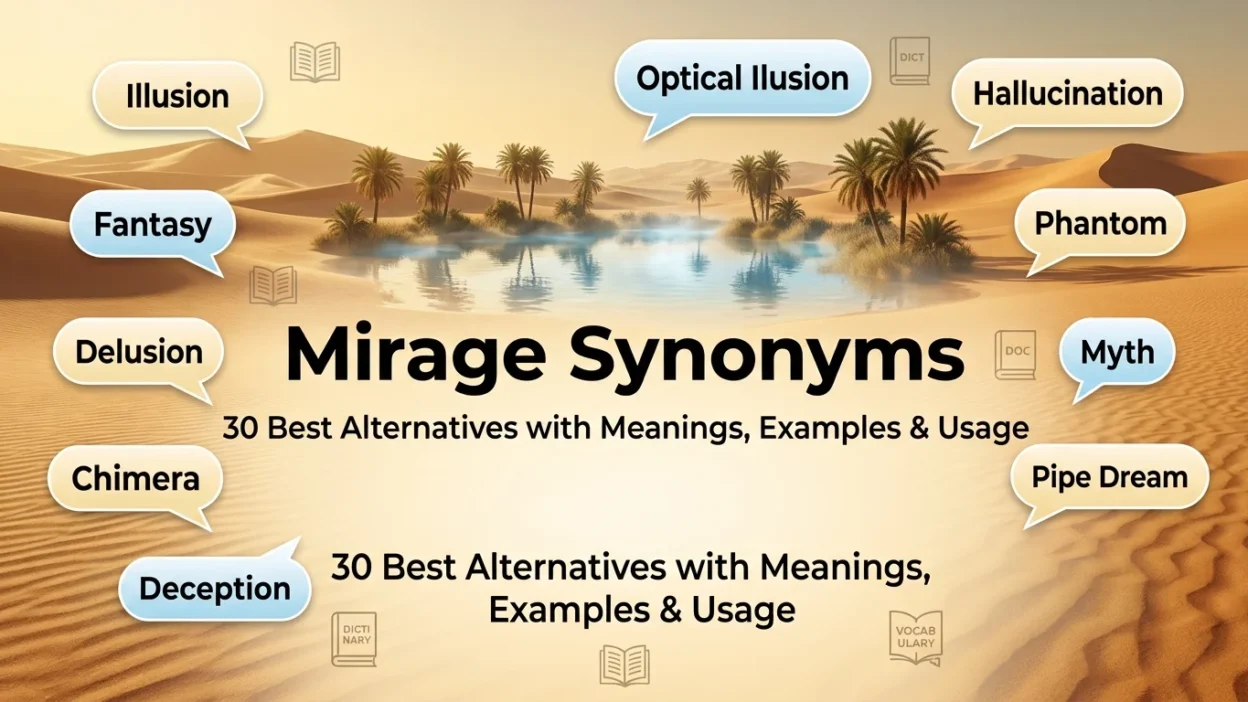
A mirage is something that appears real but is actually an illusion.
The word is often used to describe an optical illusion in deserts, where distant objects seem to shimmer or look like water.
However, mirage is also used figuratively to describe false hopes, unrealistic dreams, or deceptive appearances.
Learning mirage synonyms can help you express these ideas more accurately in both writing and conversation.
Whether you’re a student, ESL learner, writer, or content creator, understanding different words for mirage will improve your vocabulary and make your writing more engaging.
Some synonyms focus on visual illusions, while others describe deception, fantasy, or false expectations.
This guide explains each synonym in simple English with meanings, examples, and practical usage tips.
What Does “Mirage” Mean?
A mirage is an optical illusion caused by light and heat that makes something appear where it doesn’t actually exist. It can also refer to something that seems real or achievable but is actually false or impossible.
Example Sentences
- The travelers thought they saw water, but it was only a mirage.
- His promise of instant wealth turned out to be a mirage.
- The desert heat created a beautiful mirage.
Tone and Usage Context
The word mirage is commonly used in:
- Literature
- Science
- Everyday conversations
- Journalism
- Creative writing
- Motivational writing
It usually has a symbolic or descriptive tone.
Why Learn Mirage Synonyms?
Learning mirage synonyms helps you:
- Expand your English vocabulary.
- Avoid repeating the same word.
- Write more creatively.
- Understand literature and poetry.
- Express ideas about illusion and deception more clearly.
30 Mirage Synonyms with Meanings, Examples, and Usage
1. Illusion
Meaning: Something that appears real but is not.
Example: The magician created a clever illusion.
Best Usage: General writing and psychology.
2. Hallucination
Meaning: Seeing or hearing something that isn’t actually there.
Example: The patient experienced a hallucination.
Best Usage: Medical and psychological contexts.
3. Fantasy
Meaning: An imagined situation that isn’t real.
Example: Living without responsibilities is just a fantasy.
Best Usage: Literature and casual conversation.
4. Delusion
Meaning: A false belief despite evidence.
Example: He lived under the delusion that everyone admired him.
Best Usage: Psychology and formal writing.
5. Vision
Meaning: Something imagined or mentally seen.
Example: She had a vision of a better future.
Best Usage: Inspirational writing.
6. Apparition
Meaning: A ghost-like or mysterious appearance.
Example: The old castle was said to contain an apparition.
Best Usage: Horror and fiction.
7. Phantom
Meaning: Something that appears to exist but doesn’t.
Example: The phantom figure disappeared instantly.
Best Usage: Fiction and storytelling.
8. Specter
Meaning: A ghost or frightening image.
Example: The specter frightened everyone.
Best Usage: Literature.
9. Ghost
Meaning: The spirit of a dead person or a symbolic image.
Example: The abandoned house was rumored to have a ghost.
Best Usage: Fiction.
10. Deception
Meaning: The act of making someone believe something false.
Example: The advertisement was a deception.
Best Usage: Everyday and formal writing.
11. Trick
Meaning: Something intended to fool people.
Example: It was only a clever trick.
Best Usage: Casual conversation.
12. Hoax
Meaning: A deliberate false story or prank.
Example: The news turned out to be a hoax.
Best Usage: Journalism.
13. False Hope
Meaning: Hope based on something unlikely to happen.
Example: The fake promise gave everyone false hope.
Best Usage: Emotional discussions.
14. Dream
Meaning: An imagined wish or goal.
Example: Owning a castle seemed like a dream.
Best Usage: Everyday English.
15. Chimera
Meaning: An impossible or unrealistic idea.
Example: Unlimited success without effort is a chimera.
Best Usage: Literary writing.
16. Fiction
Meaning: Something invented rather than true.
Example: The story was pure fiction.
Best Usage: Literature.
17. Myth
Meaning: A widely believed but false idea.
Example: That belief is a myth.
Best Usage: General writing.
18. Misconception
Meaning: A wrong understanding.
Example: Many people have a misconception about success.
Best Usage: Education.
19. Appearance
Meaning: The way something looks.
Example: Appearances can be misleading.
Best Usage: Everyday communication.
20. Impression
Meaning: An idea formed from what you see or hear.
Example: My first impression was incorrect.
Best Usage: Conversations.
21. Optical Illusion
Meaning: A visual effect that tricks the eyes.
Example: The artwork creates an optical illusion.
Best Usage: Science and art.
22. Daydream
Meaning: Pleasant thoughts unrelated to reality.
Example: He spent the afternoon in a daydream.
Best Usage: Casual writing.
23. Fancy
Meaning: An imaginative idea.
Example: That was only a fancy.
Best Usage: Literary writing.
24. Figment
Meaning: Something invented by the imagination.
Example: The monster was a figment of his imagination.
Best Usage: Creative writing.
25. False Image
Meaning: An incorrect appearance.
Example: Social media often creates a false image.
Best Usage: Modern discussions.
26. Fabrication
Meaning: Something completely made up.
Example: The accusation was a fabrication.
Best Usage: Formal writing.
27. Pretension
Meaning: A false claim or appearance.
Example: His confidence was only pretension.
Best Usage: Literature.
28. Pipe Dream
Meaning: An unrealistic hope.
Example: Becoming rich overnight is a pipe dream.
Best Usage: Informal English.
29. False Appearance
Meaning: Something that looks real but isn’t.
Example: Wealth can sometimes be a false appearance.
Best Usage: General writing.
30. Unreality
Meaning: The quality of being unreal.
Example: The scene had an air of unreality.
Best Usage: Literature.
Comparison Guide: When to Use Different Mirage Synonyms
| Synonym | Best For | Tone |
|---|---|---|
| Illusion | General writing | Neutral |
| Hallucination | Medical contexts | Formal |
| Fantasy | Imagination | Casual |
| Delusion | Psychology | Formal |
| Optical Illusion | Science | Technical |
| Chimera | Literature | Formal |
| Pipe Dream | Everyday speech | Informal |
| Myth | False beliefs | Neutral |
| Figment | Creative writing | Literary |
| Deception | Dishonesty | Neutral |
| Hoax | News | Neutral |
| False Hope | Emotional topics | Serious |
How to Choose the Right Mirage Synonym
For Everyday Conversations
Choose:
- Illusion
- Fantasy
- Dream
- Myth
- Pipe Dream
For Formal Writing
Choose:
- Delusion
- Deception
- Fabrication
- Chimera
- Hallucination
For Creative Writing
Choose:
- Phantom
- Apparition
- Specter
- Figment
- Fancy
For Scientific Contexts
Choose:
- Optical Illusion
- Hallucination
- Illusion
- Appearance
Tips for Using Mirage Synonyms Naturally
- Use illusion for something that looks real but isn’t.
- Choose pipe dream for unrealistic ambitions.
- Use optical illusion when discussing science or vision.
- Select chimera for literary or formal writing.
- Match the synonym to the tone of your writing.
Common Mistakes to Avoid
- Confusing illusion with hallucination.
- Using ghost when you actually mean a visual illusion.
- Replacing mirage with dream in scientific contexts.
- Assuming all synonyms have exactly the same meaning.
Conclusion
Learning mirage synonyms helps you describe illusions, false hopes, deceptive appearances, and imagined situations more accurately. While mirage is the perfect word for optical illusions and symbolic false hopes, alternatives like illusion, fantasy, delusion, chimera, optical illusion, and pipe dream each carry unique shades of meaning.
Choosing the right synonym improves your vocabulary, strengthens your writing, and helps you communicate more clearly in different situations.