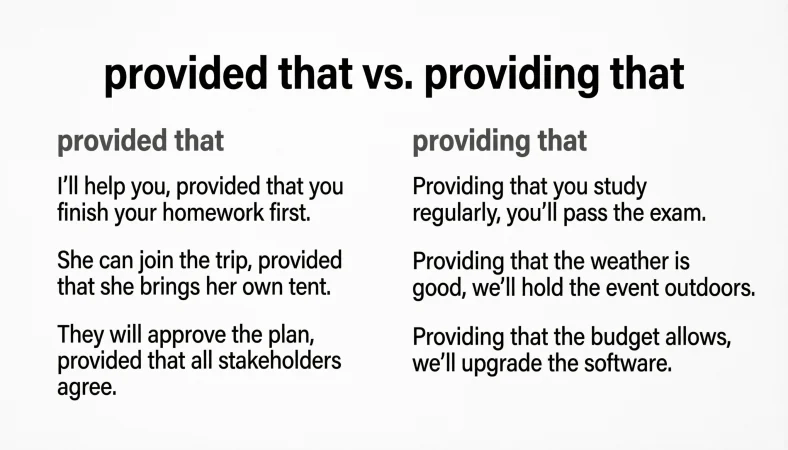
“Provided that” and “providing that” are both used to introduce a condition. In most contexts, they mean “if” or “on the condition that.”
However, provided that is more common, more formal, and generally the safer choice in academic and professional English.
Providing that is also grammatically correct, but it is less common and can sound slightly more conversational.
Quick Answer
Provided that and providing that both mean “if” or “on the condition that.” For example, “You can go provided that you finish your work” means “You can go if you finish your work.” Provided that is the more common and formal expression, while providing that is also correct and often sounds more conversational.
Why Do People Confuse It?
The confusion comes from the fact that provided and providing look like different grammatical forms, but both can function as conjunctions meaning “if a particular condition is satisfied.”
Compare:
- You can borrow my car provided that you drive carefully.
- You can borrow my car providing that you drive carefully.
Both sentences communicate essentially the same condition.
The main difference is style and frequency, rather than meaning. Provided that is especially common in formal writing, contracts, rules, instructions, and academic English.
First Word: “Provided That”
Provided that is a subordinating conjunction meaning “if,” “as long as,” or “on the condition that.”
It introduces a condition that must be met before something else can happen.
Examples
- You can stay here provided that you are quiet.
- We will go for a picnic provided that the weather is good.
- She can join the course provided that she meets the requirements.
- I will help you provided that you listen carefully.
In formal English, provided that is usually the best choice when you want to express a clear condition.
What does “provided that” mean?
It means that something is possible only if a particular condition is satisfied.
For example:
You may use my laptop provided that you return it before dinner.
The condition is returning the laptop before dinner.
Second Word: “Providing That”
Providing that can also mean “if,” “as long as,” or “on the condition that.”
It has the same basic function as provided that.
Examples
- You can come with us providing that you finish your homework.
- We can leave early providing that everyone is ready.
- I will accept the offer providing that the salary is reasonable.
- You can use the room providing that you clean it afterward.
Although correct, providing that is generally less common than provided that. In formal or careful writing, provided that is often preferable.
Provided That vs. Providing That: Comparison Table
| Feature | Provided that | Providing that |
|---|---|---|
| Basic meaning | If / on the condition that | If / on the condition that |
| Grammar | Conjunction | Conjunction |
| Meaning | Conditional | Conditional |
| Formality | More formal | Slightly more conversational |
| Commonness | More common | Less common |
| Academic writing | Excellent choice | Acceptable, but less preferred |
| Contracts/rules | Very common | Less common |
| Everyday English | Common | Also possible |
| Safe choice | Yes | Yes, but less standard in formal contexts |
When Should You Use Each?
Use “provided that” for formal English
Choose provided that when writing:
- Academic essays
- Business documents
- Rules and policies
- Contracts
- Formal emails
- Official instructions
- Professional reports
Example:
Employees may work remotely, provided that they meet all performance requirements.
This sounds natural and appropriately formal.
Use “providing that” in less formal contexts
Providing that is grammatically acceptable when you simply want to express a condition.
Example:
We can go to the beach tomorrow, providing that it doesn’t rain.
The sentence is natural, although provided that would also work.
Can they replace “if”?
Usually, yes.
You can come if you finish your homework.
You can come provided that you finish your homework.
You can come providing that you finish your homework.
All three sentences express essentially the same idea.
However, provided that and providing that can emphasize the condition more strongly than a simple if.
10+ Examples of “Provided That” and “Providing That”
Examples with “provided that”
- You can borrow my book provided that you return it tomorrow.
- We will play outside provided that the weather stays dry.
- You may leave early provided that your work is finished.
- I will attend the meeting provided that it does not last too long.
- Students can use the library provided that they follow the rules.
- She can take the job provided that the company offers flexible hours.
Examples with “providing that”
- You can stay here providing that you keep the room clean.
- We can order pizza providing that everyone agrees.
- I will go with you providing that we leave before six.
- They can join the team providing that they pass the test.
- You can use my phone providing that you are careful with it.
- We can finish the project today providing that nobody is late.
Examples using both forms
- Provided that you study regularly, you should pass the exam.
- Providing that you study regularly, you should pass the exam.
- We can travel next week provided that our plans do not change.
- We can travel next week providing that our plans do not change.
The meaning of each pair is essentially the same.
Common Mistakes
1. Thinking “provided that” means “given that”
In some contexts, provided can be related to the idea of supplying something, but provided that as a conjunction means “if” or “on the condition that.”
You can attend provided that you register first.
Here, it means:
You can attend if you register first.
2. Using “provided” without understanding the condition
The phrase normally introduces a condition.
❌ You can use the computer provided.
✅ You can use the computer provided that you handle it carefully.
3. Assuming “providing that” is always wrong
It is not. Providing that is a legitimate conditional expression.
You can come providing that you arrive on time.
However, provided that is generally the more established choice, especially in formal writing.
4. Confusing “provided that” with “provided”
In many sentences, provided can appear without that:
You can come provided you finish your work.
This has essentially the same meaning as:
You can come provided that you finish your work.
5. Forgetting the condition
The important information after provided that or providing that is the condition.
We can go provided that it doesn’t rain.
The condition is “it doesn’t rain.”
Memory Trick
Think of:
PROVIDED THAT = IF
If you can replace the expression with if without changing the basic meaning, you are probably using it correctly.
You can go provided that you finish your work.
→ You can go if you finish your work.
For formal writing, remember:
Provided that = preferred formal choice.
American vs. British English
Both provided that and providing that are understood in both American and British English.
The difference is mainly one of usage and style, not a major difference between the two varieties of English.
Provided that is widely used in formal English on both sides of the Atlantic. Providing that is also found in both varieties, although it is generally less common.
For international, academic, or professional writing, provided that is the safest choice.
Similar Words
Several expressions can communicate a similar conditional meaning.
If
The simplest and most common alternative.
You can go if you finish your work.
As long as
This often emphasizes that a condition must continue to be satisfied.
You can stay as long as you are quiet.
On condition that
A formal expression meaning that something is allowed only under a particular condition.
You may enter on condition that you show your identification.
Assuming that
This means “if we suppose that something is true.”
We can finish today assuming that everyone helps.
Unless
Unless means approximately “if not.”
You cannot enter unless you have a ticket.
This is different from:
You can enter provided that you have a ticket.
Final Verdict
Provided that and providing that are both correct expressions meaning “if” or “on the condition that.”
The important difference is usage and style. Provided that is more common and is generally preferred in formal, academic, professional, and official writing. Providing that is also acceptable, especially in ordinary conversation and less formal writing.
If you are unsure which one to choose, use provided that.
FAQs
Is “provided that” grammatically correct?
Yes. Provided that is a standard conjunction used to introduce a condition. It means “if,” “as long as,” or “on the condition that.”
Is “providing that” grammatically correct?
Yes. Providing that can also introduce a condition and generally has the same meaning as provided that.
Which is more common: “provided that” or “providing that”?
Provided that is generally more common and is especially suitable for formal writing.
Can I use “if” instead of “provided that”?
Usually, yes. For example, “You can leave provided that you finish your work” can become “You can leave if you finish your work.”
Is “provided that” formal?
Yes. Provided that is commonly used in formal English, including academic, professional, legal, and official contexts.
Is “providing that” informal?
It can sound somewhat more conversational than provided that, although it is not incorrect or necessarily very informal.
Can “provided that” and “providing that” be used interchangeably?
In most conditional sentences, yes. They normally express the same basic condition, although provided that is usually the preferred choice in formal writing.
Does “provided that” mean “as long as”?
Often, yes. For example, “You can borrow the car provided that you drive carefully” is similar in meaning to “You can borrow the car as long as you drive carefully.”
Remember This
Provided that = providing that = if / on the condition that
But when you need one expression for formal or academic English, choose:
Provided that
You can join the program provided that you meet the requirements.
Conclusion
Provided that and providing that are both correct ways to introduce a condition.
They usually mean “if,” “as long as,” or “on the condition that.” Their meanings are so similar that they can normally be substituted for each other without changing the main idea of a sentence.
The main practical distinction is style. Provided that is more common and is the better choice for formal and professional writing.
Providing that is also acceptable, but if you want the safest and most widely appropriate option, remember: use “provided that.”