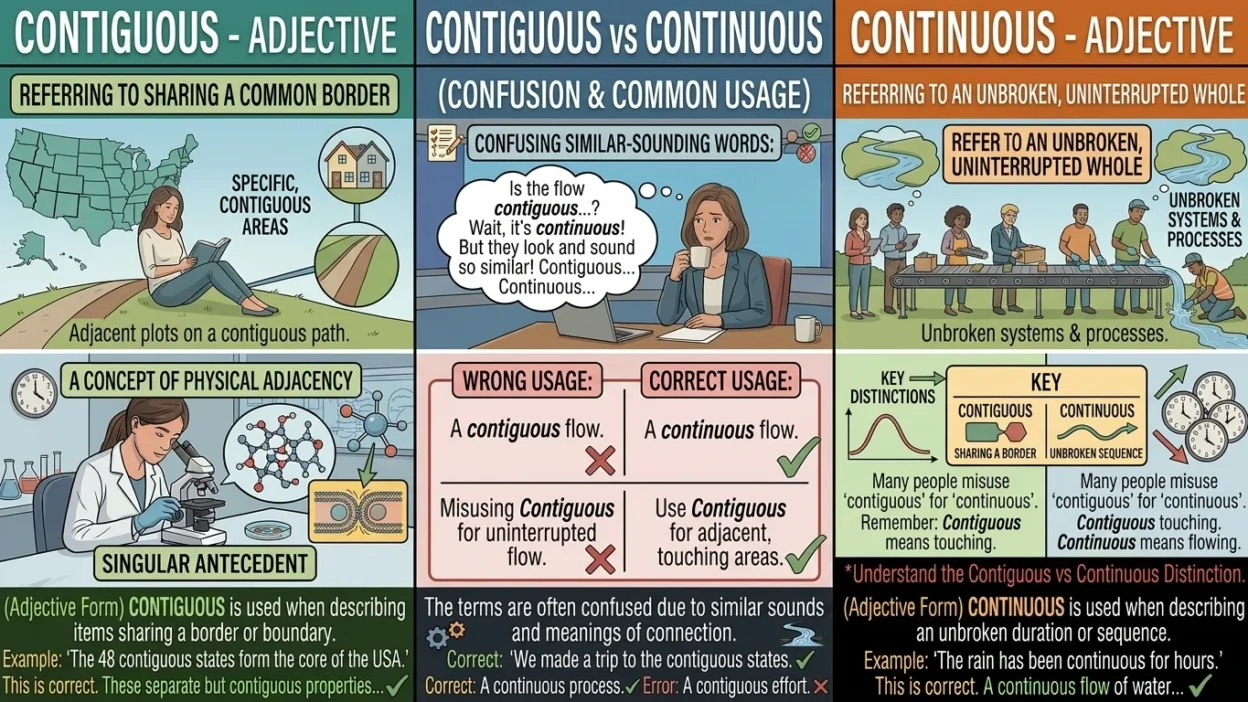
Contiguous and continuous are often confused because they look and sound similar, but they describe different kinds of connection.
Contiguous means next to, touching, or sharing a boundary, while continuous means continuing without interruption or a break.
For example, two areas of land can be contiguous because they touch, while a process can be continuous because it keeps going without stopping.
Knowing the difference is useful in everyday English as well as geography, mathematics, science, computing, business, and formal writing.
You may encounter phrases such as contiguous land, contiguous regions, and contiguous memory, while continuous service, continuous improvement, and continuous operation describe something that continues without interruption.
The easiest way to choose the correct word is to ask whether you are describing things that are next to one another or something that keeps going.
Quick Answer
Contiguous means next to or touching, especially when things share a boundary. Continuous means continuing without interruption or a break. Use “contiguous” mainly for spatial relationships and “continuous” for uninterrupted processes, activities, sequences, or conditions. For example, contiguous properties touch; continuous service does not stop.
Why Do People Confuse Contiguous and Continuous?
The two words are easy to mix up because both relate to things being connected or extending together. They also have similar-looking beginnings and are frequently used in formal or technical contexts.
The important difference is how the things are connected:
- Contiguous → connected because things are next to each other
- Continuous → connected because something continues without a break
Compare:
The two properties are contiguous.
This means the properties are next to each other or share a boundary.
The service is continuous.
This means the service continues without interruption.
A useful shortcut is to think space versus continuation.
First Word: Contiguous
Contiguous means sharing a boundary, touching, or being immediately next to something else.
It usually describes a relationship between separate things, especially places, areas, objects, or sections.
Contiguous in geography
Geography is one of the most common contexts for this word.
The two countries have contiguous territories.
This means their territories share a boundary.
You may also hear the contiguous United States, referring to the 48 states that share land borders with other U.S. states. Alaska and Hawaii are excluded because neither shares a land border with those 48 states.
Contiguous in property and land
The company purchased three contiguous plots of land.
The plots are separate properties, but they are next to one another.
Contiguous in computing
The word can also describe adjacent locations in computer memory.
The program stores the data in contiguous memory locations.
Here, the relevant memory locations are adjacent rather than separated by unrelated locations.
Second Word: Continuous
Continuous means extending, happening, or operating without interruption or a break.
It often describes something that continues through time, space, or a process.
Examples include:
The machine requires continuous power.
We heard a continuous buzzing sound.
The company provides continuous support.
The river creates a continuous flow through the valley.
The emphasis is on unbroken continuation, not simply on two things being next to each other.
Continuous in mathematics
In mathematics, continuous has a specific technical meaning. Informally, a continuous function does not have a break, jump, or other discontinuity at the point being considered.
The everyday meaning and the mathematical meaning share the general idea of no break, but mathematical continuity has a precise formal definition.
Contiguous vs Continuous: Comparison Table
| Word | Meaning | Main Focus | Example |
|---|---|---|---|
| Contiguous | Next to, touching, or sharing a boundary | Space or position | The two properties are contiguous. |
| Continuous | Continuing without interruption | Time, process, movement, or unbroken extent | The machine operates continuously. |
| Adjacent | Next to or nearby | Position | The rooms are adjacent. |
| Consecutive | Following one another in order | Sequence | She worked three consecutive days. |
| Uninterrupted | Not stopped or broken | Continuation | The meeting lasted three hours uninterrupted. |
When Should You Use Contiguous?
Use contiguous when the main idea is physical or spatial closeness with direct contact or a shared boundary.
Use “contiguous” for land
The farmers own two contiguous fields.
The fields are next to each other.
Use “contiguous” for regions
The forest covers several contiguous regions.
The regions are connected spatially.
Use “contiguous” for properties
The business purchased two contiguous buildings.
The buildings are immediately next to each other.
Use “contiguous” for data
The files were placed in contiguous blocks of memory.
The blocks occupy adjacent memory locations.
A helpful question is:
“Are these things next to or touching each other?”
If the answer is yes, contiguous may be the appropriate word.
When Should You Use Continuous?
Use continuous when something keeps going without interruption.
Use “continuous” for activities
The machine requires continuous operation.
Use “continuous” for time
The system ran for ten continuous hours.
Use “continuous” for sound
There was a continuous noise coming from the engine.
Use “continuous” for processes
The company uses continuous improvement to improve its services.
Use “continuous” for monitoring
The patient needs continuous monitoring.
A useful question is:
“Does it continue without a break?”
If yes, continuous is likely the right choice.
12+ Examples of Contiguous and Continuous
Examples of “contiguous”
- The two properties are contiguous.
- The company owns several contiguous buildings.
- The farmers purchased two contiguous fields.
- The regions have contiguous borders.
- The forest consists of several contiguous areas.
- The houses form a contiguous row.
- The software uses contiguous memory locations.
- The park contains several contiguous sections.
- The two plots of land are contiguous.
- The researchers selected a contiguous area for the study.
- The neighboring territories are contiguous.
- The company bought a contiguous parcel of land.
Examples of “continuous”
- The machine needs continuous power.
- The rain continued for six continuous hours.
- The patient requires continuous monitoring.
- The company provides continuous customer support.
- The engine produced a continuous sound.
- The system operates continuously.
- The road forms a continuous route along the coast.
- The company focuses on continuous improvement.
- The process requires continuous attention.
- The graph represents a continuous function.
- The service operates continuously throughout the day.
- The river maintains a continuous flow through the region.
Common Mistakes
Mistake 1: Using “continuous” to mean “next to”
❌ The two buildings are continuous.
If you mean the buildings are next to each other, contiguous or adjacent is more precise.
✅ The two buildings are contiguous.
Mistake 2: Using “contiguous” to mean “without stopping”
❌ The machine operated contiguous for eight hours.
✅ The machine operated continuously for eight hours.
Mistake 3: Assuming they are interchangeable
They are not interchangeable in most situations.
Contiguous areas = areas next to each other.
Continuous activity = activity that does not stop.
Mistake 4: Confusing continuous with consecutive
These words are related but different.
She worked for three consecutive days.
The days followed one another.
She worked continuously for three days.
This emphasizes that the work did not stop during that period.
The exact meaning of a sentence can therefore change depending on the word you choose.
Memory Trick
Remember:
Contiguous = contact
If two things are next to each other or touching, think contiguous.
Continuous = continues
If something keeps going without a break, think continuous.
You can remember the difference this way:
Contiguous = next to.
Continuous = no stop.
American vs British English
There is no significant difference between American and British English in the basic meanings of contiguous and continuous.
Both varieties use contiguous to describe things that are next to one another or share a boundary:
The two areas are contiguous.
Both use continuous for something that continues without interruption:
The service is continuous.
Contiguous is somewhat formal and is especially common in geographical, technical, legal, and administrative contexts. Continuous is much more common in everyday English.
Similar Words
Adjacent
Adjacent means next to or near something.
The two rooms are adjacent.
It is often a simpler alternative to contiguous, although adjacent does not always imply the same degree of direct connection.
Connected
Connected means joined or linked in some way.
The two buildings are connected by a bridge.
A connection does not necessarily mean that the things are directly next to each other.
Consecutive
Consecutive means following one another in order.
He missed three consecutive classes.
It is commonly used with dates, numbers, events, and periods.
Uninterrupted
Uninterrupted means continuing without being stopped or broken.
The workers had two hours of uninterrupted rest.
This is often close to continuous.
Ongoing
Ongoing means continuing or still happening.
The investigation is ongoing.
Unlike continuous, it does not necessarily mean that there has been no interruption.
Final Verdict
Contiguous and continuous describe different types of connection.
Use contiguous when things are next to each other, touching, or sharing a boundary. Use continuous when something continues without interruption or a break.
For example:
The two plots are contiguous.
The plots are next to each other.
The machine runs continuously.
The machine keeps operating without stopping.
The easiest way to remember the difference is “contiguous = next to” and “continuous = keeps going.”
Frequently Asked Questions
What is the difference between contiguous and continuous?
Contiguous means next to, touching, or sharing a boundary. Continuous means continuing without interruption or a break. Contiguous usually describes a spatial relationship, while continuous often describes an ongoing process, activity, or condition.
Does contiguous mean touching?
Generally, yes. Contiguous usually means that things are directly next to one another or share a common boundary. In technical contexts, it can also refer to adjacent positions or locations.
Does continuous mean without stopping?
Yes, in ordinary usage, continuous generally means continuing without interruption or a break. The word also has specialized meanings in fields such as mathematics.
Is contiguous the same as adjacent?
They are similar, but not exactly the same in every context. Adjacent means next to or near something, while contiguous more strongly suggests direct contact or a shared boundary.
What is the difference between continuous and consecutive?
Continuous emphasizes uninterrupted continuation. Consecutive means following one another in order.
For example, three consecutive days are three days in sequence, while three continuous hours emphasize an uninterrupted period.
Can something be both contiguous and continuous?
Yes. A set of areas can be contiguous because they touch one another, while the larger area they create can be continuous because it has no spatial break.
Is “continuous improvement” correct?
Yes. Continuous improvement is a common expression referring to an ongoing process of making improvements. It does not necessarily mean that an improvement is being made every second without interruption.
Remember This
Keep these two definitions in mind:
Contiguous = next to or touching.
Continuous = continuing without interruption.
Compare:
The properties are contiguous.
They share a boundary or are immediately next to each other.
The service is continuous.
It continues without interruption.
When you are unsure, ask yourself:
Am I talking about where things are, or whether something keeps going?
If you are talking about position or spatial connection, choose contiguous.
If you are talking about uninterrupted continuation, choose continuous.
Conclusion
The difference between contiguous and continuous is easier to understand when you focus on the type of relationship being described. Contiguous is mainly about things being next to one another, touching, or sharing a boundary. It is especially useful when discussing land, territories, buildings, properties, regions, and adjacent data locations.
Continuous focuses on something that extends or happens without a break. It is commonly used for activities, processes, services, sounds, movement, time, and mathematical functions. Remembering “contiguous = next to” and “continuous = keeps going” will help you distinguish these two commonly confused words in both everyday and formal English.