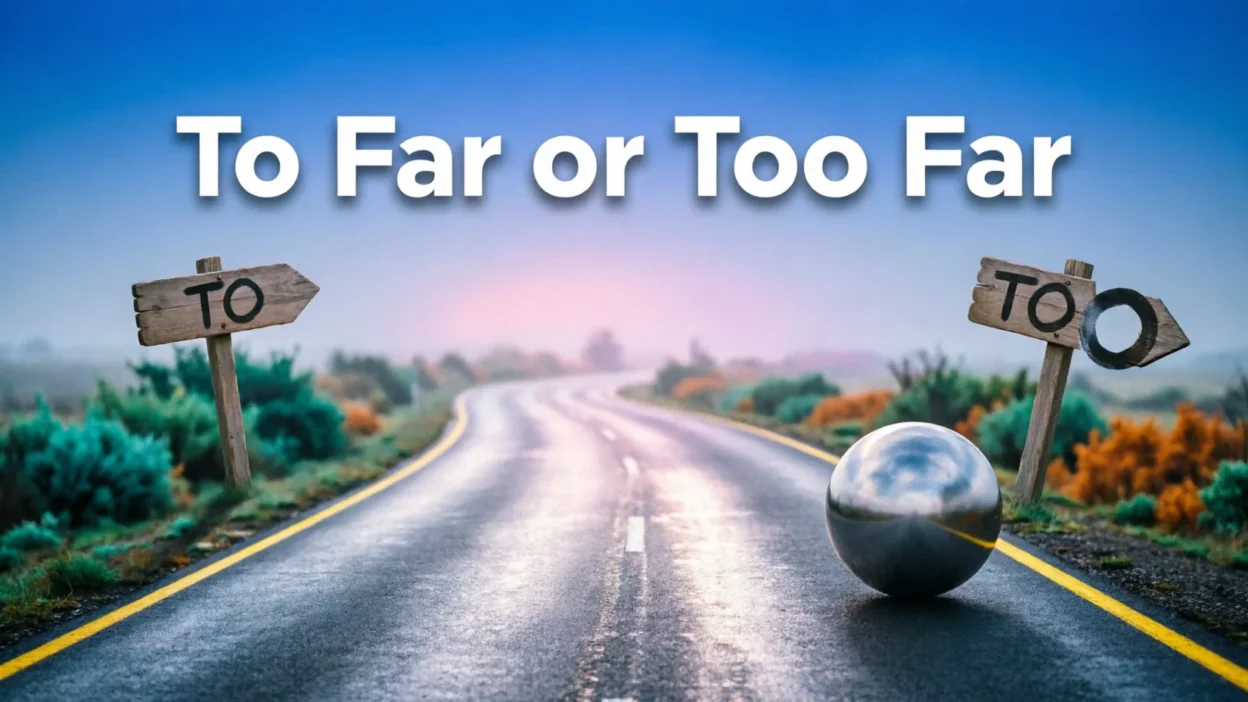
“To far” and “too far” sound almost identical, but only one is normally correct when you mean “more than is acceptable” or “at an excessive distance.”
The correct phrase is too far. Here, too means “more than necessary, desirable, or acceptable,” while far describes distance.
The word to has different jobs in English. It commonly works as a preposition, as in “go to school,” or as part of an infinitive, as in “to study.”
It does not normally mean “excessively.”
This small spelling difference causes frequent mistakes because to and too are pronounced.similarly in many varieties of English.
Learning the meaning and function of each word makes the difference much easier to remember.
Quick Answer
Use too far when you mean “more distant than necessary,” “beyond an acceptable limit,” or “excessively far.” For example, “The store is too far from my house.” To far is incorrect when you mean excessive distance. However, to can correctly appear before another word, such as “I want to go to Far Hills.”
Why People Confuse It
People often confuse to and too because they have similar pronunciations. In fast speech, the difference can be difficult to notice, so learners may choose the spelling that comes to mind first.
There is also a useful grammatical distinction:
- to usually shows direction, destination, or an infinitive.
- too can mean “also” or “more than necessary.”
- far describes a large distance or an extent.
Therefore, when you want to say that something is excessively distant, you need too far.
For example:
The airport is too far from here.
This means the airport is farther away than is convenient or acceptable.
First Word: “To”
To is one of the most common words in English. It has several grammatical uses, but it does not mean “excessively.”
To for direction or destination
Use to when someone or something moves toward a place.
- We went to the market.
- She drove to work.
- He walked to the station.
To before a verb
To can also introduce an infinitive.
- I want to learn English.
- They decided to leave.
- She needs to study.
So, to is correct in sentences such as:
I want to go there.
But if you mean “excessively far,” the phrase is:
It is too far.
Second Word: “Too”
Too has two major meanings.
Too means “also”
- I am coming too.
- She likes coffee too.
- He wants to join us too.
Here, too means “also.”
Too means “more than necessary”
This is the meaning used in too far.
- The box is too heavy.
- The water is too hot.
- The music is too loud.
- The house is too far away.
In these examples, too suggests that something exceeds a desirable, practical, or acceptable limit.
To Far vs. Too Far: Comparison Table
| Expression | Correct? | Meaning | Example |
|---|---|---|---|
| to far | ❌ Usually incorrect for this meaning | Does not mean “excessively far” | The school is to far. ❌ |
| too far | ✅ Correct | More distant than necessary or acceptable | The school is too far. |
| to | ✅ Correct in other contexts | Direction, destination, or infinitive marker | We went to school. |
| too | ✅ Correct | Also; excessively | It is too far away. |
When to Use Each
Use “too far” when distance is excessive
Use too far when something is farther away than you want or can reasonably manage.
- The restaurant is too far to walk.
- Is the hotel too far from the airport?
- That village is too far away.
Use “to” for movement or an infinitive
Use to when indicating a destination:
- We are going to the city.
- She traveled to London.
Use to before a base-form verb:
- I want to go.
- He needs to leave.
Can “to” and “far” appear together?
Yes, but not normally as the phrase to far meaning “excessively far.”
For example:
We went to Far Hills.
Here, Far Hills is a place name, so to is correctly used before it.
You might also encounter unusual or specialized constructions where to and far occur next to each other, but that does not make to far a standard replacement for too far.
10+ Examples of “Too Far”
Here are practical examples showing how too far works in everyday English:
- The supermarket is too far from my house.
- Is the train station too far to walk?
- We drove too far and had to turn around.
- That hotel is too far from the city center.
- I think you went too far down the road.
- The beach is too far away for a quick visit.
- Don’t walk too far from the group.
- The school is not too far from here.
- We may have traveled too far north.
- The restaurant isn’t too far if we take a taxi.
- You’ve pushed the chair too far back.
- The deadline is too far away to worry about yet.
Notice that too far can describe physical distance:
The station is too far.
It can also describe movement beyond a suitable point:
You pushed the door too far.
And it can describe going beyond an acceptable limit in a figurative sense:
That joke went too far.
Common Mistakes
Mistake 1: Writing “to far”
Incorrect:
The airport is to far away.
Correct:
The airport is too far away.
Mistake 2: Thinking “too” always means “also”
Too has two common meanings. It can mean “also,” but it can also mean “more than necessary.”
- I want one too. = also
- This bag is too heavy. = excessively
Therefore:
The house is too far away.
Mistake 3: Choosing spelling based only on pronunciation
Because to and too can sound similar, listening alone may not help you choose the spelling. Think about the meaning instead.
Ask yourself:
Does “too” mean “more than necessary” here?
If yes, write too.
Mistake 4: Confusing “too far” with “so far”
These expressions have different meanings.
- too far = farther than acceptable or necessary
- so far = until now, or to such an extent/distance
For example:
The shop is too far to walk.
But:
So far, everything is going well.
Memory Trick
Remember:
Too = extra.
The word too contains an extra o. Think of the extra o as representing something extra.
- too expensive = more expensive than acceptable
- too difficult = more difficult than acceptable
- too late = later than acceptable
- too far = farther than acceptable
So if you mean “more than necessary,” choose too.
American vs British English
The spelling distinction between to and too is the same in American and British English.
Both varieties use:
The school is too far away.
The pronunciation can vary somewhat depending on the speaker and regional accent, but the standard spelling does not change.
There is also no American-versus-British spelling difference that makes to far correct for the meaning “excessively far.”
Similar Words
Several expressions are related to too far, but they do not always mean exactly the same thing.
Too far
Means beyond a desirable, practical, or acceptable distance or limit.
The office is too far away.
Very far
Means at a great distance, without necessarily saying that the distance is excessive.
The office is very far away.
So far
Usually means “until now.”
So far, we have completed three lessons.
It can also refer to a particular extent or distance:
Don’t go so far that you cannot see us.
Far too
Far too means “much too” or “excessively.”
The ticket is far too expensive.
The village is far too far away for a daily commute.
The second sentence is grammatically possible, but in ordinary writing, a more natural alternative might be:
The village is much too far away for a daily commute.
Too distant
Too distant is another way to express excessive distance.
The location is too distant for most visitors.
Final Verdict
If you mean “more distant than necessary or acceptable,” the correct expression is too far.
To far is not the standard phrase for this meaning.
Remember the key distinction:
- to = direction, destination, or infinitive marker
- too = also or more than necessary
- far = a large distance or extent
So write:
The store is too far away. ✅
Not:
The store is to far away. ❌
FAQs
Is “to far” grammatically correct?
Not when you mean “more distant than necessary.” The standard expression is too far. The word to has other grammatical functions, such as showing direction or introducing an infinitive.
Is it “too far” or “to far”?
It is too far when you mean that something is excessively distant.
The school is too far from my house.
What does “too far” mean?
Too far means farther than is desirable, necessary, practical, or acceptable.
The restaurant is too far to walk.
What is the difference between “too far” and “very far”?
Very far simply describes a large distance. Too far says that the distance is excessive for a particular purpose.
The city is very far away.
The city is too far away for a day trip.
Can “too far” be used figuratively?
Yes. Too far can describe behavior, ideas, actions, or situations that go beyond an acceptable limit.
You took the joke too far.
Is “too far away” correct?
Yes. Too far away is a common and natural expression.
The airport is too far away to walk.
Is “so far” the same as “too far”?
No. So far often means “until now,” while too far means beyond an acceptable or desired limit.
So far, the lesson has been easy.
The school is too far away.
Can I say “far too far”?
It is grammatically possible, but it can sound awkward because far too already means “much too.” In many situations, much too far is more natural.
The station is much too far to walk.
Remember This
Too far = farther than acceptable or necessary.
To = direction, destination, or infinitive marker.
If you are describing excessive distance, use too far.
Is it too far? ✅
Is it to far? ❌
Conclusion
The difference between to far and too far is simple once you focus on meaning. Too far is the correct expression when you mean that something is farther away than necessary, practical, desirable, or acceptable. The word too can express excess, while to has grammatical functions such as showing direction or introducing a verb.
When you are unsure, remember the extra o in too: think “extra.” If the distance is more than you want or need, use too far. With this simple rule and a few examples, you can avoid this common English spelling mistake confidently.