The word counter has several meanings in English, making it one of the most versatile words in the language.
It can mean to oppose or respond to something, a surface used for work or service, or a device that counts numbers or items.
Because of these different meanings, learning counter synonyms helps you choose the most accurate word for every situation.
If you’re a student, ESL learner, writer, or content creator, expanding your vocabulary with counter synonyms will improve your writing and speaking skills.
This guide explains the most useful alternatives in simple English, along with easy meanings, example sentences, and the best usage contexts.
What Does “Counter” Mean?
The meaning of counter depends on how it is used.
As a verb, it means to oppose, respond to, or act against something.
As a noun, it can mean:
- A flat surface in a store or kitchen.
- A device used to count.
- A piece used in board games.
Example Sentences
- She tried to counter the argument with facts.
- Please leave the package on the counter.
- The cashier stood behind the counter.
Tone and Usage Context
The word counter is commonly used in:
- Everyday conversations
- Business writing
- Debates
- Sports
- Politics
- Retail
- Kitchens
Why Learn Counter Synonyms?
Learning counter synonyms helps you:
- Improve your English vocabulary.
- Avoid repeating the same word.
- Write more naturally.
- Choose words that fit different situations.
- Understand books, news, and professional writing.
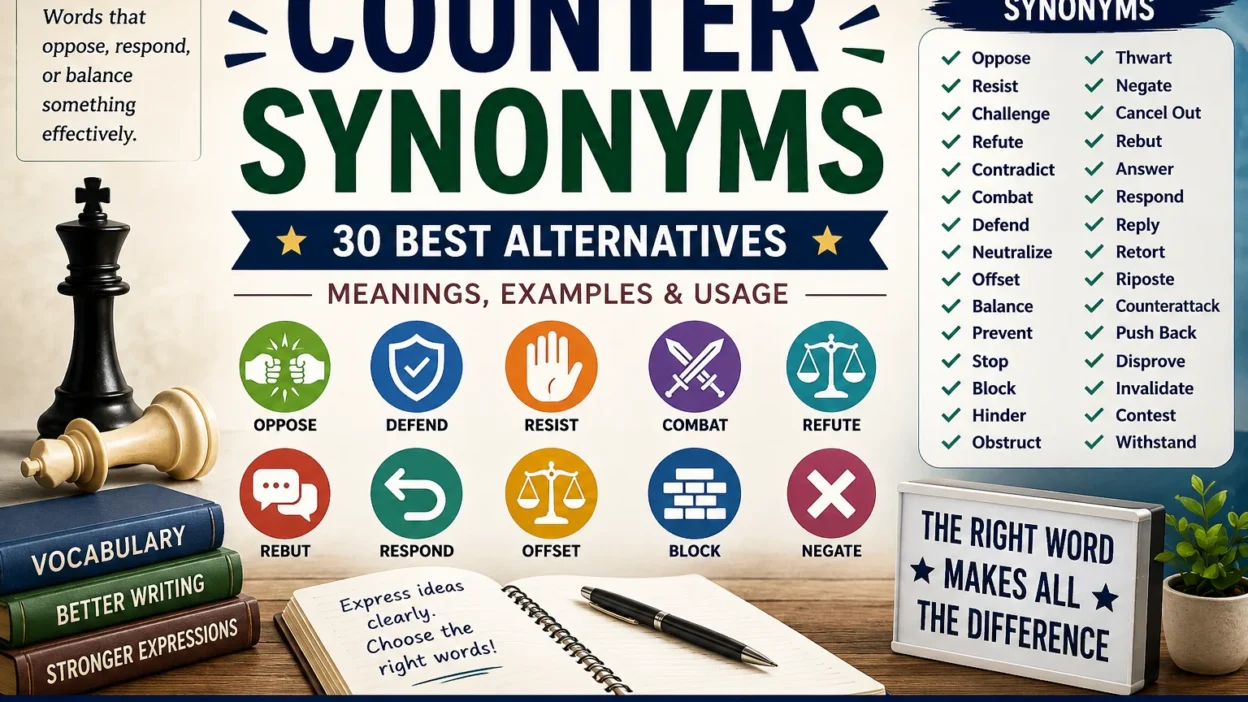
30 Counter Synonyms with Meanings, Examples, and Usage
1. Oppose
Meaning: To act against something.
Example: Many people opposed the proposal.
Best Usage: Arguments and debates.
2. Resist
Meaning: To refuse to accept or give in.
Example: She resisted the temptation.
Best Usage: Everyday and formal writing.
3. Challenge
Meaning: To question or compete against.
Example: He challenged the decision.
Best Usage: Academic and business writing.
4. Refute
Meaning: To prove something is false.
Example: Scientists refuted the claim.
Best Usage: Formal discussions.
5. Contradict
Meaning: To say the opposite.
Example: His statement contradicts the report.
Best Usage: Conversations and reports.
6. Combat
Meaning: To fight against something.
Example: The campaign combats pollution.
Best Usage: Health and environmental topics.
7. Defend
Meaning: To protect or support.
Example: She defended her opinion.
Best Usage: Legal and general writing.
8. Neutralize
Meaning: To make something ineffective.
Example: The medicine neutralized the poison.
Best Usage: Science and medicine.
9. Offset
Meaning: To balance the effect of something.
Example: Exercise offsets stress.
Best Usage: Finance and health.
10. Balance
Meaning: To keep things equal.
Example: Good planning balances risk.
Best Usage: General communication.
11. Prevent
Meaning: To stop something from happening.
Example: Vaccines help prevent disease.
Best Usage: Health and safety.
12. Stop
Meaning: To bring something to an end.
Example: Police stopped the fight.
Best Usage: Everyday English.
13. Block
Meaning: To prevent movement or progress.
Example: The fallen tree blocked the road.
Best Usage: Daily communication.
14. Hinder
Meaning: To make progress difficult.
Example: Bad weather hindered travel.
Best Usage: Formal writing.
15. Obstruct
Meaning: To block completely.
Example: Construction obstructed traffic.
Best Usage: Reports.
16. Thwart
Meaning: To prevent success.
Example: Police thwarted the robbery.
Best Usage: News and formal writing.
17. Negate
Meaning: To cancel the effect.
Example: His apology did not negate the damage.
Best Usage: Formal writing.
18. Cancel Out
Meaning: To remove the effect.
Example: The two forces cancel each other out.
Best Usage: Science and everyday English.
19. Rebut
Meaning: To argue against.
Example: The lawyer rebutted every accusation.
Best Usage: Legal writing.
20. Answer
Meaning: To respond.
Example: She answered every question confidently.
Best Usage: General communication.
21. Respond
Meaning: To reply or react.
Example: He responded calmly.
Best Usage: Everyday English.
22. Reply
Meaning: To give an answer.
Example: She replied politely.
Best Usage: Informal writing.
23. Retort
Meaning: To answer sharply.
Example: He retorted with a joke.
Best Usage: Conversations.
24. Riposte
Meaning: A quick, clever reply.
Example: Her riposte made everyone laugh.
Best Usage: Literary writing.
25. Counterattack
Meaning: To attack in response.
Example: The army launched a counterattack.
Best Usage: Military and sports.
26. Push Back
Meaning: To resist or oppose.
Example: Employees pushed back against the new rules.
Best Usage: Business and conversation.
27. Disprove
Meaning: To show something is false.
Example: New evidence disproved the theory.
Best Usage: Academic writing.
28. Invalidate
Meaning: To make something no longer valid.
Example: The judge invalidated the contract.
Best Usage: Legal writing.
29. Contest
Meaning: To argue against.
Example: They contested the election results.
Best Usage: Legal and political writing.
30. Withstand
Meaning: To resist successfully.
Example: The building withstood the storm.
Best Usage: Engineering and general writing.
Comparison Guide: When to Use Different Counter Synonyms
| Synonym | Best For | Tone |
|---|---|---|
| Oppose | General disagreement | Neutral |
| Resist | Fighting pressure | Neutral |
| Challenge | Questioning ideas | Professional |
| Refute | Proving false | Formal |
| Contradict | Opposite statements | Neutral |
| Combat | Fighting problems | Strong |
| Offset | Balancing effects | Neutral |
| Rebut | Legal arguments | Formal |
| Reply | Everyday responses | Casual |
| Retort | Sharp responses | Informal |
| Contest | Legal disputes | Formal |
| Withstand | Enduring challenges | Positive |
How to Choose the Right Counter Synonym
For Everyday Conversations
Choose:
- Oppose
- Stop
- Respond
- Reply
- Resist
These are simple and commonly understood.
For Formal Writing
Choose:
- Refute
- Rebut
- Negate
- Invalidate
- Contest
These work well in essays, reports, and legal documents.
For Academic Writing
Choose:
- Challenge
- Disprove
- Contradict
- Refute
- Offset
These are appropriate for research and analysis.
For Business and Professional Writing
Choose:
- Push Back
- Respond
- Balance
- Prevent
- Challenge
These fit workplace communication and reports.
Tips for Using Counter Synonyms Naturally
- Use oppose when disagreeing with an idea.
- Choose refute when proving something false.
- Use respond or reply for everyday communication.
- Select combat when discussing problems or threats.
- Match the synonym to the tone and context.
Common Mistakes to Avoid
- Confusing counter (oppose) with counter (table or surface).
- Using retort in formal academic writing.
- Replacing refute with oppose when evidence is required.
- Assuming every synonym has the same meaning.
Conclusion
Learning counter synonyms helps you express opposition, responses, prevention, and resistance more effectively. While counter is useful in many situations, alternatives such as oppose, resist, challenge, refute, combat, respond, and offset each provide a slightly different meaning and tone.
By choosing the right synonym for your context, you’ll improve your vocabulary, make your writing more engaging, and communicate with greater clarity.

Liam Henry is a content author at Synonymed, specializing in vocabulary enrichment and synonym guides. He creates clear, engaging resources that help learners improve English word knowledge and language fluency.