The English word complex is common in everyday conversations, academic writing, business communication, and creative content.
However, using the same word repeatedly can make your writing sound repetitive.
Learning different synonyms for complex helps you express ideas more clearly while making your vocabulary stronger.
Whether you are a student, an ESL learner, a writer, or a content creator, knowing the right alternative for complex allows you to match the tone and meaning of your sentence more accurately.
Some synonyms describe something difficult to understand, while others refer to something made up of many connected parts.
What Does “Complex” Mean?
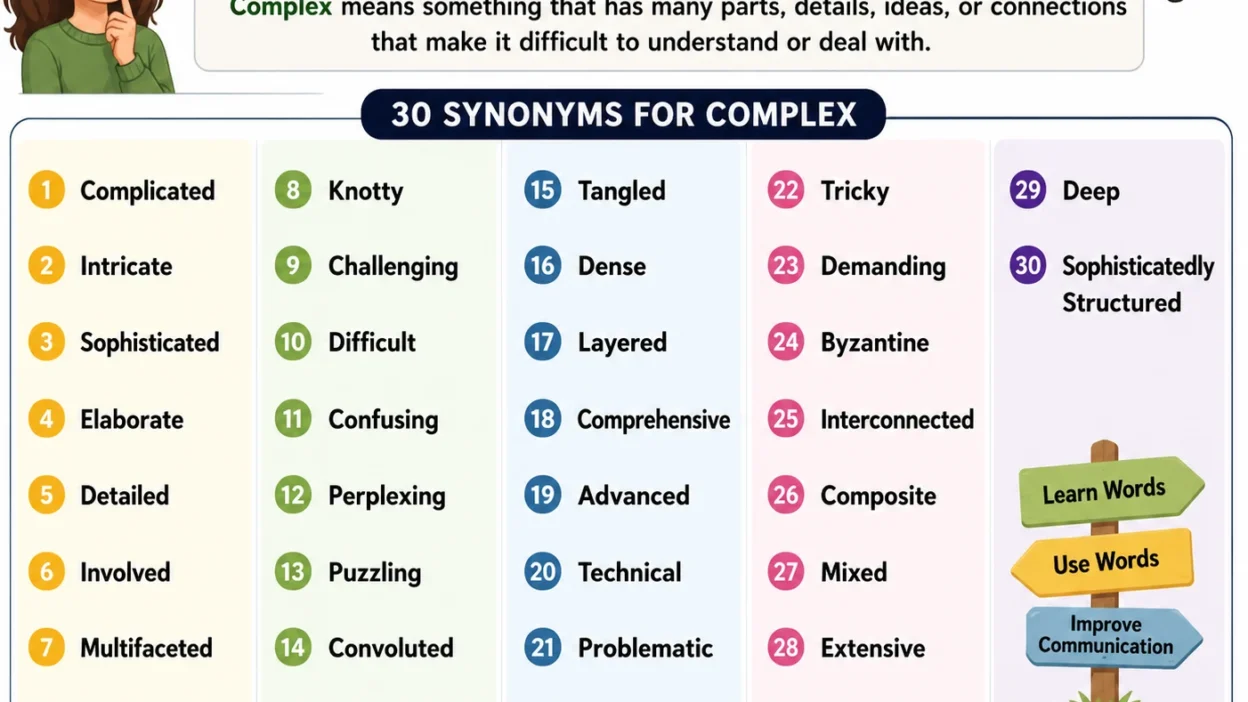
Complex means something that has many parts, details, or ideas that make it difficult to understand, explain, or solve.
It can describe a difficult problem, a detailed system, a complicated relationship, or even someone’s personality.
Example
- The instructions were complex, so I had to read them twice.
The word can be used in formal writing, everyday conversations, education, science, technology, and business.
30 Synonyms for Complex
1. Complicated
Meaning: Difficult because it has many parts or steps.
Example: The machine has a complicated design.
Best Usage Context: Everyday conversations and academic writing.
2. Intricate
Meaning: Having many small details that fit together carefully.
Example: The artist created an intricate pattern.
Best Usage Context: Art, design, architecture, and detailed descriptions.
3. Sophisticated
Meaning: Highly developed or advanced.
Example: The company uses sophisticated software.
Best Usage Context: Technology, education, and business.
4. Elaborate
Meaning: Carefully planned with many details.
Example: She prepared an elaborate presentation.
Best Usage Context: Formal writing and event planning.
5. Detailed
Meaning: Including a lot of information.
Example: The report provides a detailed explanation.
Best Usage Context: Reports, essays, and research.
6. Involved
Meaning: Difficult because many things are connected.
Example: It was an involved legal process.
Best Usage Context: Formal and professional writing.
7. Multifaceted
Meaning: Having many different parts or qualities.
Example: Leadership is a multifaceted skill.
Best Usage Context: Academic and professional writing.
8. Knotty
Meaning: Difficult to solve or understand.
Example: They discussed a knotty legal issue.
Best Usage Context: Formal discussions and problem-solving.
9. Challenging
Meaning: Difficult but possible to complete.
Example: Learning a new language is challenging.
Best Usage Context: Everyday speech and education.
10. Difficult
Meaning: Not easy to do or understand.
Example: This question is difficult.
Best Usage Context: General communication.
11. Confusing
Meaning: Hard to understand.
Example: The directions were confusing.
Best Usage Context: Everyday conversation.
12. Perplexing
Meaning: Causing confusion or uncertainty.
Example: His behavior was perplexing.
Best Usage Context: Formal and literary writing.
13. Puzzling
Meaning: Difficult to explain.
Example: The mystery remained puzzling.
Best Usage Context: Stories and conversations.
14. Convoluted
Meaning: Unnecessarily complicated.
Example: The contract contained convoluted language.
Best Usage Context: Business and legal writing.
15. Tangled
Meaning: Twisted together and difficult to separate.
Example: They faced a tangled financial situation.
Best UsageContext: Problems and relationships.
16. Dense
Meaning: Difficult because it contains a lot of information.
Example: The textbook is dense.
Best Usage Context: Academic writing.
17. Layered
Meaning: Having several levels of meaning.
Example: The novel has a layered storyline.
Best Usage Context: Literature and media.
18. Comprehensive
Meaning: Complete and covering many details.
Example: The guide is comprehensive.
Best Usage Context: Education and reports.
19. Advanced
Meaning: More developed than basic.
Example: She completed an advanced course.
Best Usage Context: Education and technology.
20. Technical
Meaning: Related to specialized knowledge.
Example: The manual uses technical language.
Best Usage Context: Engineering and science.
21. Problematic
Meaning: Causing difficulties.
Example: The proposal is problematic.
Best Usage Context: Formal discussions.
22. Tricky
Meaning: Slightly difficult.
Example: This puzzle is tricky.
Best Usage Context: Informal English.
23. Demanding
Meaning: Requiring a lot of effort.
Example: The project was demanding.
Best Usage Context: Work and education.
24. Byzantine
Meaning: Extremely complicated with many rules.
Example: The approval process was Byzantine.
Best Usage Context: Formal writing.
25. Interconnected
Meaning: Connected in many ways.
Example: Modern economies are interconnected.
Best Usage Context: Business and science.
26. Composite
Meaning: Made from several different parts.
Example: This material is a composite structure.
Best Usage Context: Engineering and design.
27. Mixed
Meaning: Made of different elements.
Example: The results showed mixed outcomes.
Best Usage Context: General writing.
28. Extensive
Meaning: Large and covering many areas.
Example: The research required extensive analysis.
Best Usage Context: Academic writing.
29. Deep
Meaning: Rich in meaning or thought.
Example: The discussion became deep and thoughtful.
Best Usage Context: Conversations and literature.
30. Sophisticatedly Structured
Meaning: Carefully organized with advanced design.
Example: The organization has a sophisticatedly structured system.
Best Usage Context: Business and technical writing.
Comparison Guide: When to Use Different Synonyms
| Synonym | Best For | Tone |
|---|---|---|
| Complicated | Everyday situations | Neutral |
| Intricate | Art and design | Descriptive |
| Sophisticated | Technology and business | Professional |
| Elaborate | Plans and presentations | Formal |
| Detailed | Reports and essays | Neutral |
| Challenging | Learning and work | Positive |
| Confusing | Daily conversations | Informal |
| Perplexing | Literature | Formal |
| Convoluted | Legal documents | Critical |
| Multifaceted | Academic writing | Professional |
How to Choose the Right Synonym
When Something Is Hard to Understand
Choose words like:
- Complicated
- Confusing
- Perplexing
- Puzzling
- Convoluted
These describe ideas, instructions, or situations that are difficult to understand.
When Something Has Many Parts
Use:
- Intricate
- Multifaceted
- Composite
- Layered
- Interconnected
These are ideal for describing systems, designs, organizations, and relationships.
For Academic or Professional Writing
Choose:
- Sophisticated
- Comprehensive
- Technical
- Elaborate
- Advanced
These words sound more formal and precise.
For Everyday Conversation
Use:
- Difficult
- Challenging
- Tricky
- Mixed
- Detailed
These are simple, natural, and easy for everyone to understand.
Why Learning Synonyms for Complex Matters
Using different words instead of repeating complex makes your writing more interesting and easier to read.
It also helps you communicate with greater accuracy because every synonym has a slightly different meaning.
For students, this improves essays and assignments. For ESL learners, it builds vocabulary and confidence.
For writers and content creators, it creates engaging content that sounds natural and professional.
Conclusion
Learning the best synonyms for complex helps you become a stronger communicator.
While complex is a useful word, alternatives like complicated, intricate, sophisticated, multifaceted, and challenging allow you to express different shades of meaning more effectively.
Remember that no synonym fits every situation.
Think about your audience, your tone, and what you want to describe before choosing the right word.
With regular practice, you’ll naturally use a wider vocabulary and produce clearer, more engaging writing.