Finding the right word can make your writing clearer, more natural, and more engaging. If you are looking for reluctance synonyms, you have come to the right place.
if you are a student, ESL learner, writer, or content creator, knowing different words for reluctance helps you express different levels of hesitation and unwillingness with greater accuracy.
The English language offers many alternatives to the word reluctance, but each synonym carries a slightly different meaning and tone.
Some describe mild hesitation, while others suggest fear, uncertainty, or even resistance. This guide explains each synonym in simple English with easy examples so you can confidently choose the best word for your writing.
What Does “Reluctance” Mean?
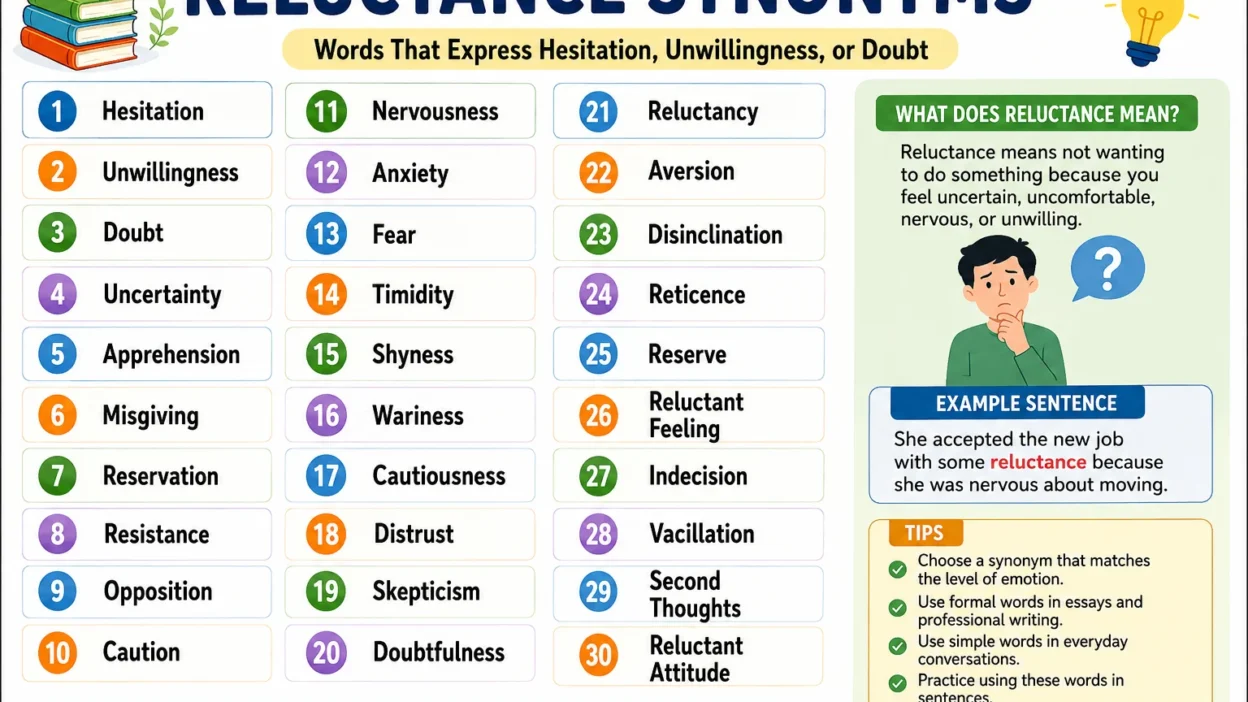
Reluctance means not wanting to do something because you feel uncertain, uncomfortable, nervous, or unwilling. It does not always mean refusing. Instead, it often describes hesitation before taking action.
Common Usage
People use reluctance when talking about:
- Hesitating before making a decision
- Feeling unsure about trying something new
- Being unwilling because of fear or doubt
- Showing resistance without completely refusing
Example:
She accepted the new job with some reluctance because she was nervous about moving.
30 Reluctance Synonyms with Meanings and Examples
1. Hesitation
Meaning: Taking time before acting because you are unsure.
Example: He answered the question without hesitation.
Best Usage: General conversations and writing.
2. Unwillingness
Meaning: Not wanting to do something.
Example: Her unwillingness to apologize caused more problems.
Best Usage: Formal and everyday situations.
3. Doubt
Meaning: Feeling uncertain about something.
Example: She expressed doubt about the plan.
Best Usage: Decisions and opinions.
4. Uncertainty
Meaning: Not being sure what will happen.
Example: There was uncertainty about the project’s future.
Best Usage: Business and academic writing.
5. Apprehension
Meaning: Worry about something that may happen.
Example: He felt apprehension before the interview.
Best Usage: Emotional situations.
6. Misgiving
Meaning: A feeling that something may not be right.
Example: She had misgivings about signing the contract.
Best Usage: Formal writing.
7. Reservation
Meaning: A feeling of doubt or concern.
Example: I have reservations about this idea.
Best Usage: Professional discussions.
8. Resistance
Meaning: Refusing or opposing something.
Example: The new rule faced resistance.
Best Usage: Social and political topics.
9. Opposition
Meaning: Active disagreement.
Example: There was strong opposition to the proposal.
Best Usage: Formal writing.
10. Caution
Meaning: Acting carefully to avoid problems.
Example: She approached the situation with caution.
Best Usage: Safety and advice.
11. Nervousness
Meaning: Feeling worried or anxious.
Example: His nervousness was easy to notice.
Best Usage: Emotional descriptions.
12. Anxiety
Meaning: Strong worry or fear.
Example: Travel caused her anxiety.
Best Usage: Emotional and medical contexts.
13. Fear
Meaning: Feeling afraid.
Example: Fear stopped him from speaking.
Best Usage: Strong emotional situations.
14. Timidity
Meaning: Lack of confidence.
Example: Timidity kept her from joining the discussion.
Best Usage: Personality descriptions.
15. Shyness
Meaning: Feeling uncomfortable around others.
Example: His shyness made introductions difficult.
Best Usage: Social situations.
16. Wariness
Meaning: Being careful because of possible danger.
Example: Travelers showed wariness toward strangers.
Best Usage: Safety discussions.
17. Cautiousness
Meaning: The habit of being careful.
Example: Her cautiousness prevented mistakes.
Best Usage: Advice and learning.
18. Distrust
Meaning: Not believing someone completely.
Example: Distrust damaged the friendship.
Best Usage: Relationships.
19. Skepticism
Meaning: Doubting whether something is true.
Example: Scientists greeted the claim with skepticism.
Best Usage: Academic writing.
20. Doubtfulness
Meaning: A state of uncertainty.
Example: His face showed doubtfulness.
Best Usage: Formal descriptions.
21. Reluctancy
Meaning: Another word for reluctance.
Example: She showed reluctancy before agreeing.
Best Usage: Less common writing.
22. Aversion
Meaning: A strong dislike.
Example: He has an aversion to public speaking.
Best Usage: Personal preferences.
23. Disinclination
Meaning: A lack of desire to do something.
Example: She showed a disinclination to argue.
Best Usage: Formal English.
24. Reticence
Meaning: Being quiet or unwilling to speak.
Example: His reticence surprised everyone.
Best Usage: Communication.
25. Reserve
Meaning: Being emotionally controlled or cautious.
Example: She spoke with reserve.
Best Usage: Personality traits.
26. Reluctant Feeling
Meaning: A feeling of hesitation.
Example: He had a reluctant feeling before leaving.
Best Usage: Informal writing.
27. Indecision
Meaning: Difficulty making a choice.
Example: Her indecision delayed the meeting.
Best Usage: Decision-making.
28. Vacillation
Meaning: Changing between different choices.
Example: His vacillation frustrated the team.
Best Usage: Formal writing.
29. Second Thoughts
Meaning: Doubts after making a decision.
Example: She had second thoughts about moving.
Best Usage: Everyday English.
30. Reluctant Attitude
Meaning: An unwilling or hesitant behavior.
Example: His reluctant attitude was obvious.
Best Usage: Informal descriptions.
Comparison Guide: When to Use Different Reluctance Synonyms
| Synonym | Best For | Tone |
|---|---|---|
| Hesitation | Everyday conversations | Neutral |
| Unwillingness | Formal writing | Neutral |
| Apprehension | Fear of future events | Emotional |
| Misgiving | Doubts | Formal |
| Reservation | Concerns | Professional |
| Resistance | Opposition | Strong |
| Caution | Carefulness | Positive |
| Anxiety | Emotional stress | Strong |
| Fear | Serious situations | Strong |
| Timidity | Lack of confidence | Gentle |
| Wariness | Possible danger | Neutral |
| Skepticism | Questioning facts | Academic |
| Aversion | Strong dislike | Strong |
| Disinclination | Formal unwillingness | Formal |
| Reticence | Quiet hesitation | Formal |
| Indecision | Difficulty choosing | Neutral |
| Vacillation | Repeated changing of mind | Formal |
| Second Thoughts | Everyday doubt | Informal |
How to Choose the Right Synonym
For Everyday Conversations
Choose simple words that are easy to understand:
- Hesitation
- Doubt
- Uncertainty
- Second Thoughts
- Caution
For Formal Writing
Use professional vocabulary such as:
- Misgiving
- Reservation
- Disinclination
- Reticence
- Vacillation
- Skepticism
For Emotional Situations
These words describe feelings:
- Anxiety
- Fear
- Nervousness
- Apprehension
- Timidity
For Strong Opposition
When someone actively does not want something:
- Resistance
- Opposition
- Aversion
- Distrust
For Decision-Making
These words work well when discussing choices:
- Hesitation
- Indecision
- Doubt
- Uncertainty
- Vacillation
Tips for Using Reluctance Synonyms Correctly
- Pick a synonym that matches the level of emotion.
- Use formal words in essays, reports, and professional writing.
- Choose simple words like hesitation or doubt for everyday conversations.
- Read example sentences to understand the natural context.
- Avoid using difficult words if your audience includes beginners or ESL learners.
Conclusion
Learning reluctance synonyms helps you communicate more clearly and naturally. While all of these words relate to hesitation or unwillingness, each has its own meaning and best situation for use. Some describe simple uncertainty, while others express fear, caution, resistance, or emotional discomfort.
By understanding these differences, you can improve your vocabulary, write with greater confidence, and choose the most accurate word for every situation.
Practice using these synonyms in your own sentences, and they will quickly become a natural part of your English vocabulary.