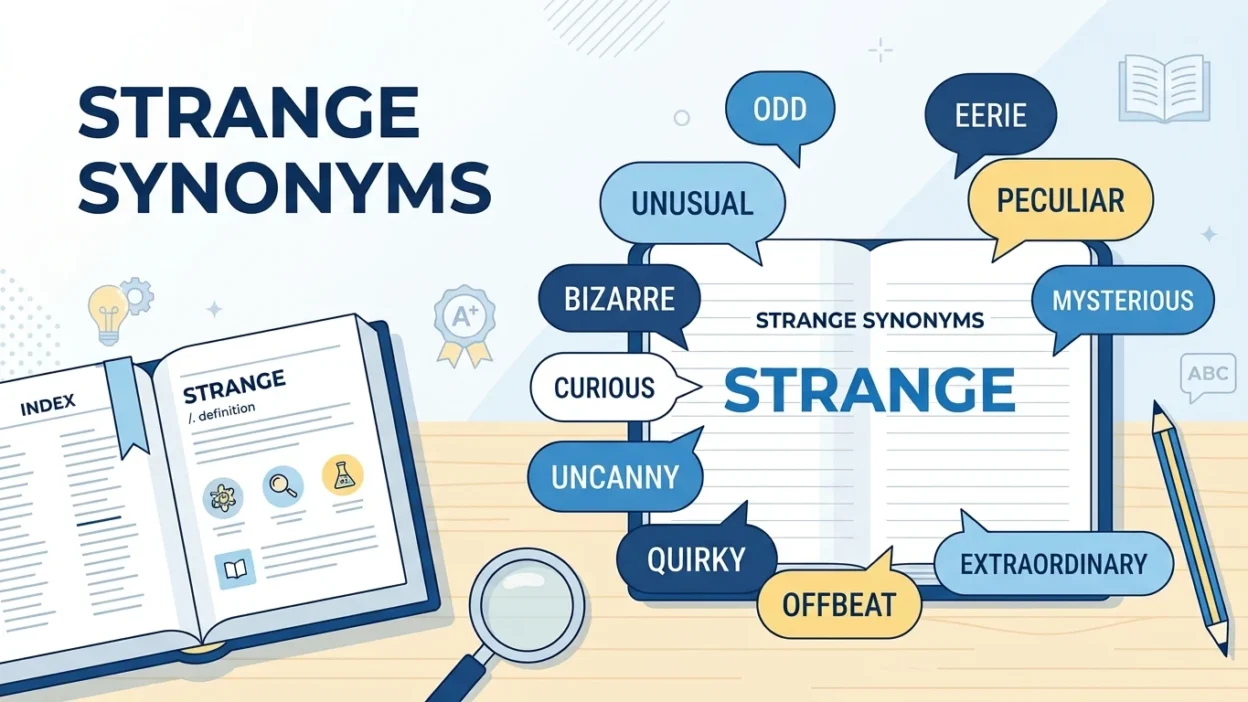
The English language offers many ways to express the idea of something being strange.
Learning strange synonyms helps you communicate more clearly, improve your writing, and choose the perfect word for different situations.
If you are a student, an ESL learner, a writer, or a content creator, expanding your vocabulary makes your communication more interesting and precise.
Not every synonym for strange means exactly the same thing. Some describe something mysterious, while others suggest something unusual, unexpected, or even frightening.
Understanding these subtle differences helps you sound more natural and confident in both speaking and writing.
What Does “Strange” Mean?
Simple Meaning
The word strange describes something that is unusual, unfamiliar, unexpected, or difficult to understand. It can refer to people, places, events, behaviors, sounds, or situations that seem different from what we normally expect.
Tone and Usage
The word strange is neutral in most situations. Depending on the context, it may express:
- Surprise
- Curiosity
- Confusion
- Mystery
- Discomfort
- Unfamiliarity
Examples:
- That was a strange noise coming from the attic.
- She gave me a strange look.
- It feels strange to be back after so many years.
30 Strange Synonyms with Meanings, Examples, and Usage
1. Odd
Meaning: Different from what is normal.
Example: His behavior seemed odd during the meeting.
Best Usage: Everyday conversations and casual writing.
2. Unusual
Meaning: Not common or ordinary.
Example: It is unusual to see snow here in summer.
Best Usage: General writing and formal situations.
3. Weird
Meaning: Very strange or surprising.
Example: That movie had a weird ending.
Best Usage: Informal conversations.
4. Peculiar
Meaning: Strange in an interesting or noticeable way.
Example: She has a peculiar habit of talking to plants.
Best Usage: Formal and descriptive writing.
5. Bizarre
Meaning: Extremely unusual or shocking.
Example: The news reported a bizarre accident.
Best Usage: News, storytelling, and dramatic writing.
6. Curious
Meaning: Unusual enough to attract attention.
Example: It was a curious coincidence.
Best Usage: Literature and formal writing.
7. Unfamiliar
Meaning: Not known or recognized.
Example: I heard an unfamiliar voice outside.
Best Usage: Describing new experiences.
8. Mysterious
Meaning: Difficult to explain or understand.
Example: A mysterious figure appeared in the fog.
Best Usage: Stories and suspense writing.
9. Eerie
Meaning: Strange in a frightening way.
Example: The abandoned house felt eerie.
Best Usage: Horror and mystery content.
10. Uncanny
Meaning: Strange because it seems impossible or supernatural.
Example: They had an uncanny resemblance.
Best Usage: Fiction and advanced writing.
11. Queer
Meaning: Strange or unusual (traditional meaning).
Example: There was a queer sound in the hallway.
Best Usage: Classic literature only.
12. Abnormal
Meaning: Different from what is considered normal.
Example: The doctor noticed abnormal results.
Best Usage: Medical and scientific writing.
13. Extraordinary
Meaning: Very unusual and remarkable.
Example: She showed extraordinary talent.
Best Usage: Positive formal writing.
14. Exceptional
Meaning: Better or more unusual than average.
Example: He has exceptional skills.
Best Usage: Professional and academic writing.
15. Rare
Meaning: Not often seen or found.
Example: This bird is extremely rare.
Best Usage: Nature, science, and general writing.
16. Singular
Meaning: Unique or unlike anything else.
Example: His singular style impressed everyone.
Best Usage: Formal writing.
17. Fantastic
Meaning: So unusual that it seems unreal.
Example: The story contains fantastic creatures.
Best Usage: Fantasy writing.
18. Fantastic-looking
Meaning: Appearing unusual or imaginative.
Example: The costume looked fantastic.
Best Usage: Creative descriptions.
19. Outlandish
Meaning: Very strange and difficult to believe.
Example: His outlandish ideas shocked everyone.
Best Usage: Opinions and storytelling.
20. Exotic
Meaning: Unusual because it comes from another place.
Example: They enjoyed exotic fruits.
Best Usage: Travel and culture writing.
21. Foreign
Meaning: Coming from another country or unfamiliar place.
Example: The language sounded foreign.
Best Usage: Geography and travel.
22. Unexpected
Meaning: Happening without warning.
Example: We received unexpected visitors.
Best Usage: Everyday writing.
23. Surprising
Meaning: Causing surprise.
Example: Her answer was surprising.
Best Usage: General communication.
24. Astonishing
Meaning: Extremely surprising.
Example: The magician performed astonishing tricks.
Best Usage: Dramatic descriptions.
25. Remarkable
Meaning: Worth noticing because it is unusual.
Example: Her progress was remarkable.
Best Usage: Academic and business writing.
26. Curious-looking
Meaning: Appearing unusual.
Example: The old machine looked curious.
Best Usage: Descriptive writing.
27. Funny
Meaning: Strange in an unexpected way.
Example: Something feels funny about this plan.
Best Usage: Informal English.
28. Offbeat
Meaning: Unusual but interesting.
Example: He enjoys offbeat music.
Best Usage: Entertainment and lifestyle writing.
29. Quirky
Meaning: Pleasantly unusual.
Example: She has a quirky personality.
Best Usage: Personality descriptions.
30. Uncommon
Meaning: Not frequently seen.
Example: Such talent is uncommon.
Best Usage: Formal and academic writing.
Comparison Guide: When to Use Different Strange Synonyms
Quick Comparison Table
| Synonym | Strength | Best Used For |
|---|---|---|
| Odd | Mild | Everyday conversation |
| Unusual | Neutral | General writing |
| Weird | Informal | Casual speech |
| Peculiar | Formal | Professional writing |
| Bizarre | Strong | News and storytelling |
| Mysterious | Medium | Mystery stories |
| Eerie | Strong | Horror content |
| Uncanny | Strong | Fiction and unusual events |
| Quirky | Positive | Personalities |
| Offbeat | Positive | Creative topics |
| Rare | Neutral | Science and nature |
| Extraordinary | Positive | Achievements |
How to Choose the Right Synonym
For Everyday Conversations
Choose words like:
- Odd
- Weird
- Unusual
- Funny
These sound natural in daily English.
For Formal Writing
Use:
- Peculiar
- Exceptional
- Extraordinary
- Uncommon
- Remarkable
These words work well in essays, reports, and professional communication.
For Mystery or Horror
The best choices are:
- Mysterious
- Eerie
- Uncanny
- Bizarre
These create suspense and mystery.
For Positive Descriptions
Use:
- Extraordinary
- Exceptional
- Quirky
- Remarkable
- Rare
These usually have a positive meaning.
For Creative Writing
Good options include:
- Outlandish
- Fantastic
- Curious
- Exotic
- Offbeat
These make stories and descriptions more vivid.
Why Learning Strange Synonyms Matters
Building your vocabulary helps you:
- Avoid repeating the same word.
- Write more naturally.
- Improve essays and assignments.
- Speak with greater confidence.
- Create engaging blog posts and articles.
- Choose words that match the exact meaning you want.
Instead of always saying strange, you can select a synonym that better fits the situation and tone.
Common Mistakes to Avoid
Don’t Use “Weird” in Formal Writing
“Weird” is common in conversation but may sound too casual in academic or professional writing.
Know the Tone
Some words like eerie suggest fear, while quirky often has a positive feeling. Always choose a synonym that matches your intended meaning.
Consider Your Audience
Students, professionals, and casual readers may interpret certain words differently. Pick the synonym that best fits your audience and purpose.
Conclusion
Learning strange synonyms is an excellent way to improve your English vocabulary and become a more confident speaker and writer. While all these words share the basic idea of something being unusual, each has its own tone, level of formality, and specific meaning.
If you’re writing an essay, creating content, telling a story, or simply expanding your vocabulary, choosing the right synonym helps your message become clearer and more engaging. Practice using these words in different contexts, and you’ll soon find your writing more varied, expressive, and natural.