Have you ever wanted to describe something that made you feel embarrassed, awkward, or uncomfortable, but didn’t want to repeat the word cringe every time?
Learning different cringe synonyms can make your writing, conversations, and social media posts much more interesting and accurate.
if you are a student, an ESL learner, a writer, or a content creator, understanding the subtle differences between similar words helps you express yourself more naturally.
Some synonyms describe embarrassment, while others suggest awkwardness, poor taste, or even secondhand shame.
This guide explains each one in simple English with clear examples.
What Does “Cringe” Mean?
The word cringe means to feel embarrassed, uncomfortable, or awkward because of someone’s actions, words, or behavior. Sometimes you cringe because of something you did yourself. Other times, you feel embarrassed for someone else.
Example:
Everyone cringed when he told an inappropriate joke during the meeting.
Today, the word is also widely used online to describe content, behavior, or situations that feel awkward, forced, or embarrassing.
Why Learn Cringe Synonyms?
Using different words instead of repeating cringe helps you:
- Improve your English vocabulary
- Write more naturally
- Choose the right tone for different situations
- Avoid repeating the same word
- Better express emotions and reactions
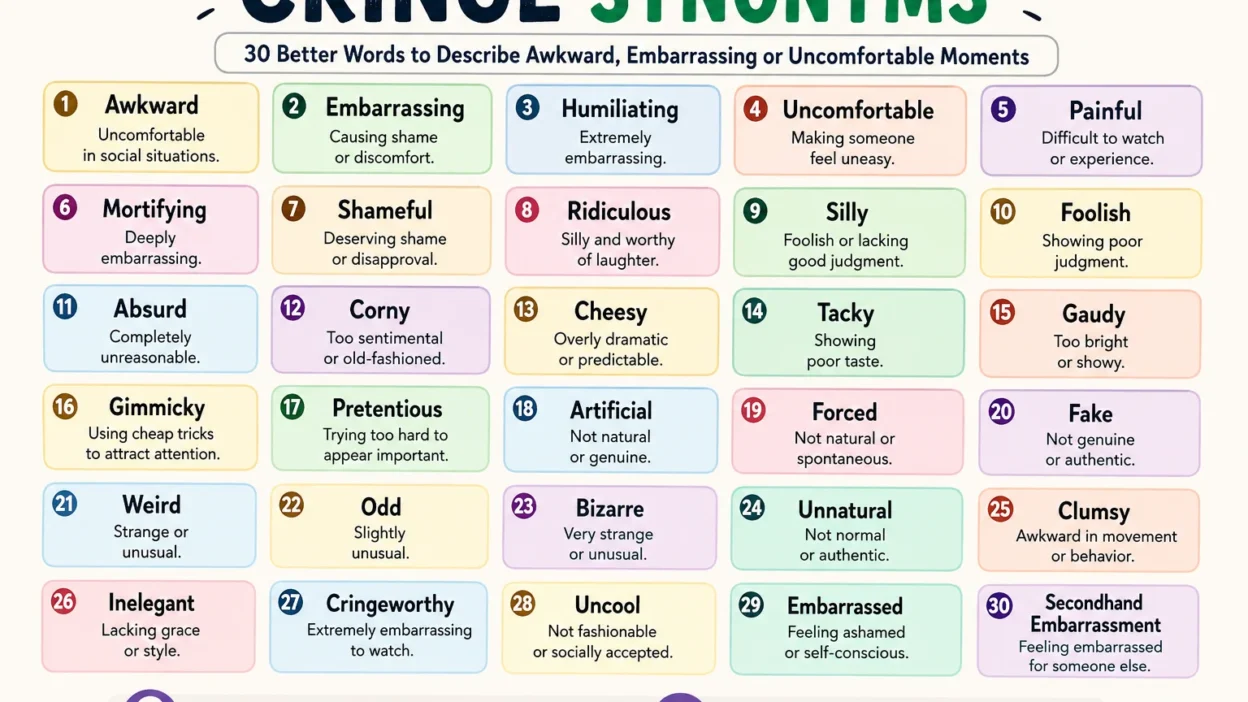
30 Cringe Synonyms with Meanings and Examples
1. Awkward
Meaning: Something that feels uncomfortable or socially difficult.
Example: The conversation became awkward after nobody laughed.
Best Usage Context: Social situations and conversations.
2. Embarrassing
Meaning: Causing shame or discomfort.
Example: Forgetting my speech was embarrassing.
Best Usage Context: Personal mistakes and public situations.
3. Humiliating
Meaning: Extremely embarrassing.
Example: Losing in front of everyone was humiliating.
Best Usage Context: Strong emotional embarrassment.
4. Uncomfortable
Meaning: Making someone feel uneasy.
Example: His rude comments made everyone uncomfortable.
Best Usage Context: General emotional discomfort.
5. Painful
Meaning: Difficult to watch because it is embarrassing.
Example: The interview was painful to watch.
Best Usage Context: Watching awkward moments.
6. Mortifying
Meaning: Deeply embarrassing.
Example: Calling the teacher “Mom” was mortifying.
Best Usage Context: Serious personal embarrassment.
7. Shameful
Meaning: Deserving shame or disapproval.
Example: His dishonest behavior was shameful.
Best Usage Context: Moral or ethical situations.
8. Ridiculous
Meaning: Silly in a way that invites laughter.
Example: That excuse sounded ridiculous.
Best Usage Context: Poor ideas or actions.
9. Silly
Meaning: Foolish or lacking good judgment.
Example: It was a silly mistake.
Best Usage Context: Light-hearted criticism.
10. Foolish
Meaning: Showing poor judgment.
Example: It was foolish to ignore the warning.
Best Usage Context: Decisions and actions.
11. Absurd
Meaning: Completely unreasonable or illogical.
Example: The excuse sounded absurd.
Best Usage Context: Extreme situations.
12. Corny
Meaning: Too sentimental or old-fashioned.
Example: That romantic line was corny.
Best Usage Context: Jokes, movies, and pickup lines.
13. Cheesy
Meaning: Overly dramatic or predictable.
Example: The ending was cheesy.
Best Usage Context: Entertainment and romance.
14. Tacky
Meaning: Showing poor taste.
Example: The decorations looked tacky.
Best Usage Context: Fashion and design.
15. Gaudy
Meaning: Too bright or showy.
Example: She wore a gaudy necklace.
Best Usage Context: Clothing and decoration.
16. Gimmicky
Meaning: Using cheap tricks to attract attention.
Example: The advertisement felt gimmicky.
Best Usage Context: Marketing and products.
17. Pretentious
Meaning: Trying too hard to appear important.
Example: His speech sounded pretentious.
Best Usage Context: People and writing.
18. Artificial
Meaning: Not natural or genuine.
Example: Her smile looked artificial.
Best Usage Context: Behavior and emotions.
19. Forced
Meaning: Not natural or spontaneous.
Example: The joke felt forced.
Best Usage Context: Humor and conversations.
20. Fake
Meaning: Not genuine or authentic.
Example: His apology seemed fake.
Best Usage Context: Personality and emotions.
21. Weird
Meaning: Strange or unusual.
Example: That was a weird comment.
Best Usage Context: Everyday conversations.
22. Odd
Meaning: Slightly unusual.
Example: His behavior seemed odd.
Best Usage Context: Mildly unusual situations.
23. Bizarre
Meaning: Very strange.
Example: The video had a bizarre ending.
Best Usage Context: Unusual events.
24. Unnatural
Meaning: Not normal or authentic.
Example: The acting felt unnatural.
Best Usage Context: Performances.
25. Clumsy
Meaning: Awkward in movement or behavior.
Example: His introduction was clumsy.
Best Usage Context: Physical or social awkwardness.
26. Inelegant
Meaning: Lacking grace or style.
Example: It was an inelegant solution.
Best Usage Context: Writing and design.
27. Cringeworthy
Meaning: Extremely embarrassing to watch.
Example: The performance was cringeworthy.
Best Usage Context: Internet content and videos.
28. Uncool
Meaning: Not fashionable or socially accepted.
Example: That joke was uncool.
Best Usage Context: Informal conversations.
29. Embarrassed
Meaning: Feeling ashamed or self-conscious.
Example: She looked embarrassed after falling.
Best Usage Context: Describing emotions.
30. Secondhand Embarrassment
Meaning: Feeling embarrassed for someone else.
Example: I felt secondhand embarrassment during the speech.
Best Usage Context: Watching awkward situations.
Comparison Guide: When to Use Different Cringe Synonyms
| Synonym | Best For | Tone |
|---|---|---|
| Awkward | Social situations | Neutral |
| Embarrassing | Personal mistakes | Common |
| Humiliating | Serious embarrassment | Strong |
| Mortifying | Extreme embarrassment | Very Strong |
| Corny | Old-fashioned humor | Casual |
| Cheesy | Romance and movies | Casual |
| Tacky | Fashion and decoration | Critical |
| Pretentious | People acting superior | Formal |
| Forced | Unnatural jokes | Neutral |
| Fake | Insincere behavior | Informal |
| Weird | Strange situations | Everyday |
| Cringeworthy | Online content | Modern |
How to Choose the Right Synonym
For Everyday Conversations
Choose:
- Awkward
- Weird
- Embarrassing
- Silly
These words are easy to understand and work in most situations.
For Social Media
Choose:
- Cringeworthy
- Corny
- Cheesy
- Uncool
These words match modern online conversations.
For Academic or Professional Writing
Choose:
- Pretentious
- Artificial
- Inelegant
- Uncomfortable
These sound more formal and appropriate.
For Strong Emotional Reactions
Choose:
- Humiliating
- Mortifying
- Shameful
- Painful
These express intense embarrassment or discomfort.
For Creative Writing
Choose:
- Absurd
- Bizarre
- Clumsy
- Forced
These create vivid descriptions and add variety.
Common Mistakes When Using Cringe Synonyms
- Don’t use humiliating when a situation is only slightly embarrassing.
- Don’t confuse cheesy with tacky. Cheesy often refers to romance or entertainment, while tacky usually refers to poor taste.
- Remember that awkward describes discomfort, not necessarily embarrassment.
- Use cringeworthy mainly in informal writing and online discussions.
Quick Tips for Expanding Your Vocabulary
- Learn words in groups based on meaning.
- Read books, blogs, and news articles regularly.
- Practice writing example sentences.
- Listen to native English speakers.
- Replace repeated words with suitable synonyms when editing your work.
Conclusion
Learning cringe synonyms helps you communicate with greater precision and confidence.
While cringe is a popular word for describing embarrassment or awkwardness, many alternatives offer more specific meanings and tones. Words like awkward, embarrassing, corny, pretentious, and cringeworthy each fit different situations.
By understanding when and how to use these synonyms, you can improve your vocabulary, make your writing more engaging, and express ideas more naturally.
if you’re writing essays, creating content, or simply improving your English, choosing the right synonym will make your communication clearer and more effective.