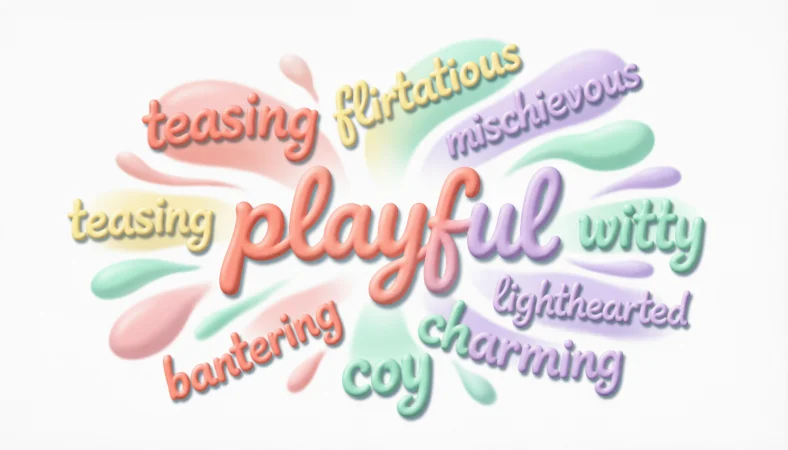
When someone makes a playful tease, they usually say something light, funny, or slightly mischievous without seriously trying to hurt another person.
It can be a friendly joke between friends, a witty comment, or a gentle way of teasing someone you know well.
Understanding playful tease synonyms is useful because not every form of teasing has the same feeling. Some words sound warm and friendly, while others can suggest sarcasm, criticism, flirting, or unkind behavior.
Choosing the right word helps students, ESL learners, writers, and content creators communicate the exact tone they want.
What Does “Playful Tease” Mean?
Simple Meaning
A playful tease is a lighthearted comment or joke made to amuse someone, get a reaction, or create friendly interaction. The speaker normally does not intend serious harm.
For example:
“You finally arrived! We were about to send a search party for you.”
This could be a playful tease if the speaker is joking with a friend who is only a few minutes late.
Tone and Usage
The meaning of a tease depends heavily on tone, relationship, and situation. A phrase that sounds funny between close friends may sound rude when said to a stranger.
Common situations include:
- Friendly conversations
- Joking between friends
- Light romantic or flirtatious exchanges
- Humorous writing
- Social media captions
- Dialogue in stories
- Casual workplace conversations, when appropriate
The safest synonyms are words such as banter, joke, jest, rib, and good-natured teasing when the intention is clearly friendly.
30 Playful Tease Synonyms
1. Banter
Meaning: Friendly and playful conversation that often includes teasing.
Example sentence:
“Alex and Mia exchanged playful banter during lunch.”
Best usage context: Use banter for friendly back-and-forth teasing, especially between people who know each other well.
2. Joke
Meaning: Something said or done to make people laugh.
Example sentence:
“He was only joking when he called her the queen of late arrivals.”
Best usage context: A very common and easy word for casual situations.
3. Jest
Meaning: A playful or humorous remark that is not meant seriously.
Example sentence:
“In jest, Daniel said he deserved a medal for finishing his homework.”
Best usage context: Slightly more formal than “joke”; useful in writing.
4. Tease
Meaning: To make fun of someone in a light or playful way.
Example sentence:
“My brother likes to tease me about my love of old movies.”
Best usage context: The most direct choice when someone is playfully making fun of another person.
5. Rib
Meaning: To tease someone in a friendly way.
Example sentence:
“His friends always rib him about his enormous collection of sneakers.”
Best usage context: Informal English, especially American English.
6. Kid
Meaning: To joke with someone or tell them something untrue for fun.
Example sentence:
“I’m just kidding—you don’t really have to clean the whole house.”
Best usage context: Very common in everyday spoken English.
7. Chaff
Meaning: To tease or joke with someone in a lighthearted way.
Example sentence:
“The two teammates often chaffed each other before a match.”
Best usage context: More common in British or Australian English and less familiar to beginners.
8. Poke Fun At
Meaning: To make humorous comments about someone or something.
Example sentence:
“They like to poke fun at each other’s cooking mistakes.”
Best usage context: Friendly humor when the subject is not being seriously attacked.
9. Make Fun Of
Meaning: To laugh at or joke about someone or something.
Example sentence:
“Her friends made fun of her funny dance moves.”
Best usage context: Common and easy to understand, but it can sound unkind depending on context.
10. Ribbing
Meaning: Friendly teasing or joking.
Example sentence:
“There was plenty of good-natured ribbing after the team lost the game.”
Best usage context: Informal conversations and descriptions of group humor.
11. Playful Mockery
Meaning: Pretending to criticize or imitate someone for humorous effect.
Example sentence:
“His playful mockery of the professor’s dramatic gestures made everyone laugh.”
Best usage context: Useful when the teasing involves imitation or exaggerated criticism.
12. Witty Teasing
Meaning: Teasing that uses clever, quick, or amusing language.
Example sentence:
“Her witty teasing made the conversation more entertaining.”
Best usage context: Good for describing clever verbal humor.
13. Good-Natured Teasing
Meaning: Friendly teasing that is not intended to cause harm.
Example sentence:
“The cousins exchanged good-natured teasing throughout the evening.”
Best usage context: One of the safest choices when you want to clearly show that the teasing is friendly.
14. Lighthearted Teasing
Meaning: Teasing that is cheerful, relaxed, and not serious.
Example sentence:
“His lighthearted teasing helped everyone relax.”
Best usage context: Excellent for positive or gentle situations.
15. Friendly Jibe
Meaning: A small, humorous criticism or teasing remark.
Example sentence:
“She made a friendly jibe about his habit of checking the clock.”
Best usage context: Useful in writing when the remark has a slightly sharper edge but remains friendly.
16. Jibe
Meaning: A mocking or teasing remark.
Example sentence:
“He responded to his friend’s jibe with a smile.”
Best usage context: Use carefully because “jibe” can sometimes sound more critical than playful.
17. Jestful Remark
Meaning: A comment made humorously rather than seriously.
Example sentence:
“Her jestful remark made the serious meeting feel less tense.”
Best usage context: Suitable for descriptive or formal writing.
18. Quip
Meaning: A short, clever, and often funny comment.
Example sentence:
“Tom made a quick quip about his terrible sense of direction.”
Best usage context: Best when the teasing is brief and clever.
19. Wisecrack
Meaning: A funny or sarcastic comment, often made quickly.
Example sentence:
“Her wisecrack about the broken printer made her coworkers laugh.”
Best usage context: Informal situations where the humor may have a slightly sarcastic edge.
20. Taunt
Meaning: To deliberately provoke or annoy someone with mocking words.
Example sentence:
“The players exchanged harmless taunts during the friendly competition.”
Best usage context: Use with caution. Taunt often sounds more aggressive than a playful tease.
21. Needle
Meaning: To annoy or tease someone repeatedly, usually in a playful or provocative way.
Example sentence:
“His teammates liked to needle him about his obsession with winning.”
Best usage context: Informal English; can suggest persistent teasing.
22. Chide
Meaning: To gently criticize or scold someone, sometimes in a playful way.
Example sentence:
“She chided her friend for forgetting their coffee date.”
Best usage context: Better for gentle criticism than pure joking.
23. Tease Lightly
Meaning: To joke about someone without serious criticism or hostility.
Example sentence:
“He lightly teased his sister about her huge collection of notebooks.”
Best usage context: A clear phrase when you want to emphasize a gentle tone.
24. Flirt
Meaning: To behave playfully toward someone to show romantic or personal interest.
Example sentence:
“She smiled and flirted playfully with him during the conversation.”
Best usage context: Use when teasing has a romantic or attractive quality.
25. Flirtatious Teasing
Meaning: Playful teasing that suggests romantic interest.
Example sentence:
“Their flirtatious teasing made it clear that they enjoyed each other’s company.”
Best usage context: Dating, romance, and light social interactions.
26. Playful Needling
Meaning: Repeatedly teasing someone in a humorous way.
Example sentence:
“His playful needling about her favorite team never bothered her.”
Best usage context: Good for describing ongoing teasing between familiar people.
27. Satirical Teasing
Meaning: Humor that exaggerates or criticizes something for comic effect.
Example sentence:
“The article used satirical teasing to comment on modern office culture.”
Best usage context: Writing, media, commentary, and social criticism.
28. Sarcasm
Meaning: Saying something that often means the opposite of the literal words, usually for humor or criticism.
Example sentence:
“With a smile, she used sarcasm to tease her friend about his messy desk.”
Best usage context: Use when the humor depends on irony or an obvious contrast between words and meaning.
29. Mocking
Meaning: Making someone or something seem funny by imitating or criticizing it.
Example sentence:
“His mocking imitation was meant as a joke among close friends.”
Best usage context: Use carefully because “mocking” can easily sound insulting.
30. Playful Poking
Meaning: Light teasing intended to get a reaction or make someone laugh.
Example sentence:
“Her playful poking about his favorite snack made him laugh.”
Best usage context: Informal and conversational; especially useful for casual writing.
Comparing Playful Tease Synonyms
Quick Comparison Guide
| Synonym | Tone | Typical Meaning | Best For |
|---|---|---|---|
| Banter | Friendly | Back-and-forth teasing | Friends and casual conversation |
| Joke | Neutral/Friendly | Humor not meant seriously | Everyday English |
| Jest | Light/Formal | A humorous remark | Writing and formal contexts |
| Rib | Friendly | Friendly teasing | Informal conversation |
| Kid | Very casual | Joke with someone | Spoken English |
| Quip | Clever | Short witty comment | Writing and dialogue |
| Jibe | Slightly sharp | Teasing criticism | Informal writing |
| Poke fun at | Casual | Make humorous comments | Everyday situations |
| Good-natured teasing | Warm | Clearly friendly teasing | Positive descriptions |
| Lighthearted teasing | Gentle | Cheerful teasing | Friendly situations |
| Wisecrack | Sarcastic | Quick funny remark | Casual humor |
| Needle | Provocative | Repeated teasing | Close relationships |
| Chide | Gentle | Mild criticism | Friendly correction |
| Flirtatious teasing | Romantic | Teasing with attraction | Dating and romance |
| Sarcasm | Sharp/Ironic | Humor through indirect meaning | Humor and commentary |
| Taunt | Aggressive | Provoking someone | Competitive situations |
| Mocking | Risky | Imitating or ridiculing | Stronger humor or criticism |
How to Choose the Right Synonym
For Friendly and Warm Teasing
Choose banter, good-natured teasing, lighthearted teasing, rib, or joke when you want the interaction to sound friendly.
These words work especially well when both people are comfortable with the humor.
For Casual Everyday English
Choose kid, tease, rib, poke fun at, or joke.
These are easy to understand and sound natural in everyday conversations.
For Clever or Witty Humor
Choose quip, wisecrack, witty teasing, or jest.
These words work well when the speaker uses clever language rather than simply making fun of someone.
For Gentle Criticism
Choose chide, jibe, or playful needling when the teasing includes a small amount of criticism.
Be aware that these words can become negative if the speaker’s intention is hostile.
For Romantic or Flirtatious Situations
Choose flirt, flirtatious teasing, or another phrase that clearly suggests romantic interest.
For example, “They exchanged flirtatious teasing” tells the reader that the interaction has a romantic tone.
For Sarcastic or Sharper Humor
Choose sarcasm, wisecrack, mocking, taunt, or jibe when the humor is more pointed.
These words require more care because they can imply that someone is being rude, critical, or deliberately provocative.
Playful Tease Synonyms for Different Writing Situations
For Essays and Academic Writing
Use words such as jest, witty remark, playful mockery, or good-natured teasing when you need a more descriptive style.
Avoid very casual expressions such as “kid” unless you are discussing spoken language.
For Fiction and Dialogue
Banter, tease, rib, quip, wisecrack, and jibe can make dialogue feel natural.
The best choice depends on the character. A friendly character might use banter, while a sarcastic character might use wisecracks.
For Social Media Content
Words such as banter, playful teasing, joking, and lighthearted teasing are usually easy for audiences to understand.
They also make the intended tone clearer when written humor could otherwise be misunderstood.
For ESL Learners
Start with the most common words:
- Joke
- Tease
- Kid
- Banter
- Make fun of
- Poke fun at
- Rib
- Jest
Once these are comfortable, learn more nuanced words such as jibe, quip, needle, chide, and wisecrack.
Playful Teasing vs. Hurtful Teasing
The Main Difference
The most important difference is intention and effect.
A playful tease usually creates laughter, connection, or friendly interaction. Hurtful teasing is intended to embarrass, insult, intimidate, or upset someone.
Compare these examples:
Playful:
“Look who finally remembered to bring an umbrella!”
Potentially hurtful:
“You always forget everything. You’re completely useless.”
The first comment can be friendly depending on the relationship and tone. The second attacks the person’s character.
Why Context Matters
Words do not always have one fixed emotional meaning. For example, mocking, taunting, sarcasm, and making fun of can be playful among close friends but offensive in another setting.
When in doubt, choose a phrase that clearly communicates friendliness, such as good-natured teasing or lighthearted banter.
Common Questions About Playful Tease Synonyms
What is the closest synonym for “playful tease”?
Banter is one of the closest choices when the teasing is friendly and conversational. Joke, rib, kid, and good-natured teasing can also work depending on the sentence.
Is “banter” always positive?
No. Banter usually suggests friendly interaction, but its effect depends on the people involved and the subject of the joke.
What is a formal synonym for playful tease?
Jest or jestful remark can work in more formal writing. Good-natured teasing is also clear and neutral.
What is a synonym for playful teasing between friends?
Good choices include banter, ribbing, joking, kidding, good-natured teasing, and lighthearted teasing.
Is “taunt” a synonym for playful tease?
Sometimes, but it is not usually the safest choice. Taunt often suggests deliberate provocation and can sound hostile.
What is the difference between teasing and banter?
Teasing usually focuses on joking about a person, while banter often describes a back-and-forth exchange of playful comments between people.
Final Takeaways
Choose the Word That Matches the Tone
There is no single perfect synonym for playful tease in every situation. Banter is excellent for friendly back-and-forth conversation, while joke is the simplest general choice. Rib and kid are natural in casual speech, while jest works better in formal or written contexts.
For clever humor, consider quip or wisecrack. For romantic situations, flirtatious teasing may be more precise.
Words such as sarcasm, mocking, and taunt should be used carefully because they can suggest a sharper or more negative tone.
The key is to think about intention, relationship, audience, and emotional tone before choosing a synonym.
When you select the word that matches the situation, your English becomes clearer, more natural, and more expressive.