
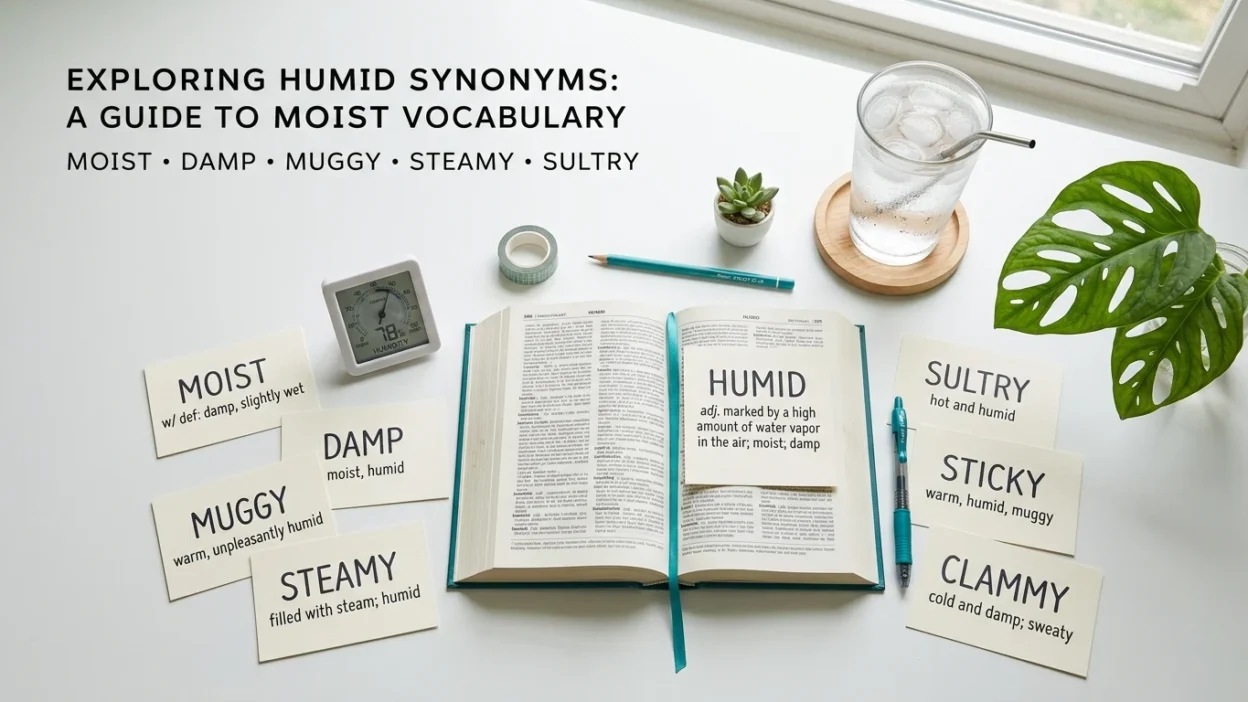
Learning humid synonyms is a great way to improve your English vocabulary and make your writing more interesting. Whether you are a student, an ESL learner, a writer, or a content creator, knowing different words related to humid helps you describe weather, air, climates, and environments more accurately.
Although the word humid is common, it is not always the best choice in every situation. Some alternatives describe sticky weather, while others refer to moisture, dampness, or tropical conditions. This guide explains these words in simple English with easy examples and practical usage tips.
What Does “Humid” Mean?
Humid means that the air contains a lot of water vapor or moisture. Humid weather often feels warm, sticky, and uncomfortable because the moisture in the air slows down the evaporation of sweat.
The word humid is commonly used in:
- Weather reports
- Geography
- Climate studies
- Travel writing
- Daily conversations
- Science
Depending on the situation, different synonyms may describe the feeling of moisture more accurately than simply saying “humid.
30 Humid Synonyms with Meanings, Examples, and Usage
1. Damp
Meaning: Slightly wet or moist.
Example: The walls felt damp after the rain.
Best Usage: Light moisture.
2. Moist
Meaning: Slightly wet but not soaked.
Example: The soil remained moist all day.
Best Usage: Gardening and nature.
3. Muggy
Meaning: Warm, humid, and uncomfortable.
Example: It was a muggy summer afternoon.
Best Usage: Weather descriptions.
4. Sticky
Meaning: Feeling uncomfortable because of humidity.
Example: The air felt sticky after sunset.
Best Usage: Casual conversation.
5. Sultry
Meaning: Hot and humid in an uncomfortable way.
Example: The city experienced a sultry evening.
Best Usage: Formal weather writing.
6. Clammy
Meaning: Unpleasantly damp or moist.
Example: My hands became clammy before the exam.
Best Usage: Feelings and body conditions.
7. Wet
Meaning: Covered with water or moisture.
Example: The grass stayed wet until noon.
Best Usage: General situations.
8. Dewy
Meaning: Covered with tiny drops of moisture.
Example: The flowers looked dewy in the morning.
Best Usage: Nature writing.
9. Rainy
Meaning: Having frequent rainfall.
Example: The rainy season lasts several months.
Best Usage: Climate descriptions.
10. Waterlogged
Meaning: Filled with too much water.
Example: The fields became waterlogged after the storm.
Best Usage: Agriculture.
11. Soggy
Meaning: Very wet and soft.
Example: The bread became soggy.
Best Usage: Food and objects.
12. Saturated
Meaning: Completely filled with moisture.
Example: The ground was saturated after days of rain.
Best Usage: Scientific writing.
13. Moisture-Laden
Meaning: Containing a large amount of moisture.
Example: Moisture-laden air moved inland.
Best Usage: Weather reports.
14. Tropical
Meaning: Having the warm, humid climate of tropical regions.
Example: Tropical weather is common near the equator.
Best Usage: Climate discussions.
15. Steamy
Meaning: Hot with noticeable moisture.
Example: The greenhouse felt steamy.
Best Usage: Indoor humidity.
16. Close
Meaning: Warm with little fresh air.
Example: The room felt close and uncomfortable.
Best Usage: British English.
17. Heavy
Meaning: Thick and moisture-filled air.
Example: The air felt heavy before the storm.
Best Usage: Everyday speech.
18. Oppressive
Meaning: Extremely hot and humid.
Example: The oppressive heat kept everyone indoors.
Best Usage: Extreme weather.
19. Sweltering
Meaning: Extremely hot, often with humidity.
Example: It was a sweltering afternoon.
Best Usage: Summer weather.
20. Airless
Meaning: Lacking fresh airflow.
Example: The airless room became uncomfortable.
Best Usage: Indoor conditions.
21. Dripping
Meaning: Very wet or covered in moisture.
Example: The leaves were dripping after the rain.
Best Usage: Nature descriptions.
22. Misty
Meaning: Filled with fine water droplets.
Example: The hills looked misty at sunrise.
Best Usage: Scenic writing.
23. Foggy
Meaning: Covered with thick moisture in the air.
Example: It was a foggy morning.
Best Usage: Weather reports.
24. Cloudy
Meaning: Covered with clouds, often linked with humid conditions.
Example: Cloudy skies brought higher humidity.
Best Usage: Weather forecasts.
25. Choked
Meaning: Filled with thick, heavy air.
Example: The factory felt choked with humid air.
Best Usage: Descriptive writing.
26. Moisturized
Meaning: Made moist or hydrated.
Example: The skin remained moisturized.
Best Usage: Beauty and skincare.
27. Hydrated
Meaning: Containing enough water.
Example: The plants stayed hydrated during the rainy season.
Best Usage: Plants and health.
28. Rain-Soaked
Meaning: Completely wet from rain.
Example: The streets were rain-soaked.
Best Usage: Weather stories.
29. Condensed
Meaning: Moisture collected into water droplets.
Example: Water condensed on the cold glass.
Best Usage: Science.
30. Moisture-Rich
Meaning: Containing plenty of moisture.
Example: Moisture-rich air helps tropical forests grow.
Best Usage: Climate and environmental writing.
Comparison Guide: When to Use Different Humid Synonyms
| Synonym | Best Used For | Tone |
|---|---|---|
| Damp | Slight moisture | Neutral |
| Moist | Light wetness | Neutral |
| Muggy | Sticky weather | Everyday |
| Sultry | Hot, humid climate | Formal |
| Clammy | Unpleasant moisture | Descriptive |
| Steamy | Hot indoor humidity | Casual |
| Tropical | Warm climates | Informative |
| Saturated | Scientific writing | Technical |
| Oppressive | Extreme heat and humidity | Strong |
| Moisture-Laden | Weather reports | Formal |
How to Choose the Right Synonym
For Everyday Conversation
Use:
- Muggy
- Sticky
- Damp
- Heavy
- Steamy
These words are common and easy to understand.
For Academic Writing
Choose:
- Moisture-Laden
- Saturated
- Tropical
- Condensed
- Moisture-Rich
These fit science and geography topics.
For Creative Writing
Choose:
- Sultry
- Dewy
- Misty
- Clammy
- Oppressive
These words create vivid descriptions.
For Weather Reports
Choose:
- Humid
- Muggy
- Moisture-Laden
- Tropical
- Cloudy
These are clear and accurate for climate discussions.
For Nature Writing
Choose:
- Dewy
- Moist
- Rain-Soaked
- Misty
- Dripping
These words help describe landscapes and plants naturally.
Common Mistakes When Using Humid Synonyms
- Do not use wet when describing air unless you mean objects covered with water.
- Muggy describes uncomfortable humid weather, while moist usually refers to objects or surfaces.
- Sultry often suggests hot, humid weather and is more formal or literary.
- Saturated is best for scientific or technical contexts rather than casual conversation.
- Choose the synonym that best matches the amount of moisture and the situation.
Why Learning Humid Synonyms Is Useful
Knowing humid synonyms improves your vocabulary and helps you describe weather and environments more accurately. Students can write stronger essays, ESL learners can speak more naturally, and writers can avoid repeating the same word. Understanding these alternatives also makes reading books, weather reports, and travel articles much easier.
Conclusion
Learning humid synonyms gives you many useful ways to describe moisture in the air, weather conditions, and different environments. While words like muggy, damp, moist, sultry, and steamy are closely related, each has a slightly different meaning and purpose.
By choosing the right synonym for the right situation, your writing becomes clearer, richer, and more engaging. if you are studying English, creating content, or improving your vocabulary, these alternatives will help you communicate with confidence.