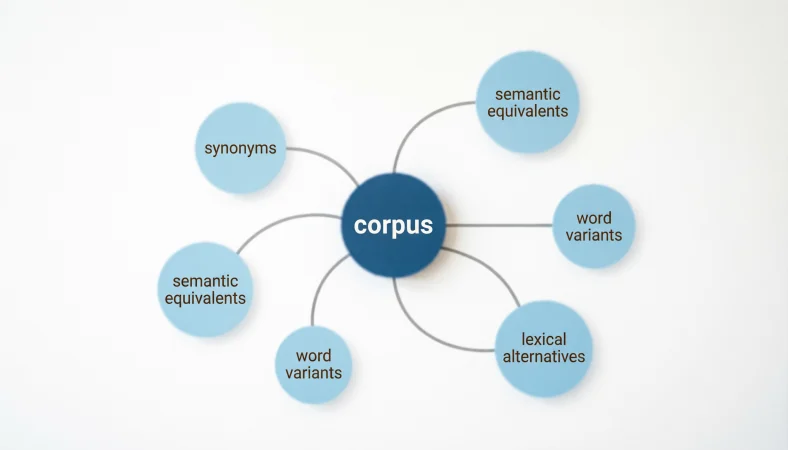
If you are looking for corpus synonyms, you may already know that the word corpus has a more specific meaning than ordinary words such as collection or group.
It is often used in linguistics, academic research, writing, and data analysis to describe a collected body of texts or other material.
Understanding the right synonym can make your writing clearer and more natural.
For students, ESL learners, writers, and content creators, knowing the difference between similar words helps you choose vocabulary that matches your meaning, audience, and tone.
In this guide, you will learn 30 useful corpus synonyms and related words, with simple meanings, example sentences, and notes about when each word works best.
What Does “Corpus” Mean?
Simple meaning of corpus
A corpus is a large, organized collection of written or spoken material used for study, research, or analysis.
In linguistics, a corpus usually contains examples of real language. Researchers can use it to study vocabulary, grammar, sentence patterns, word frequency, and how people actually use language.
Example:
The researchers examined a corpus of English newspaper articles.
The plural of corpus is commonly corpora.
Tone and usage context
Corpus is a formal and specialized word. It is especially common in:
- Linguistics
- Academic research
- Language learning
- Literature studies
- Data analysis
- Digital humanities
- Scholarly writing
In everyday English, words such as collection, archive, or database may sound more natural.
30 Corpus Synonyms and Related Words
1. Collection
Meaning: A group of things gathered together for a particular purpose.
Example:
The researcher created a collection of student essays.
Best usage context: General writing and everyday English. This is one of the safest alternatives to corpus.
2. Compilation
Meaning: A group of materials collected and arranged into one resource.
Example:
The book is a compilation of historical documents.
Best usage context: Formal writing when materials have been deliberately gathered together.
3. Body
Meaning: A large or organized amount of material considered as a whole.
Example:
The study examined a body of contemporary English texts.
Best usage context: Academic and formal writing, especially when discussing texts or research material.
4. Body of Texts
Meaning: A group of written texts considered together.
Example:
The researcher analyzed a body of texts from the nineteenth century.
Best usage context: Linguistics, literature, and academic research.
5. Text Collection
Meaning: A group of written texts gathered for study or reference.
Example:
The university developed a text collection for language researchers.
Best usage context: Linguistics and language-related writing.
6. Text Database
Meaning: An organized digital collection of texts that can be searched or analyzed.
Example:
Students used the text database to find examples of common phrases.
Best usage context: Digital research, computational linguistics, and online resources.
7. Database
Meaning: An organized collection of information stored electronically.
Example:
The researchers searched a database containing thousands of articles.
Best usage context: Technology and research. Use it when the collection is stored and organized digitally.
8. Repository
Meaning: A place or system where information, documents, or other materials are stored.
Example:
The university maintains a repository of academic papers.
Best usage context: Academic, technical, and digital contexts.
9. Archive
Meaning: A collection of historical or important records preserved for future use.
Example:
The archive contains letters written by local authors.
Best usage context: Historical documents, records, manuscripts, and preserved materials.
10. Dataset
Meaning: A structured collection of data used for analysis.
Example:
The researchers created a dataset from online conversations.
Best usage context: Data science, computational research, artificial intelligence, and quantitative studies.
11. Data Collection
Meaning: A group of information gathered for a particular study.
Example:
The language data collection included thousands of spoken sentences.
Best usage context: Research and academic writing.
12. Language Database
Meaning: An organized collection of language information or examples.
Example:
The language database contains examples from several English varieties.
Best usage context: Linguistics and language technology.
13. Textual Database
Meaning: A digital database containing written texts.
Example:
The scholar searched a textual database for examples of the phrase.
Best usage context: Formal linguistic and literary research.
14. Library
Meaning: A collection of books, documents, or information resources.
Example:
The digital library provides access to thousands of historical texts.
Best usage context: Books and broad information resources. It is related to corpus but is not always an exact replacement.
15. Anthology
Meaning: A collection of selected works, usually literary or artistic.
Example:
The anthology contains poems from twenty modern writers.
Best usage context: Literature, poetry, essays, and other selected creative works.
16. Compilation of Texts
Meaning: A group of texts gathered into one organized set.
Example:
The compilation of texts was used in a university research project.
Best usage context: Academic and formal writing.
17. Record
Meaning: A documented piece of information about an event, person, or subject.
Example:
The researchers examined the historical record to understand language change.
Best usage context: Historical and documentary contexts.
18. Documentation
Meaning: A collection of documents or written evidence about something.
Example:
The project includes documentation from several decades of research.
Best usage context: Professional, technical, academic, and historical writing.
19. Source Material
Meaning: Original material used to research, understand, or create something.
Example:
The letters provided valuable source material for the study.
Best usage context: Academic research, journalism, history, and content creation.
20. Reference Collection
Meaning: A group of materials kept for consultation or research.
Example:
The reference collection contains dictionaries and language guides.
Best usage context: Libraries, education, research, and academic settings.
21. Research Material
Meaning: Information or resources used to conduct research.
Example:
The interviews became important research material for the project.
Best usage context: General academic writing.
22. Sample
Meaning: A smaller group selected to represent a larger group.
Example:
The researchers studied a sample of online comments.
Best usage context: Research and statistics. Use this when the material represents a larger population rather than referring to the entire collection.
23. Pool
Meaning: A supply or group of resources gathered together.
Example:
The study used a large pool of language examples.
Best usage context: Less formal academic writing and general research descriptions.
24. Bank
Meaning: A large stored collection of information or resources.
Example:
The project uses a pronunciation bank containing thousands of recordings.
Best usage context: Language resources, educational materials, and specialized databases.
25. Inventory
Meaning: A complete or organized list or collection of items.
Example:
The researchers created an inventory of common expressions.
Best usage context: Organized lists or collections rather than a traditional linguistic corpus.
26. Catalog
Meaning: An organized list or record of items.
Example:
The online catalog includes thousands of historical documents.
Best usage context: Libraries, archives, museums, and organized information systems.
27. Store
Meaning: A place or system where information or materials are kept.
Example:
The website provides a large store of historical language data.
Best usage context: General or descriptive writing. It is usually less precise than corpus.
28. Resource Collection
Meaning: A group of useful materials gathered for a specific purpose.
Example:
The website offers a resource collection for English teachers.
Best usage context: Education, teaching, research, and content creation.
29. Body of Evidence
Meaning: A group of facts, documents, or observations supporting an idea or conclusion.
Example:
The researchers considered the body of evidence before reaching a conclusion.
Best usage context: Academic, scientific, legal, and analytical writing.
30. Body of Data
Meaning: A large amount of organized information considered together.
Example:
The study analyzed a body of data collected from online conversations.
Best usage context: Research, statistics, science, and data analysis.
Corpus Synonyms: Quick Comparison Guide
Not every synonym of corpus can replace it in every sentence. The best choice depends on what kind of material you are describing.
| Word | Best for | Formality | Exact replacement for “corpus”? |
|---|---|---|---|
| Collection | General groups of material | Neutral | Sometimes |
| Compilation | Gathered materials | Formal | Sometimes |
| Body | Texts or information as a whole | Formal | Often |
| Database | Digital information | Neutral/Formal | Sometimes |
| Repository | Stored academic or digital material | Formal | Sometimes |
| Archive | Preserved historical material | Formal | No |
| Dataset | Structured data | Formal/Technical | Sometimes |
| Text collection | Groups of texts | Formal | Often |
| Anthology | Selected literary works | Neutral/Formal | No |
| Sample | Representative portion | Academic | No |
| Source material | Original research material | Neutral/Formal | No |
| Language database | Language information | Technical | Often |
| Body of texts | Written material | Formal | Often |
The key point is simple: corpus is more specific than collection. A corpus normally refers to an organized body of material created or gathered for study and analysis.
How to Choose the Right Synonym
For general writing: collection or compilation
If your readers may not know the technical meaning of corpus, collection is usually the easiest choice.
Use compilation when you want to emphasize that different materials were gathered and combined.
Example:
The website contains a collection of historical speeches.
For academic writing: body or body of texts
In scholarly writing, body, body of texts, and body of data can sound natural and precise.
Example:
The researchers examined a body of texts written by university students.
These expressions are particularly useful when you want to avoid repeating corpus.
For digital resources: database or repository
Use database when the information is electronically stored and searchable.
Use repository when the main idea is storage and access to documents or research resources.
Example:
The research team uploaded the documents to an online repository.
For historical material: archive
Archive is the better word when documents have been preserved because they have historical, cultural, or research value.
Example:
The archive contains newspapers from the early twentieth century.
Do not automatically use archive for every corpus because a corpus does not have to be historical.
For data analysis: dataset
Use dataset when the material is structured as data for analysis.
Example:
The machine-learning model was trained using a large dataset.
A dataset may contain language, numbers, images, or other types of information, so it is broader than the linguistic meaning of corpus.
For literature: anthology
Use anthology when you are talking about a selected collection of literary works.
Example:
The anthology includes short stories by emerging writers.
An anthology is usually a curated selection, while a corpus is generally assembled for research or analysis.
Corpus vs. Collection
What is the difference?
A collection is a broad term for things gathered together.
A corpus is usually a more specialized and organized collection, especially one used for research.
Collection:
A collection of English books
Corpus:
A corpus of English books used to study vocabulary patterns
The second example gives the collection a research purpose.
Corpus vs. Database
Are corpus and database the same?
Not exactly.
A database describes how information is stored and organized. A corpus describes a body of material, particularly language material, collected for analysis.
A corpus can be stored in a database, but the two words do not always mean the same thing.
Corpus vs. Dataset
When should you use each word?
A dataset is usually a structured set of data used for analysis.
A corpus is often a collection of authentic language examples, such as books, articles, conversations, or transcripts.
For example:
The researchers created a dataset of customer reviews.
The linguists analyzed a corpus of customer reviews.
Both can be correct, but the emphasis is different.
Corpus vs. Archive
Which word is more accurate?
Use archive when preservation is the main idea.
Use corpus when analysis or study is the main idea.
For example, a collection of old newspapers preserved by a historical institution may be an archive. The same newspapers selected and organized for linguistic research may form a corpus.
Common Mistakes When Using Corpus Synonyms
Using “collection” in every situation
Although collection is a useful synonym, it is very general. It does not automatically communicate that the material is organized for research.
Calling every database a corpus
A database can contain almost any type of information. A corpus usually has a specific body of material, especially language data in linguistic research.
Using “archive” for modern research data
An archive usually suggests preservation. If you are describing a searchable set of modern research data, database, dataset, or corpus may be more appropriate.
Treating “sample” and “corpus” as identical
A sample is normally only part of a larger population. A corpus can be designed as a complete research collection rather than a small representative sample.
Why Understanding Corpus Synonyms Matters
Learning corpus synonyms is useful because good vocabulary is not simply about knowing more words. It is about knowing which word fits a particular situation.
For ESL learners, understanding these differences can make academic writing sound more natural.
For students, the right word can make research papers clearer.
For writers and content creators, varied vocabulary can prevent repetitive writing while keeping the intended meaning accurate.
For researchers, precise terminology is especially important because small differences in meaning can affect how readers understand a study.
Frequently Asked Questions About Corpus Synonyms
What is the closest synonym for corpus?
Collection is one of the closest general synonyms, while body of texts is often closer when referring specifically to language material.
What is another word for corpus in linguistics?
In linguistics, useful alternatives include text collection, body of texts, language database, and textual database. However, corpus remains the standard technical term.
Is “collection” the same as “corpus”?
Not always. A collection can be any group of gathered items, while a corpus generally has a specific research or analytical purpose.
What is the synonym of corpus in academic writing?
Depending on the context, body, body of texts, collection, dataset, repository, or compilation may work.
What is the plural of corpus?
The traditional plural is corpora. In some contexts, corpuses is also used, but corpora is especially common in academic and linguistic writing.
Final Takeaways
The word corpus refers to an organized body or collection of material, especially texts or spoken language gathered for research and analysis. While words such as collection, database, dataset, archive, and repository can sometimes replace it, each carries a slightly different meaning.
The best synonym depends on your purpose. Choose collection for simple general writing, body of texts for academic discussions, database for searchable digital information, archive for preserved historical material, and dataset for structured research data.
For ESL learners, students, writers, and content creators, learning these distinctions can lead to clearer, more natural, and more precise English. Instead of simply replacing one word with another, focus on the meaning and context you want to communicate.