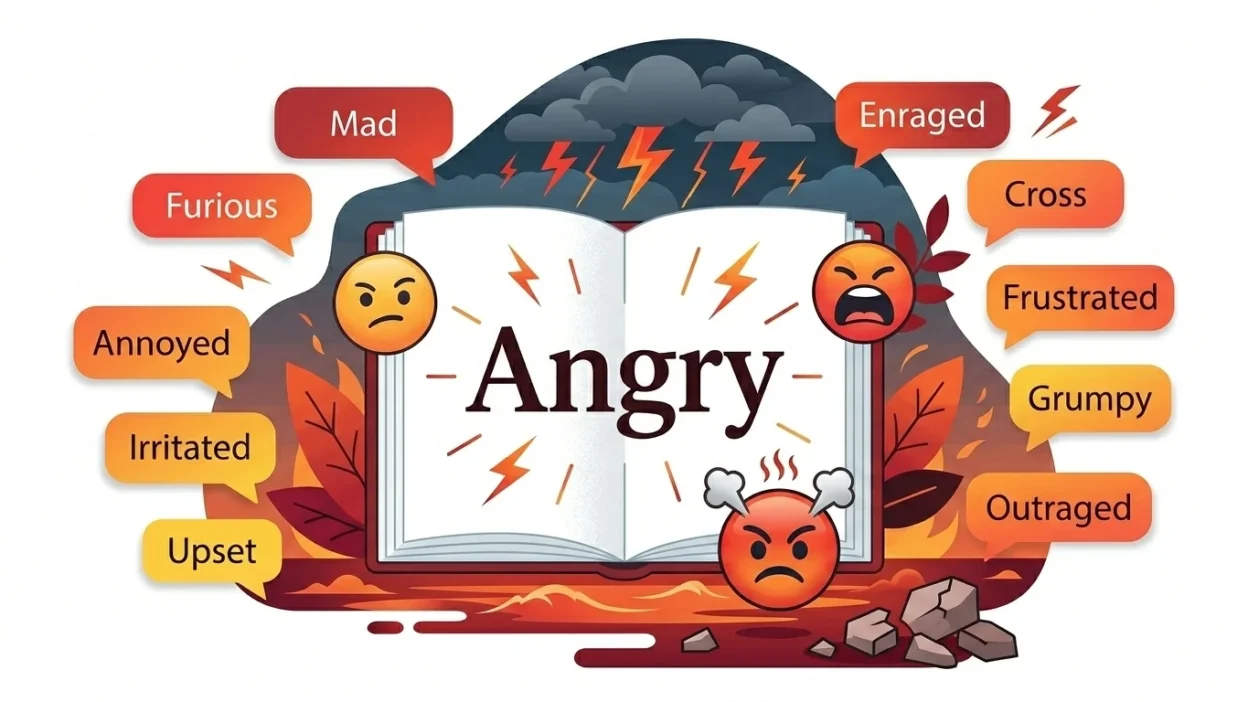
Learning different synonyms for angry is an excellent way to expand your English vocabulary and make your writing more expressive.
If you are a student, an ESL learner, a writer, or a content creator, understanding different words for angry helps you describe emotions more accurately.
The word angry is one of the most common ways to express feelings of displeasure or frustration.
However, English offers many alternatives that vary in strength, tone, and situation.
Some words describe mild irritation, while others express intense rage or deep resentment.
Knowing these differences helps you communicate naturally and choose the most suitable word for every context.
In this guide, you’ll explore 30 synonyms for angry, their meanings, example sentences, and the best situations to use each one. By the end of this article, you’ll have a stronger vocabulary and greater confidence in speaking and writing English.
What Does “Angry” Mean?
Meaning of Angry
The word angry means feeling strong displeasure, annoyance, or frustration because something has gone wrong or someone has behaved unfairly.
It can describe emotions ranging from mild irritation to intense fury.
For example:
- She became angry after hearing the bad news.
- The customer was angry about the delayed order.
- He tried to stay calm even though he felt angry.
The best synonym depends on how strong the emotion is and the situation in which it is used.
30 Synonyms for Angry
Complete List
- Mad
- Furious
- Annoyed
- Upset
- Irritated
- Enraged
- Cross
- Resentful
- Indignant
- Outraged
- Bitter
- Frustrated
- Agitated
- Exasperated
- Infuriated
- Heated
- Offended
- Displeased
- Hostile
- Wrathful
- Fuming
- Seething
- Vexed
- Irate
- Sore
- Riled
- Provoked
- Testy
- Cranky
- Grumpy
Individual Synonyms
Mad
Meaning: Very angry or upset.
Example Sentence: She was mad because someone damaged her bicycle.
Best Usage Context: Everyday conversation, especially in American English.
Furious
Meaning: Extremely angry.
Example Sentence: The coach was furious after the team ignored his instructions.
Best Usage Context: Strong emotions in speech and writing.
Annoyed
Meaning: Slightly angry because of something unpleasant.
Example Sentence: I felt annoyed by the constant noise.
Best Usage Context: Everyday situations and polite conversations.
Upset
Meaning: Feeling unhappy, disappointed, or slightly angry.
Example Sentence: He was upset after the argument.
Best Usage Context: Informal conversations and emotional situations.
Irritated
Meaning: Feeling mildly angry or bothered.
Example Sentence: She became irritated by the repeated interruptions.
Best Usage Context: Professional and everyday writing.
Enraged
Meaning: Filled with extreme anger.
Example Sentence: The unfair decision enraged the crowd.
Best Usage Context: News articles, storytelling, and formal writing.
Cross
Meaning: Slightly angry or annoyed.
Example Sentence: My teacher looked cross when the homework was missing.
Best Usage Context: British English.
Resentful
Meaning: Feeling anger because of unfair treatment.
Example Sentence: He became resentful after being ignored.
Best Usage Context: Emotional and relationship writing.
Indignant
Meaning: Angry because something is unfair or wrong.
Example Sentence: She felt indignant about the false accusation.
Best Usage Context: Formal writing and academic English.
Outraged
Meaning: Extremely shocked and angry.
Example Sentence: Citizens were outraged by the corruption scandal.
Best Usage Context: News, politics, and journalism.
Bitter
Meaning: Angry for a long time because of disappointment.
Example Sentence: He remained bitter after losing the competition.
Best Usage Context: Emotional storytelling.
Frustrated
Meaning: Angry because something is difficult or unsuccessful.
Example Sentence: She felt frustrated when the computer stopped working.
Best Usage Context: Everyday life, school, and work.
Agitated
Meaning: Nervous, upset, and slightly angry.
Example Sentence: The customer became agitated while waiting.
Best Usage Context: Professional and formal writing.
Exasperated
Meaning: Extremely annoyed after repeated problems.
Example Sentence: The parents were exasperated by the children’s behavior.
Best Usage Context: Books and formal English.
Infuriated
Meaning: Made extremely angry.
Example Sentence: The rude comment infuriated him.
Best Usage Context: Strong emotional situations.
Heated
Meaning: Filled with strong emotions and anger.
Example Sentence: They had a heated discussion about the issue.
Best Usage Context: Arguments and debates.
Offended
Meaning: Hurt or angry because of someone’s words or actions.
Example Sentence: She felt offended by the joke.
Best Usage Context: Social interactions.
Displeased
Meaning: Mildly unhappy or dissatisfied.
Example Sentence: The manager was displeased with the results.
Best Usage Context: Formal communication.
Hostile
Meaning: Showing anger and unfriendly behavior.
Example Sentence: The crowd became hostile during the protest.
Best Usage Context: News and conflict descriptions.
Wrathful
Meaning: Full of intense anger.
Example Sentence: The king gave a wrathful speech.
Best Usage Context: Literary and historical writing.
Fuming
Meaning: Extremely angry.
Example Sentence: She was fuming after the meeting.
Best Usage Context: Informal conversations.
Seething
Meaning: Quietly filled with intense anger.
Example Sentence: He sat quietly, seething with anger.
Best UsageContext: Storytelling and novels.
Vexed
Meaning: Annoyed or worried.
Example Sentence: She looked vexed by the unexpected delay.
Best Usage Context: Formal and literary writing.
Irate
Meaning: Very angry.
Example Sentence: The irate customer demanded a refund.
Best Usage Context: News and customer service.
Sore
Meaning: Upset or angry about something.
Example Sentence: He is still sore about losing the game.
Best Usage Context: Informal English.
Riled
Meaning: Made angry or excited.
Example Sentence: The unfair comment really riled him.
Best Usage Context: Casual conversations.
Provoked
Meaning: Caused to become angry.
Example Sentence: His rude behavior provoked the audience.
Best Usage Context: Discussions and storytelling.
Testy
Meaning: Easily annoyed or impatient.
Example Sentence: She sounded testy after a stressful day.
Best Usage Context: Personality descriptions.
Cranky
Meaning: Easily irritated, often because of tiredness.
Example Sentence: He becomes cranky when he doesn’t sleep well.
Best Usage Context: Informal conversations.
Grumpy
Meaning: Frequently bad-tempered or slightly angry.
Example Sentence: My grandfather gets grumpy when he’s hungry.
Best Usage Context: Everyday English.
Comparison Guide: When to Use Different Synonyms
| Synonym | Best Used For | Tone |
|---|---|---|
| Angry | General situations | Neutral |
| Mad | Everyday conversation | Informal |
| Furious | Extreme anger | Strong |
| Annoyed | Minor irritation | Neutral |
| Irritated | Repeated small problems | Professional |
| Frustrated | Difficulty or failure | Everyday |
| Outraged | Serious injustice | Formal |
| Indignant | Moral unfairness | Formal |
| Grumpy | Mood or personality | Casual |
| Hostile | Aggressive behavior | Serious |
How to Choose the Right Synonym
For Everyday Conversation
Use:
- Mad
- Annoyed
- Upset
- Irritated
- Grumpy
For Formal Writing
Use:
- Indignant
- Outraged
- Displeased
- Irate
- Hostile
For Strong Anger
Use:
- Furious
- Enraged
- Infuriated
- Wrathful
- Seething
For Mild Irritation
Use:
- Annoyed
- Irritated
- Cross
- Testy
- Vexed
For Emotional or Personal Situations
Use:
- Resentful
- Bitter
- Frustrated
- Offended
- Provoked
Conclusion
Learning different synonyms for angry helps you describe emotions more accurately and naturally.
Some words express mild annoyance, while others describe deep frustration or intense rage.
By understanding the meaning, tone, and best usage of each synonym, students, ESL learners, writers, and content creators can improve both spoken and written English while making their communication more expressive and precise

Liam Henry is a content author at Synonymed, specializing in vocabulary enrichment and synonym guides. He creates clear, engaging resources that help learners improve English word knowledge and language fluency.