When filling out a form, introducing yourself, or learning English, you may wonder whether surname, last name, and name mean the same thing.
These three expressions are closely related, and in many situations, they refer to the same part of a person’s name. However, their usage can vary depending on the country, culture, and naming system.
Understanding the difference can help you complete official documents correctly, communicate clearly, and avoid confusion when speaking or writing English.
Although the terms often describe the name shared with other family members, they are not always used in exactly the same every culture.
In this guide, you will learn what each term means, when to use it, how American and British English treat these expressions, and how to use them naturally in everyday sentences.
Quick Answer: Surname vs Last Name vs Family Name
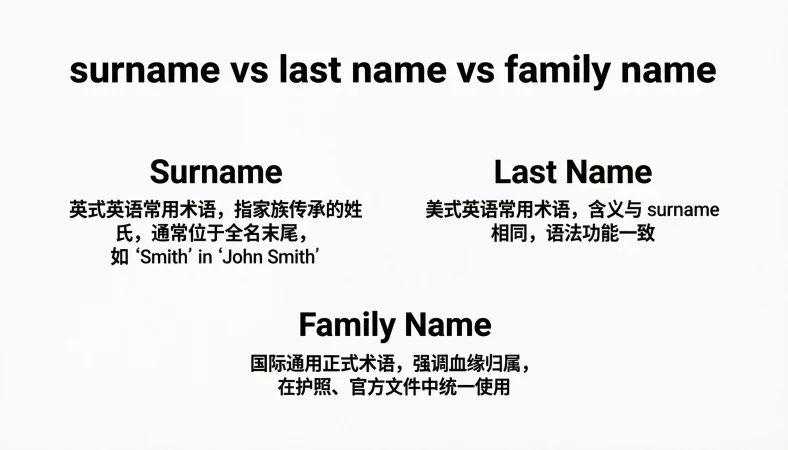
Surname, last name, and family name usually mean the same thing: the part of a person’s name associated with their family.
For example, in Emma Johnson, “Johnson” is the surname, last name, or family name. Last name is especially common in American English, while surname is widely used in British English and formal contexts. Family name is clear and common in international settings.
Why Do People Confuse Surname, Last Name, and Family Name?
People confuse these terms because they often refer to the same name in English-speaking countries. All three can identify the name that appears after a given name in a traditional Western naming order.
For example:
- Given name: Daniel
- Surname: Smith
- Full name: Daniel Smith
In this example, Smith is Daniel’s surname, last name, and family name.
However, naming traditions differ around the world. In some cultures, the family name comes before the given name. In others, people may have more than one surname, use patronymic names, or follow naming customs in which a family name does not work exactly like a Western surname.
Therefore, the three terms are often interchangeable, but it is important to consider the person’s culture and the instructions on a form.
First Word: What Does “Surname” Mean?
A surname is a name shared by members of a family or passed down through a family naming tradition. It is often used to identify a person’s family background.
In a traditional English name, the surname usually comes after the given name.
Examples of “Surname”
- Maria Garcia
- James Wilson
- Ahmed Khan
- Olivia Brown
In each example, the bold word is the surname.
The word surname is common in British English and is also widely understood in other varieties of English. It often appears in official documents, school forms, applications, and formal writing.
Example Sentences
- What is your surname?
- Please write your full name and surname.
- Her surname is Patel.
- The students were listed in alphabetical order by surname.
Second Word: What Does “Last Name” Mean?
A last name is the name that usually appears at the end of a person’s full name in a naming system that places the family name last.
For example, in Michael Taylor, “Taylor” is the last name.
Last name is especially common in American English and everyday conversation. It is often the expression used on forms, websites, and applications.
Example Sentences
- What is your last name?
- Please enter your first name and last name.
- My last name is Anderson.
- Her last name appears on her passport.
The term last name describes the position of the name in a particular naming order. It does not always mean that the name is the final name in every culture.
Third Word: What Does “Family Name” Mean?
A family name is a name connected with a family or family group. It usually refers to the same name that people call a surname or last name.
For example, in David Lee, “Lee” may be the family name.
The expression family name is useful in international communication because it clearly explains what kind of name is being requested. It is also common in official and administrative contexts.
Example Sentences
- Please enter your family name.
- Her family name is Nguyen.
- The family name is written before the given name.
- Some people share a family name but have different given names.
In many contexts, family name and surname are exact equivalents. However, the meaning of a family name can depend on the naming traditions of a particular culture.
Surname vs Last Name vs Family Name: Comparison Table
| Feature | Surname | Last name | Family name |
|---|---|---|---|
| Basic meaning | A family-associated name | Usually the name at the end of a full name | A name associated with a family |
| Common usage | British English and formal contexts | American English and everyday speech | International and official contexts |
| Typical position | Often after the given name | Usually at the end in Western naming order | Depends on cultural naming conventions |
| Example | Sarah Miller | Sarah Miller | Sarah Miller |
| Are they interchangeable? | Usually | Usually | Usually |
| Main point | Refers to the family name | Describes its usual position | Emphasizes family connection |
Important: These terms are not guaranteed to describe the same naming system in every culture. Always follow the instructions provided on official forms.
When Should You Use Each Term?
When to Use “Surname”
Use surname when you are speaking or writing in British English, completing a formal document, or discussing names in an educational context.
Examples:
- What is your surname?
- Please write your surname in capital letters.
- The teacher called the students by their surnames.
When to Use “Last Name”
Use last name in everyday American English, casual conversation, and many American forms.
Examples:
- What’s your last name?
- I forgot your last name.
- Please enter your last name below.
When to Use “Family Name”
Use family name when you want to be clear in international communication or when a form specifically uses that expression.
Examples:
- Please enter your family name exactly as it appears on your passport.
- In this naming system, the family name comes first.
- Many people in the same family share a family name.
Which Term Should You Write on a Form?
The safest choice is to follow the wording on the form.
If a form asks for:
- Surname: Enter the name it identifies as your surname.
- Last name: Enter the name requested by the form.
- Family name: Enter your family name according to your naming tradition.
If your name follows a different cultural naming order, do not assume that the final word in your full name is your family name.
10+ Examples of Surname, Last Name, and Family Name
The following examples use a traditional Western naming order unless otherwise stated.
Example 1: Surname
- Full name: Emily Carter
- Surname: Carter
Sentence: Emily’s surname is Carter.
Example 2: Last Name
- Full name: Robert Davis
- Last name: Davis
Sentence: What is Robert’s last name?
Example 3: Family Name
- Full name: Sophia Martin
- Family name: Martin
Sentence: Sophia’s family name is Martin.
Example 4: Asking Politely
Sentence: May I know your surname, please?
This is a polite and slightly formal way to ask for someone’s family name.
Example 5: American English
Sentence: What’s your last name?
This is natural in everyday American conversation.
Example 6: Filling Out a Form
Sentence: Enter your first name in the first box and your last name in the second box.
Example 7: School Records
Sentence: The school arranged the students alphabetically by surname.
Example 8: International Communication
Sentence: Please enter your family name as it appears on your official identification.
Example 9: Two People With the Same Family Name
Sentence: Aisha and Omar have the same surname.
Example 10: Different Given Names
Sentence: The brothers have the same last name but different first names.
Example 11: Family Name Comes First
Sentence: In some naming traditions, the family name is written before the given name.
Example 12: A Person With More Than One Surname
Sentence: Some people use two surnames as part of their family naming tradition.
Example 13: Formal Introduction
Sentence: My given name is Daniel, and my surname is Wilson.
Example 14: Clarifying a Form
Sentence: Does “family name” mean my surname?
Answer: In many forms, yes, but you should check the form’s instructions if your naming tradition is different.
Common Mistakes to Avoid
1. Thinking “last name” Always Means the Final Word
In many Western naming systems, the last name appears at the end. However, that is not true for every naming tradition.
Better approach: Identify the family name according to the person’s cultural naming system.
2. Assuming Everyone Has One Surname
Some people have two or more surnames, while others may use different naming structures.
Example: A person may use a compound surname or multiple family names.
3. Confusing a Given Name With a Surname
A given name is usually the personal name chosen for a child, while a surname is associated with the family or naming tradition.
Example:
- Given name: Hannah
- Surname: Wilson
4. Using “Last Name” to Mean a Nickname
A last name is not the same as a nickname.
- Last name: Wilson
- Nickname: Will
5. Ignoring Form Instructions
A form may ask for a surname, family name, or last name according to a particular administrative system.
Better approach: Read the instructions carefully and use your official name consistently.
6. Assuming All Family Members Have Identical Names
Family members may have different surnames or naming arrangements because of marriage, adoption, cultural traditions, or personal choices.
Memory Trick: How to Remember the Difference
Use this simple memory trick:
- Surname = family name
- Last name = name usually written last
- Family name = name connected with your family
Remember the sentence:
“My surname is my family name, and in a traditional Western name, it is usually my last name.”
This will help you understand the three expressions in most everyday situations.
American English vs British English
The main difference is preference, not meaning.
| Expression | American English | British English |
|---|---|---|
| Last name | Very common | Common and understood |
| Surname | Common and understood | Very common |
| Family name | Used in forms and international contexts | Used in forms and international contexts |
American English Example
“What’s your last name?”
This is a very natural question in the United States.
British English Example
“What’s your surname?”
This is a very natural question in the United Kingdom.
Both questions generally ask for the same information.
Similar Words Related to Names
Understanding related terms can make name forms and conversations easier.
First Name
A first name is usually the personal name written first in a traditional Western naming order.
Example: In Laura Smith, “Laura” is the first name.
Given Name
A given name is a personal name assigned or chosen for someone, usually at birth.
Example: In Laura Smith, “Laura” is the given name.
Middle Name
A middle name is a name placed between the given name and surname in some naming systems.
Example: In Laura Jane Smith, “Jane” is the middle name.
Full Name
A full name includes the names used to identify a person, which may include given names, middle names, and family names.
Example: Laura Jane Smith.
Maiden Name
A maiden name traditionally refers to a woman’s surname before marriage. The term does not apply to everyone, and people may retain, change, or combine surnames for many reasons.
Preferred Name
A preferred name is the name a person chooses to use in everyday life, which may differ from their legal name.
Final Verdict: Are Surname, Last Name, and Family Name the Same?
In most everyday English situations, surname, last name, and family name refer to the same part of a person’s name. The main difference is how the expressions are used.
Surname is especially common in British English and formal contexts. Last name is especially common in American English.
The most important point is that naming systems differ across cultures. A person’s family name may not always be the final word in their full name.
Frequently Asked Questions
1. Is a surname the same as a last name?
Yes. In many English-speaking contexts, surname and last name mean the same thing: a family-associated name. Their usage may differ by region, but the basic meaning is usually identical.
2. Is a family name the same as a surname?
Usually, yes. A family name generally refers to the name associated with a family. However, naming customs vary, so the exact meaning should be understood in the context of the person’s culture.
3. Which is more common: surname or last name?
Last name is especially common in American English, while surname is especially common in British English. Both are widely understood.
4. What is the difference between a first name and a surname?
A first name, also called a given name, is usually a person’s individual name. A surname is generally associated with the family or naming tradition.
For example, in John Williams, “John” is the first name and “Williams” is the surname.
5. Should I write my surname or last name on a form?
Write the name requested by the form. If the form asks for a surname, last name, or family name, enter the appropriate family-associated name according to your official naming records and cultural naming tradition.
6. Can a person have two surnames?
Yes. Some people have two or more surnames because of cultural traditions, family naming customs, marriage, or personal choice.
7. Does the last name always come last?
No. In many Western naming systems, it usually comes last. In other cultures, the family name may come first or follow a different naming pattern.
8. Can two people have the same surname but not be related?
Yes. Different families can share the same surname without being closely related.
Remember This
- Surname usually means a family-associated name.
- Last name usually means the name at the end of a traditional Western full name.
- Family name usually means the name connected with a family.
- All three terms are often interchangeable.
- Last name is especially common in American English.
- Surname is especially common in British English.
- Naming conventions differ across cultures, so always check the context.
Conclusion
Surname, last name, and family name are three expressions that usually refer to the same part of a person’s name.
Learning these terms helps you understand English conversations, complete forms, and communicate more confidently.
In most everyday situations, you can use them interchangeably when discussing a traditional family-associated name.
The main difference is regional preference and context. Americans often say last name, while British speakers often say surname.