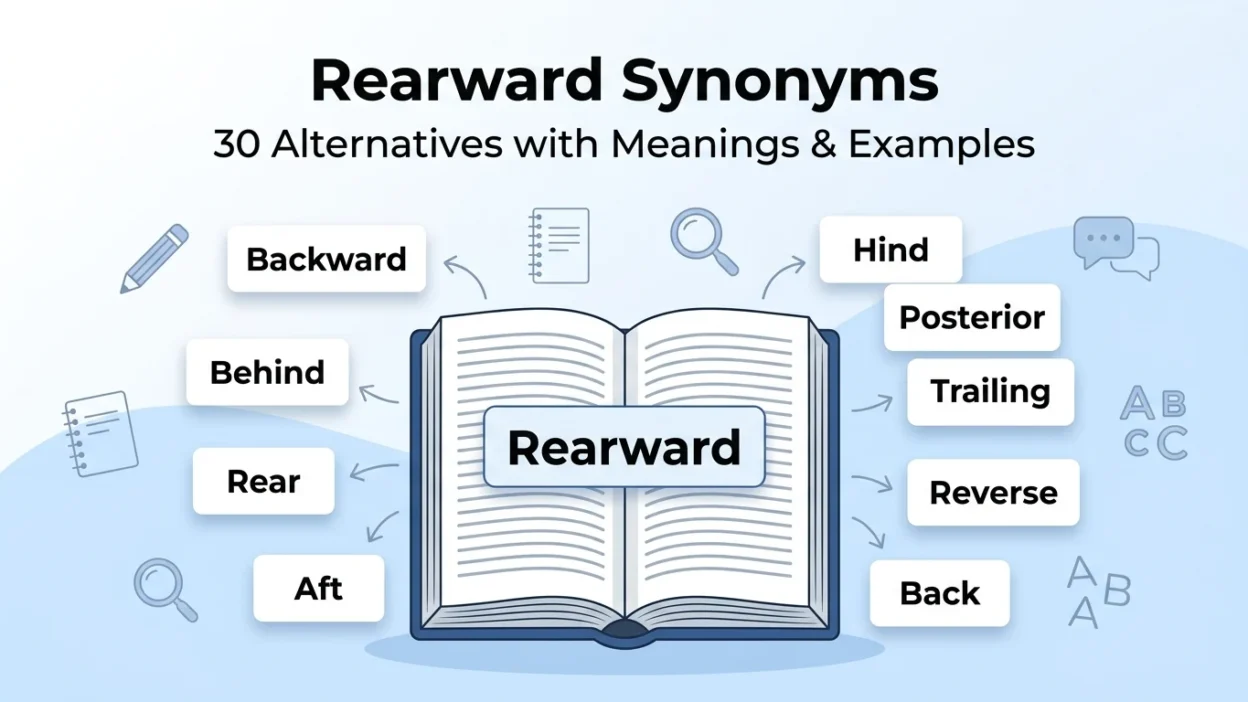
The word rearward is commonly used to describe something that is directed toward the back or positioned behind.
Although it is not an everyday word, it frequently appears in books, military writing, technical documents, transportation, and formal English.
Learning rearward synonyms can help you understand different types of writing and make your own vocabulary richer.
If you are a student, an ESL learner, a writer, or a content creator, knowing alternative words for rearward allows you to express ideas more naturally.
Some synonyms sound formal, while others are better suited for casual conversations or descriptive writing.
This guide explains each synonym in simple English with easy examples so anyone can understand and use them correctly.
What Does “Rearward” Mean?
Simple Meaning
Rearward means toward the back, at the back, or facing behind.
It can describe:
- A direction
- A position
- Movement toward the back
- Something located behind another object
Tone and Usage
The word rearward has a formal and descriptive tone. It is commonly used in:
- Military writing
- Engineering
- Vehicle descriptions
- Aviation
- Technical manuals
- Formal literature
Example:
The soldier took a rearward step to avoid danger.
30 Best Rearward Synonyms
1. Backward
Meaning: Moving or facing toward the back.
Example: She walked backward carefully.
Best Usage Context: Everyday conversation and writing.
2. Behind
Meaning: At the back of something.
Example: The bicycle was behind the car.
Best Usage Context: General English.
3. Back
Meaning: Toward the rear.
Example: Please move back a little.
Best Usage Context: Casual speech.
4. Aft
Meaning: Toward the rear of a ship or aircraft.
Example: The passengers moved aft.
Best Usage Context: Maritime and aviation.
5. Hind
Meaning: Located at the back.
Example: The horse injured its hind leg.
Best Usage Context: Animals and anatomy.
6. Posterior
Meaning: Situated at the back.
Example: The posterior wall needs repair.
Best Usage Context: Medical and scientific writing.
7. Reverse
Meaning: Moving in the opposite direction.
Example: The driver put the car in reverse.
Best Usage Context: Vehicles and movement.
8. Retreating
Meaning: Moving back from a position.
Example: The troops were retreating slowly.
Best Usage Context: Military and storytelling.
9. Receding
Meaning: Moving farther away or backward.
Example: The shoreline looked receding from the boat.
Best Usage Context: Descriptive writing.
10. Withdrawn
Meaning: Pulled back from a place.
Example: The team withdrawn from the competition.
Best Usage Context: Formal situations.
11. Rear
Meaning: Located at the back.
Example: Use the rear entrance.
Best Usage Context: Buildings and locations.
12. After
Meaning: Toward the back.
Example: The after cabin was quiet.
Best Usage Context: Nautical English.
13. Following
Meaning: Coming behind something else.
Example: The following vehicle slowed down.
Best Usage Context: Sequences and movement.
14. Trailing
Meaning: Moving behind another object.
Example: A dog was trailing the runner.
Best Usage Context: Narrative writing.
15. Lagging
Meaning: Remaining behind.
Example: He was lagging behind the group.
Best Usage Context: Everyday English.
16. Backmost
Meaning: Furthest at the back.
Example: She sat in the backmost seat.
Best Usage Context: Describing positions.
17. Hindmost
Meaning: Last or farthest behind.
Example: The hindmost wagon stopped first.
Best Usage Context: Formal or literary writing.
18. Last
Meaning: At the end.
Example: He stood last in the line.
Best Usage Context: General writing.
19. Endmost
Meaning: Closest to the end.
Example: Choose the endmost chair.
Best Usage Context: Descriptive writing.
20. Posteriorly
Meaning: Toward the back.
Example: The injury spread posteriorly.
Best Usage Context: Medical terminology.
21. Rearmost
Meaning: Furthest toward the rear.
Example: Sit in the rearmost row.
Best Usage Context: Formal descriptions.
22. Backside
Meaning: The back part of something.
Example: The backside of the building needs painting.
Best Usage Context: Everyday English.
23. At the Back
Meaning: Positioned behind.
Example: The storage room is at the back.
Best Usage Context: Casual conversation.
24. In the Rear
Meaning: Located behind others.
Example: Security remained in the rear.
Best Usage Context: Formal writing.
25. Rear End
Meaning: The back section.
Example: The rear end of the truck was damaged.
Best Usage Context: Vehicles.
26. Tail End
Meaning: The final or back part.
Example: We arrived at the tail end of the meeting.
Best Usage Context: Informal English.
27. Backside Position
Meaning: A place behind something.
Example: The equipment was stored in the backside position.
Best Usage Context: Technical descriptions.
28. Reverse Direction
Meaning: Going back the opposite way.
Example: The hikers changed to the reverse direction.
Best Usage Context: Navigation.
29. Toward the Rear
Meaning: In the direction of the back.
Example: Move toward the rear of the bus.
Best Usage Context: Instructions.
30. To the Back
Meaning: Into the back area.
Example: Please carry the boxes to the back.
Best Usage Context: Everyday speech.
Comparison Guide: Rearward Synonyms
When to Use Different Synonyms
| Synonym | Best For | Tone |
|---|---|---|
| Backward | General movement | Neutral |
| Behind | Everyday conversation | Neutral |
| Rear | Formal descriptions | Formal |
| Aft | Ships and aircraft | Technical |
| Hind | Animals | Technical |
| Posterior | Medical writing | Scientific |
| Reverse | Vehicles | Neutral |
| Rearmost | Position descriptions | Formal |
| Tail End | Informal situations | Casual |
| Trailing | Storytelling | Descriptive |
How to Choose the Right Synonym
For Everyday Conversation
Use:
- Behind
- Back
- Backward
- To the Back
- At the Back
These words sound natural in daily English.
For Formal Writing
Choose:
- Rearward
- Rear
- Rearmost
- Hindmost
- In the Rear
These work well in reports, academic writing, and professional documents.
For Technical or Scientific Writing
Use:
- Posterior
- Posteriorly
- Aft
- Hind
These are common in medicine, biology, aviation, and engineering.
For Creative Writing
Choose:
- Trailing
- Receding
- Retreating
- Tail End
- Following
These create vivid descriptions and improve storytelling.
For Vehicles and Transportation
Use:
- Reverse
- Rear End
- Rear
- Toward the Rear
These are common in driving guides and transportation manuals.
Common Mistakes When Using Rearward Synonyms
Confusing “Backward” and “Behind”
- Backward describes movement or direction.
- Behind describes position.
Correct:
- He walked backward.
- The tree is behind the house.
Using “Posterior” in Casual Conversation
Although correct, posterior sounds very formal and is mainly used in medical or scientific contexts. In everyday English, back or behind is usually a better choice.
Mixing “Aft” with General English
Aft is mainly used for ships and aircraft. Outside those contexts, words like rear, back, or behind sound more natural.
Why Learning Rearward Synonyms Matters
Expanding your vocabulary helps you:
- Write with greater variety.
- Avoid repeating the same word.
- Understand books and technical documents more easily.
- Improve essays, blogs, and creative writing.
- Communicate more naturally in different situations.
Instead of using rearward every time, you can choose a synonym that better matches the tone and context.
Conclusion
Understanding rearward synonyms helps you become a stronger English speaker and writer. While rearward simply means “toward the back,” there are many alternatives that fit different situations. Words like behind, backward, and back work well in everyday conversation, while posterior, aft, and rearmost are better suited for technical or formal writing.
The key is to choose the synonym that best matches your audience and purpose. By practicing these 30 alternatives, you’ll expand your vocabulary, improve your writing style, and communicate your ideas more clearly.