If you are searching for assonance synonyms, you may be looking for words that describe similar or sound used in writing and poetry.
Understanding these related terms can help students, ESL learners, writers, and content creators improve their vocabulary and create more engaging content.
Assonance is one of the most common sound devices in literature. However, on the , several other words and terms may express similar ideas
. This guide explains the meaning of assonance, introduces 30 related words, and helps you understand when to use each one correctly.
What Is Assonance?
Meaning of Assonance
Assonance is a literary device in which the same or similar vowel sounds are repeated in nearby words. The repeated vowel sounds create rhythm, mood, and musical quality without repeating the exact consonant sounds.
Example:
“The rain in Spain stays mainly in the plain.”
Here, the repeated “ai” vowel sound creates a pleasing rhythm.
Why Is Assonance Important?
Writers use assonance to:
- Make writing more memorable
- Add rhythm and flow
- Create emotion and atmosphere
- Improve poetry and storytelling
- Make speeches and songs more engaging
Although there is no perfect one-word replacement for assonance, many literary and stylistic terms are closely related depending on the situation.
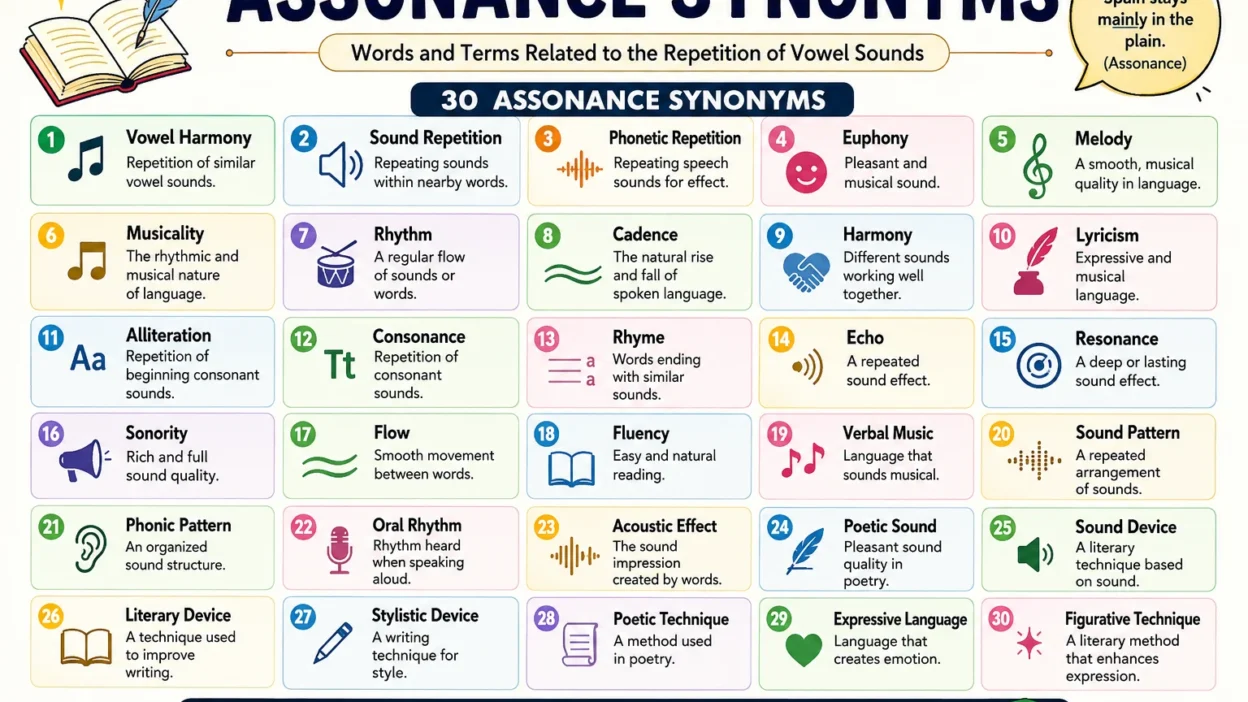
30 Assonance Synonyms and Related Words
1. Vowel Harmony
Meaning: Repetition of similar vowel sounds.
Example: The poem uses vowel harmony to create a smooth rhythm.
Best Usage Context: Literary analysis.
2. Sound Repetition
Meaning: Repeating sounds within nearby words.
Example: Sound repetition makes the sentence easier to remember.
Best Usage Context: General writing discussions.
3. Phonetic Repetition
Meaning: Repeating speech sounds for effect.
Example: The author used phonetic repetition throughout the poem.
Best Usage Context: Linguistics.
4. Euphony
Meaning: Pleasant and musical sound in writing.
Example: Soft words create euphony in the passage.
Best Usage Context: Poetry and creative writing.
5. Melody
Meaning: A smooth, musical quality in language.
Example: The speech has a beautiful melody.
Best Usage Context: Describing writing style.
6. Musicality
Meaning: The rhythmic and musical nature of language.
Example: Musicality makes poems enjoyable to read aloud.
Best Usage Context: Poetry reviews.
7. Rhythm
Meaning: A regular flow of sounds or words.
Example: Rhythm keeps readers engaged.
Best Usage Context: Poetry and speeches.
8. Cadence
Meaning: The natural rise and fall of spoken language.
Example: The author’s cadence feels smooth.
Best Usage Context: Public speaking and literature.
9. Harmony
Meaning: Different sounds working well together.
Example: The words create harmony throughout the verse.
Best Usage Context: Literary criticism.
10. Lyricism
Meaning: Expressive and musical language.
Example: The novel is known for its lyricism.
Best Usage Context: Creative writing.
11. Alliteration
Meaning: Repetition of beginning consonant sounds.
Example: Peter Piper picked peppers.
Best Usage Context: Comparing literary devices.
12. Consonance
Meaning: Repetition of consonant sounds.
Example: The repeated “t” sounds create consonance.
Best Usage Context: Poetry.
13. Rhyme
Meaning: Words ending with similar sounds.
Example: Light and bright rhyme together.
Best Usage Context: Poems and songs.
14. Echo
Meaning: A repeated sound effect.
Example: The repeated vowels create an echo.
Best Usage Context: Creative descriptions.
15. Resonance
Meaning: A deep or lasting sound effect.
Example: The phrase has emotional resonance.
Best Usage Context: Literary discussion.
16. Sonority
Meaning: Rich and full sound quality.
Example: The speech has impressive sonority.
Best Usage Context: Formal writing.
17. Flow
Meaning: Smooth movement between words.
Example: Assonance improves the flow of the sentence.
Best Usage Context: Everyday writing advice.
18. Fluency
Meaning: Easy and natural reading.
Example: The sound patterns improve fluency.
Best Usage Context: ESL learning.
19. Verbal Music
Meaning: Language that sounds musical.
Example: Shakespeare often created verbal music.
Best Usage Context: Literary appreciation.
20. Sound Pattern
Meaning: A repeated arrangement of sounds.
Example: The sound pattern strengthens the poem.
Best Usage Context: Literature classes.
21. Phonic Pattern
Meaning: An organized sound structure.
Example: Students identified the phonic pattern.
Best Usage Context: Language studies.
22. Oral Rhythm
Meaning: Rhythm heard when speaking aloud.
Example: Oral rhythm makes speeches effective.
Best Usage Context: Public speaking.
23. Acoustic Effect
Meaning: The sound impression created by words.
Example: The acoustic effect adds emotion.
Best Usage Context: Literary analysis.
24. Poetic Sound
Meaning: Pleasant sound quality in poetry.
Example: The poet carefully crafted the poetic sound.
Best Usage Context: Poetry discussions.
25. Sound Device
Meaning: A literary technique based on sound.
Example: Assonance is a common sound device.
Best Usage Context: Education.
26. Literary Device
Meaning: A technique used to improve writing.
Example: Assonance is an effective literary device.
Best Usage Context: General literature.
27. Stylistic Device
Meaning: A writing technique for style.
Example: The stylistic device creates emotion.
Best Usage Context: Writing analysis.
28. Poetic Technique
Meaning: A method used in poetry.
Example: Students learned a new poetic technique.
Best Usage Context: Poetry education.
29. Expressive Language
Meaning: Language that creates emotion.
Example: Expressive language improves storytelling.
Best Usage Context: Creative writing.
30. Figurative Technique
Meaning: A literary method that enhances expression.
Example: The figurative technique strengthens the poem.
Best Usage Context: Literature studies.
Comparison Guide: When to Use Different Assonance Synonyms
Quick Comparison Table
| Word | Best Used For | Similarity to Assonance |
|---|---|---|
| Assonance | Repeated vowel sounds | Exact term |
| Consonance | Repeated consonant sounds | Very close |
| Alliteration | Beginning consonant sounds | Related |
| Euphony | Pleasant sound | Similar effect |
| Rhythm | Flow of language | General concept |
| Cadence | Speech rhythm | Related |
| Musicality | Musical writing | Similar style |
| Lyricism | Beautiful language | Broadly related |
| Sound Device | General literary term | Category |
| Literary Device | Overall writing technique | Broad term |
How to Choose the Right Synonym
If You Mean Repeated Sounds
Use:
- Assonance
- Consonance
- Alliteration
- Sound Repetition
- Phonetic Repetition
If You Mean Beautiful or Musical Writing
Use:
- Euphony
- Musicality
- Melody
- Lyricism
- Harmony
If You Mean Writing Style
Use:
- Literary Device
- Stylistic Device
- Poetic Technique
- Expressive Language
- Sound Device
If You Mean Rhythm and Flow
Use:
- Rhythm
- Cadence
- Flow
- Fluency
- Oral Rhythm
Common Mistakes to Avoid
Don’t Confuse Assonance with Alliteration
Assonance repeats vowel sounds, while alliteration repeats beginning consonant sounds.
Don’t Confuse Assonance with Consonance
Consonance focuses on repeated consonant sounds, whereas assonance focuses on repeated vowel sounds.
Choose Based on Context
Not every synonym can replace assonance directly. Some describe related literary ideas rather than identical meanings. Select the word that best matches your writing purpose.
Frequently Asked Questions
Is there an exact synonym for assonance?
No. Assonance is a specific literary term. Most alternatives are related concepts rather than exact replacements.
What is the closest related word?
Consonance is one of the closest related literary devices, although it refers to repeated consonant sounds instead of vowel sounds.
Is euphony the same as assonance?
No. Euphony describes pleasant-sounding language, while assonance is one technique that can help create that pleasant sound.
Why should writers learn these related terms?
Understanding related literary devices helps writers improve style, analyze literature more effectively, and choose the most accurate vocabulary.
Conclusion
Learning assonance synonyms and related literary terms helps you better understand how sound shapes effective writing.
While assonance specifically refers to the repetition of vowel sounds, related terms such as consonance, alliteration, euphony, rhythm, and musicality describe similar sound-based techniques or broader stylistic effects
. By understanding when and how to use these words, students, ESL learners, writers, and content creators can strengthen their vocabulary, write with greater confidence, and produce more engaging, expressive content.

Liam Henry is a content author at Synonymed, specializing in vocabulary enrichment and synonym guides. He creates clear, engaging resources that help learners improve English word knowledge and language fluency.