
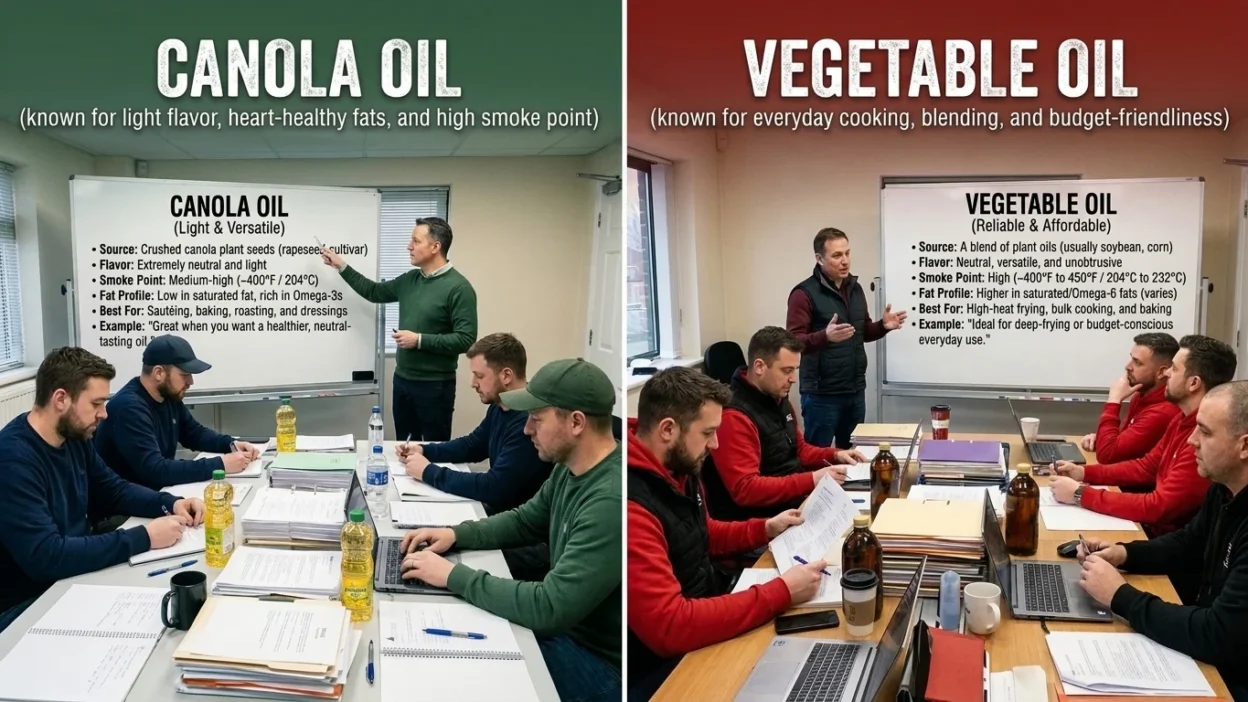
When choosing cooking oil, you may wonder about the difference between canola oil and vegetable oil.
Both are common kitchen ingredients used for frying, baking, roasting, and everyday cooking.
They often look similar, taste mild, and work well in many recipes. However, they are not exactly the same.
The main difference is their source and composition. Canola oil comes from specially bred rapeseed plants, while vegetable oil is a broad term for oil made from plants such as soybeans, corn, sunflower seeds, or a blend of different oils.
Canola oil is generally low in saturated fat and contains both monounsaturated and polyunsaturated fats. Vegetable oil has a nutritional profile that depends on its ingredients.
Understanding these differences can help you choose the right oil for your meals, budget, and cooking method.
If you are frying chicken, baking a cake, or preparing a salad dressing, knowing when to use each oil makes cooking easier.
Quick Answer: Canola Oil vs Vegetable Oil
Canola oil is a specific type of cooking oil made from canola seeds, while vegetable oil is a general name for oils extracted from plants. Both are mild in flavor and suitable for many cooking methods. Canola oil is often lower in saturated fat, but vegetable oil’s nutritional value depends on its ingredients.
Why Do People Confuse Canola Oil and Vegetable Oil?
People often confuse these oils because they share several characteristics.
- Similar appearance: Both are usually light yellow and clear.
- Mild flavor: Neither typically adds a strong taste to food.
- Similar cooking uses: Both work well for frying, baking, roasting, and sautéing.
- Similar availability: Both are widely sold in supermarkets.
- Overlapping ingredients: Canola oil and some vegetable oil blends can have similar nutritional profiles.
The biggest source of confusion is the label vegetable oil. It does not identify one particular plant. Instead, it describes oil made from vegetable sources, including seeds and other plant materials.
First Word: What Is Canola Oil?
Canola oil is a cooking oil made from the seeds of canola plants. These plants are varieties of rapeseed bred to produce oil with a favorable fatty acid composition and low levels of certain undesirable compounds found in traditional rapeseed varieties.
Canola oil is popular because it has a neutral taste, a light texture, and a relatively high smoke point when refined.
What Are the Main Characteristics of Canola Oil?
- Source: Canola seeds.
- Flavor: Mild and neutral.
- Color: Usually pale yellow.
- Texture: Light and smooth.
- Smoke point: Refined canola oil commonly has a smoke point around 400°F (204°C), although the exact temperature varies by product.
- Nutrition: Generally low in saturated fat and rich in unsaturated fats, including monounsaturated fat.
- Common uses: Frying, baking, roasting, sautéing, and salad dressings.
Canola oil also contains alpha-linolenic acid, a plant-based omega-3 fatty acid. The amount varies by product, but it is one nutritional feature that distinguishes canola oil from many other common cooking oils.
Second Word: What Is Vegetable Oil?
Vegetable oil is a general term for oil extracted from plants. In grocery stores, the label often refers to a refined blend of oils, frequently soybean oil or a combination of soybean, corn, sunflower, or other oils.
Because vegetable oil can contain different ingredients, its flavor, nutritional composition, and smoke point depend on the particular product.
What Are the Main Characteristics of Vegetable Oil?
- Source: One or more oil-producing plants.
- Flavor: Usually mild when refined.
- Color: Typically light yellow.
- Texture: Generally light and suitable for everyday cooking.
- Smoke point: Varies by oil and refining method; many refined vegetable oils have smoke points suitable for frying.
- Nutrition: Depends on the blend and its proportions of saturated, monounsaturated, and polyunsaturated fats.
- Common uses: Deep-frying, baking, roasting, sautéing, and preparing sauces.
Always check the ingredient label if you want to know exactly what is in a bottle of vegetable oil.
Canola Oil vs Vegetable Oil: A Side-by-Side Comparison
| Feature | Canola Oil | Vegetable Oil |
|---|---|---|
| Definition | A specific type of plant oil | A general category of plant oils |
| Main source | Canola seeds | Soybeans, corn, sunflower seeds, or blends |
| Flavor | Mild and neutral | Usually mild and neutral |
| Appearance | Usually pale yellow | Usually light yellow |
| Saturated fat | Generally low | Varies by ingredients |
| Unsaturated fats | Rich in monounsaturated and polyunsaturated fats | Varies by blend |
| Omega-3 content | Contains some plant-based omega-3 fat | Depends on the oil used |
| Smoke point | Often around 400°F (204°C) when refined | Varies; many refined blends are suitable for frying |
| Frying | Suitable for many frying methods | Suitable for many frying methods |
| Baking | Excellent for cakes, muffins, and quick breads | Excellent for many baked goods |
| Price | Depends on brand and location | Often competitively priced |
| Best choice | When you want a specific oil with a known profile | When you want a versatile, often economical cooking oil |
When Should You Use Canola Oil or Vegetable Oil?
Both oils can work in similar recipes. Your best choice depends on the dish, the product’s ingredients, and your nutritional preferences.
When Should You Use Canola Oil?
Choose canola oil when you want a neutral-tasting oil with a generally low saturated fat content.
It is particularly useful for:
- Baking cakes and muffins: It adds moisture without a strong flavor.
- Making salad dressings: Its mild taste allows herbs, vinegar, and spices to stand out.
- Sautéing vegetables: It works well for everyday stovetop cooking.
- Roasting potatoes: It helps the surface brown and crisp.
- Light frying: Refined canola oil is suitable for many shallow- and deep-frying applications.
For example, if you are making banana bread, canola oil can provide moisture without competing with the banana flavor.
When Should You Use Vegetable Oil?
Choose vegetable oil when you need a versatile oil for general cooking and the product meets your recipe’s requirements.
It works well for:
- Deep-frying chicken: A suitable refined vegetable oil can withstand typical frying temperatures.
- Making pancakes: Its neutral flavor will not overpower the batter.
- Preparing brownies: It adds moisture and helps create a soft texture.
- Roasting vegetables: It helps distribute heat and encourages browning.
- Cooking on a budget: Some vegetable oil blends are economical options for everyday meals.
For example, if you regularly fry large batches of food, an affordable refined vegetable oil blend may be a practical choice.
Can You Substitute Canola Oil for Vegetable Oil?
Yes. In most recipes, you can replace vegetable oil with canola oil in the same amount, or replace canola oil with vegetable oil in equal quantities.
For example, if a cake recipe requires half a cup of vegetable oil, you can usually use half a cup of canola oil instead.
The substitution generally works because both oils have mild flavors and similar functions in baking and cooking. However, check the specific product if the recipe requires a particular flavor or cooking temperature.
12 Examples of Canola Oil and Vegetable Oil in Everyday Use
These examples show how the two oils appear in common cooking situations.
- Canola oil for cake: Maria uses canola oil to keep her chocolate cake moist.
- Vegetable oil for frying: Ahmed uses vegetable oil to fry crispy chicken.
- Canola oil for salad dressing: Sara combines canola oil with lemon juice and herbs.
- Vegetable oil for pancakes: James adds vegetable oil to his pancake batter.
- Canola oil for roasting: Fatima coats potatoes with canola oil before roasting them.
- Vegetable oil for brownies: Olivia uses vegetable oil to make soft, moist brownies.
- Canola oil for sautéing: Daniel uses canola oil to cook onions and peppers.
- Vegetable oil for deep-frying: A restaurant uses a suitable refined vegetable oil for fried snacks.
- Canola oil for muffins: Emma adds canola oil to blueberry muffin batter.
- Vegetable oil for stir-frying: Noah uses a refined vegetable oil blend to cook mixed vegetables.
- Canola oil for homemade bread: A baker adds canola oil to a dough recipe that calls for neutral oil.
- Vegetable oil for roasting chicken: A cook coats chicken with vegetable oil before placing it in the oven.
These examples demonstrate that the oils are often interchangeable. The most important factors are the recipe, the oil’s composition, and the cooking temperature.
Common Mistakes When Comparing Canola Oil and Vegetable Oil
Understanding these common mistakes helps you make better cooking decisions.
Mistake 1: Thinking Vegetable Oil Comes From Vegetables Only
Vegetable oil can come from seeds such as soybeans, corn, and sunflower seeds. The word vegetable does not mean the oil must come from leafy vegetables or other vegetables commonly eaten at dinner.
Mistake 2: Assuming All Vegetable Oils Are the Same
Different vegetable oils have different fatty acid profiles, flavors, and smoke points. A soybean-based blend may have a different nutritional composition from a sunflower-based oil.
Better approach: Read the ingredient list and nutrition label.
Mistake 3: Believing Canola Oil Is Always Healthier
Canola oil is generally low in saturated fat, but the overall nutritional value of vegetable oil depends on its ingredients. Some vegetable oil blends are also rich in unsaturated fats.
Better approach: Compare the saturated fat content, the types of fats, and your overall eating pattern rather than relying on the name alone.
Mistake 4: Thinking Both Oils Have Exactly the Same Smoke Point
A smoke point is the temperature at which an oil begins to produce visible smoke. It varies with the type of oil, its refinement, and its condition.
Better approach: Choose a suitable refined oil for high-temperature cooking and avoid repeatedly overheating it.
Mistake 5: Assuming Oil Makes Food Healthy or Unhealthy by Itself
The health impact of a meal depends on more than the cooking oil. Portion size, the rest of the diet, and the cooking method also matter.
Better approach: Use appropriate amounts of oil and favor unsaturated fats over saturated fats in your overall diet.
Memory Trick: How to Remember the Difference
Use this simple memory trick:
- Canola = one specific oil.
- Vegetable = a general category.
Think of canola oil as one member of a larger family of plant oils. Vegetable oil is the broad label that can include several different oils.
For example, every canola oil is a plant-based oil, but not every vegetable oil is canola oil.
Remembering this distinction makes it easier to understand product labels and compare cooking oils.
American vs British English: Is There a Difference?
The terms canola oil and vegetable oil are used in both American and British English, but naming conventions can vary.
In American English, canola oil is the common name for oil from canola varieties of rapeseed. Vegetable oil often appears on supermarket labels for refined cooking oil blends.
In British English, rapeseed oil is the more common general term for oil from rapeseed, including products that may be marketed as canola oil elsewhere. The word canola is also understood in the UK, particularly in international food products.
One important detail is that not all rapeseed oil is identical to canola oil. Canola refers to specific low-erucic-acid varieties of rapeseed, so the terms should not automatically be treated as interchangeable in every technical context.
Similar Words and Related Cooking Oils
Several other cooking oils are related to canola oil and vegetable oil.
- Rapeseed oil: Oil extracted from rapeseed plants; some varieties produce canola oil.
- Soybean oil: A widely used cooking oil that may be a main ingredient in vegetable oil blends.
- Sunflower oil: An oil extracted from sunflower seeds, often used for frying and baking.
- Corn oil: Oil extracted from corn, commonly used in cooking and frying.
- Olive oil: Oil made from olives, available in different grades and commonly used in dressings and cooking.
- Avocado oil: Oil made from avocado flesh, available in refined and unrefined forms.
- Cooking oil: A broad term for oils used to prepare food.
- Refined oil: Oil processed to remove impurities and often reduce color, odor, and flavor.
These terms describe different products or categories. Knowing them can help you understand grocery labels and select the right oil for a particular recipe.
Final Verdict: Which Oil Is Better?
Canola oil and vegetable oil are both useful for everyday cooking, and neither is automatically the best choice for every situation.
Canola oil is a good option if you want a specific oil that is generally low in saturated fat and contains some plant-based omega-3 fatty acids. Vegetable oil is a practical choice if you want a versatile cooking oil, especially when the blend is affordable and suitable for your recipe.
If nutrition is your main concern, compare the actual ingredients and nutrition labels. If convenience is your priority, either oil can work well for many recipes.
For most home cooks, the simplest rule is to choose an oil with a suitable smoke point, a flavor that fits the dish, and a fatty acid profile that supports their dietary needs.
Frequently Asked Questions
1. Is canola oil the same as vegetable oil?
No. Canola oil is a specific oil made from canola seeds, while vegetable oil is a general term for plant-derived oils. A bottle labeled vegetable oil may contain soybean oil, corn oil, sunflower oil, or a blend.
2. Is canola oil healthier than vegetable oil?
Canola oil is generally low in saturated fat and contains monounsaturated and polyunsaturated fats. However, vegetable oil can have a similar nutritional profile depending on its ingredients. Comparing nutrition labels is the best way to assess a particular product.
3. Can I use canola oil instead of vegetable oil in baking?
Yes. Canola oil can usually replace vegetable oil in equal amounts in cakes, muffins, brownies, and quick breads. Its mild flavor makes it a suitable substitute in most recipes that call for neutral cooking oil.
4. Which oil is better for deep-frying?
Both canola oil and refined vegetable oil can be suitable for deep-frying. The better option depends on the product’s smoke point, stability at frying temperatures, cost, and how often the oil will be used.
5. Does vegetable oil contain canola oil?
Sometimes. Vegetable oil is a broad category, and a particular blend may contain canola oil. However, many products contain soybean oil or other plant oils instead. Check the ingredient list to confirm.
6. Which oil has less saturated fat?
Canola oil is generally low in saturated fat. Some vegetable oil blends are similarly low, while others have different proportions of saturated and unsaturated fats. Compare the nutrition information on the bottles to determine which has less.
7. Can I use vegetable oil instead of canola oil for frying eggs?
Yes. A neutral-tasting vegetable oil blend generally works well for frying eggs, provided it is suitable for the cooking temperature. You can usually substitute it for canola oil in the same amount.
8. Which oil is better for everyday cooking?
Either can be a good choice. Canola oil offers a predictable nutritional profile, while vegetable oil provides flexibility and may be less expensive. Choose a product that suits your cooking method, dietary preferences, and budget.
Remember This
- Canola oil is a specific type of plant oil.
- Vegetable oil is a broad category that may contain one or several oils.
- Both can be used for frying, baking, roasting, and sautéing.
- Canola oil is generally low in saturated fat and contains some omega-3 fatty acids.
- The nutritional value of vegetable oil depends on its ingredients.
- Always check the product label when the exact composition matters.
Conclusion
The difference between canola oil and vegetable oil comes down to their definitions, sources, and nutritional composition. Canola oil is made from specific varieties of rapeseed, while vegetable oil is a general term that often describes a refined blend of plant oils. Both have mild flavors and are suitable for many everyday recipes, including cakes, fried foods, roasted vegetables, and sauces.
Ultimately, the best cooking oil depends on what you are preparing and what matters most to you. Canola oil is a useful choice when you want a specific oil with a generally low saturated fat content, while vegetable oil can be a convenient and economical option for everyday meals. Check the ingredient list, compare nutritional information, and choose an oil that works for your recipe and dietary needs.