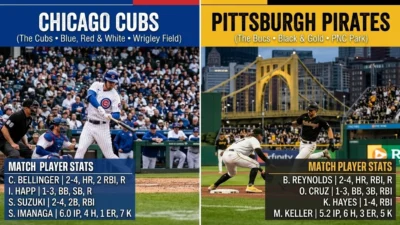
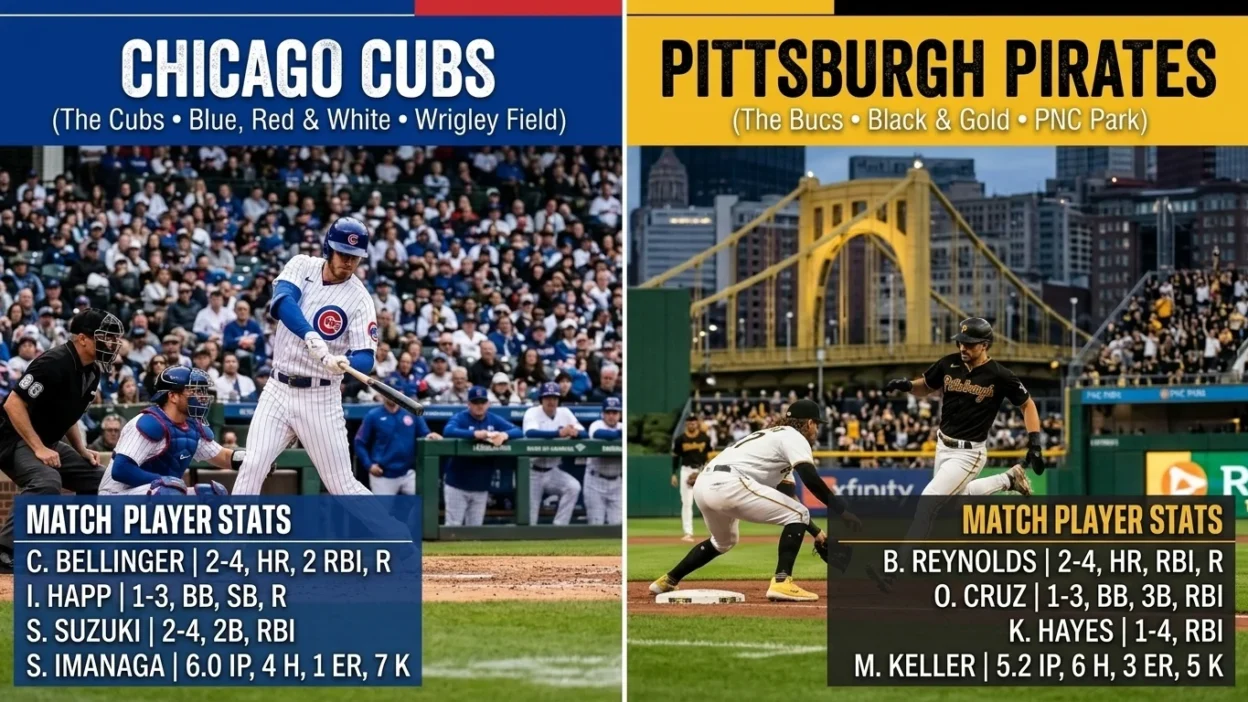
The Chicago Cubs vs Pittsburgh Pirates match player stats help baseball fans understand how individual players performed, which team controlled the game, and what decided the final score.
Batting statistics, pitching numbers, home runs, runs batted in, and defensive errors all provide useful information about a matchup between these two Major League Baseball (MLB) teams.
In their September 12, 2026, meeting at Wrigley Field, the Chicago Cubs defeated the Pittsburgh Pirates 4–3.
The Pirates collected six hits, while the Cubs recorded five. Pittsburgh scored all three of its runs in the sixth inning, but Chicago responded with two runs in the eighth to secure the victory.
Michael Busch homered for the Cubs, while Ryan O’Hearn drove in three runs for Pittsburgh.
These figures show why a close baseball game cannot be understood from the final score alone. Individual player statistics explain how teams scored, how pitchers handled pressure, and which performances made the biggest difference.
Quick Answer
The Chicago Cubs beat the Pittsburgh Pirates 4–3 on September 12, 2026, at Wrigley Field. The Pirates recorded six hits and three runs, while the Cubs finished with five hits and four runs. Michael Busch hit a home run, and Ryan O’Hearn drove in three runs for Pittsburgh. The Cubs scored twice in the eighth inning to win.
Why Do Fans Compare Cubs vs Pirates Player Stats?
Fans compare player statistics to understand the difference between the teams’ performances. A team can collect more hits and still lose because hits do not automatically become runs.
The September 12 matchup is a good example. Pittsburgh had more hits, but Chicago scored one additional run and won the game.
Player statistics help readers answer several important questions:
- Which batters produced runs?
- Which players hit home runs or collected multiple hits?
- How many innings did each starting pitcher complete?
- Which relief pitchers protected the lead?
- How did the game change in its most important innings?
First Team: Chicago Cubs Player Stats
The Chicago Cubs entered the final innings behind after Pittsburgh scored three times in the sixth. Chicago then scored twice in the eighth to take the lead.
Michael Busch was one of the Cubs’ key offensive contributors. He hit a home run and finished with one run scored and one RBI. Pedro Ramirez recorded two hits, scored twice, and drove in one run. Alex Bregman and Nico Hoerner also contributed to the scoring.
Important Cubs batting performances
| Player | At-bats | Hits | Runs | RBIs | Home runs |
|---|---|---|---|---|---|
| Michael Busch | 3 | 1 | 1 | 1 | 1 |
| Pedro Ramirez | 3 | 2 | 2 | 1 | 1 |
| Alex Bregman | 2 | 1 | 1 | 0 | 0 |
| Nico Hoerner | 3 | 1 | 0 | 1 | 0 |
These figures summarize the listed batting performances in the game. A player’s contribution can include getting on base, advancing runners, or helping create a scoring opportunity, even without hitting a home run.
Cubs pitching performance
Chicago’s pitching staff limited Pittsburgh to three runs. Starter Clay Holmes pitched 5⅔ innings, allowing five hits and three earned runs, with four walks and six strikeouts. Ryan Rolison earned the win, while Ryan Zeferjahn recorded the save.
Second Team: Pittsburgh Pirates Player Stats
The Pittsburgh Pirates produced six hits and scored three runs. Their biggest scoring moment came in the sixth inning, when Ryan O’Hearn hit a three-run home run that brought home Brandon Lowe and Bryan Reynolds.
O’Hearn finished with one hit, one run, and three RBIs. Lowe and Reynolds also contributed to the offense, while Spencer Horwitz and Jacob Gonzalez recorded hits.
Important Pirates batting performances
| Player | At-bats | Hits | Runs | RBIs | Home runs |
|---|---|---|---|---|---|
| Ryan O’Hearn | 4 | 1 | 1 | 3 | 1 |
| Brandon Lowe | 4 | 1 | 1 | 0 | 0 |
| Bryan Reynolds | 5 | 1 | 1 | 0 | 0 |
| Spencer Horwitz | 3 | 1 | 0 | 0 | 0 |
| Jacob Gonzalez | 2 | 1 | 0 | 0 | 0 |
Ryan O’Hearn’s three-run homer was Pittsburgh’s biggest scoring play. It gave the Pirates a temporary 3–2 lead, but Chicago answered late in the game.
Pirates pitching performance
Paul Skenes started for Pittsburgh and pitched seven innings, allowing four hits and two earned runs while striking out four and walking one. Gregory Soto took the loss after allowing two runs in the eighth inning.
Chicago Cubs vs Pittsburgh Pirates: Team Comparison
The final team totals show how close the matchup was.
| Statistic | Chicago Cubs | Pittsburgh Pirates |
|---|---|---|
| Final score | 4 | 3 |
| Total hits | 5 | 6 |
| Errors | 1 | 0 |
| Starting pitcher | Clay Holmes | Paul Skenes |
| Starting pitcher’s innings | 5⅔ | 7 |
| Starting pitcher strikeouts | 6 | 4 |
| Winning pitcher | Ryan Rolison | — |
| Losing pitcher | — | Gregory Soto |
The Cubs won despite recording one fewer hit and one more error. Pittsburgh’s starting pitcher completed more innings, but the Cubs’ late scoring proved decisive. The result highlights the importance of timing, relief pitching, and turning scoring opportunities into runs.When Should You Use Each Player Statistic?
Different statistics answer different questions about a baseball game. Choosing the correct stat helps readers understand player performance more accurately.
- Runs (R): Use this statistic to see how many times a player crossed home plate.
- Hits (H): Use it to measure how often a batter recorded a hit.
- Runs batted in (RBI): Use it to measure how many runs a batter drove home through a qualifying plate appearance.
- Home runs (HR): Use this figure to identify home-run hitters.
- At-bats (AB): Use it to understand batting opportunities, excluding certain plate appearances such as walks.
- Strikeouts (SO): Use it to compare a pitcher’s ability to retire batters by strikeout or a batter’s strikeout frequency.
- Earned run average (ERA): Use it to compare pitchers’ earned runs allowed per nine innings.
- Walks plus hits per inning pitched (WHIP): Use it to assess how frequently a pitcher allows baserunners through walks and hits.
12 Examples of How to Read Cubs vs Pirates Match Stats
The following examples use the September 12, 2026, game to explain common baseball statistics.
- Cubs win 4–3: Chicago scored four runs, one more than Pittsburgh.
- Pirates record six hits: Pittsburgh collected one more hit than Chicago.
- Cubs record five hits: Chicago produced enough offense to win despite fewer hits.
- Michael Busch hits a home run: Busch’s homer contributed one run and one RBI.
- Pedro Ramirez records two hits: He reached base safely on two hits.
- Pedro Ramirez scores twice: He crossed home plate two times.
- Ryan O’Hearn records three RBIs: His batting produced three runs for Pittsburgh.
- Paul Skenes pitches seven innings: He worked longer than Chicago’s starting pitcher.
- Clay Holmes records six strikeouts: He retired six batters by strikeout.
- Gregory Soto takes the loss: The official decision credited Soto with the defeat.
- Ryan Rolison earns the win: He received the official winning-pitcher decision.
- Ryan Zeferjahn records the save: He finished the game and received the official save.
These examples show why a box score should be read as a collection of related measurements rather than a simple ranking of players.
Common Mistakes When Reading Baseball Player Stats
Baseball statistics can be confusing for new fans. Avoid these common errors.
- Confusing hits with runs: A hit does not automatically mean a run scores.
- Treating RBIs as runs scored: A batter can drive in a run without personally scoring.
- Assuming the team with more hits must win: The Pirates had more hits in this game but lost.
- Confusing ERA with total runs: ERA measures earned runs allowed per nine innings, not a pitcher’s total runs allowed.
- Ignoring innings pitched: A pitcher who works seven innings has a different workload from one who works five.
- Judging a player by one game alone: One matchup cannot establish a player’s full-season ability.
- Treating every error as an earned run: An error can affect whether a run is classified as earned or unearned.
Memory Trick: Remember R-H-RBI-HR
A simple way to remember the most common batting statistics is R-H-RBI-HR:
- R: Runs scored
- H: Hits
- RBI: Runs batted in
- HR: Home runs
For pitching, remember IP-SO-ERA: innings pitched, strikeouts, and earned run average.
These abbreviations make it easier to read a Cubs vs Pirates box score without stopping to look up every term.
American vs British English: Baseball Vocabulary
Baseball is especially associated with American English, so many statistical terms are standard in American sports reporting.
| American baseball term | Meaning in simple English |
|---|---|
| Home run | A hit that allows the batter to circle the bases and score without an intervening defensive play that prevents it |
| Lineup | The list and batting order of players |
| Bullpen | The relief pitchers and the area where they warm up |
| Box score | A summary of a game’s team and player statistics |
| Strikeout | An out recorded when a batter strikes out or a batter is retired by a strikeout |
British English generally uses the same terms when discussing MLB because these are established baseball expressions. Some everyday words differ between American and British English, but baseball’s official statistical abbreviations usually remain the same.
Similar Baseball Statistics and Terms
Understanding related terms makes match reports easier to follow.
- Batting average (AVG): Hits divided by official at-bats.
- On-base percentage (OBP): Measures how frequently a batter reaches base, including qualifying walks and hit-by-pitches.
- Slugging percentage (SLG): Measures total bases per at-bat.
- On-base plus slugging (OPS): The sum of on-base percentage and slugging percentage.
- Earned run average (ERA): Earned runs allowed per nine innings pitched.
- WHIP: Walks plus hits allowed per inning pitched.
- Save: An official pitching credit awarded in qualifying situations when a reliever finishes a team’s victory.
- Win probability: An estimate of a team’s chance of winning at a particular point in a game.
Each statistic measures a different part of performance. No single number provides a complete picture of a player’s value.
Final Verdict: Who Performed Better?
The Chicago Cubs won the September 12, 2026, game by defeating the Pittsburgh Pirates 4–3. Pittsburgh had the advantage in total hits, 6–5, and Paul Skenes delivered seven innings as the starting pitcher. However, Chicago produced the winning runs in the eighth inning.
Michael Busch and Pedro Ramirez provided important offensive contributions for the Cubs, while Ryan O’Hearn supplied Pittsburgh’s most significant scoring hit. The matchup demonstrates that late-inning execution and bullpen performance can matter just as much as total hits or starting-pitcher statistics.
For an accurate assessment, compare each player’s complete box score, the inning-by-inning score, and the pitching decisions rather than relying on one statistic.
Frequently Asked Questions
1. Who won the Chicago Cubs vs Pittsburgh Pirates game on September 12, 2026?
The Chicago Cubs won 4–3 at Wrigley Field. They scored twice in the eighth inning to overcome Pittsburgh’s 3–2 lead.
2. How many hits did the Cubs and Pirates record?
The Cubs recorded five hits, while the Pirates collected six. Pittsburgh had more hits but scored one fewer run.
3. Which player hit a home run in the Cubs vs Pirates matchup?
Michael Busch hit a home run for Chicago, and Ryan O’Hearn hit a three-run home run for Pittsburgh.
4. How many RBIs did Ryan O’Hearn record?
Ryan O’Hearn recorded three RBIs. His three-run homer brought home three Pittsburgh runs in the sixth inning.
5. How did Paul Skenes perform against the Cubs?
Paul Skenes pitched seven innings, allowing four hits and two earned runs. He recorded four strikeouts and one walk.
6. Which pitcher received the win and which received the loss?
Ryan Rolison earned the win for Chicago, and Gregory Soto took the loss for Pittsburgh. Ryan Zeferjahn recorded the save.
7. Where can I find the complete Cubs vs Pirates box score?
You can review the game details and individual player statistics through the Baseball-Reference box score. Official MLB statistics and other established sports-score services are also useful sources for verifying results.
Remember This
The Cubs defeated the Pirates 4–3 on September 12, 2026. Pittsburgh recorded more hits, but Chicago scored the decisive runs in the eighth inning. Michael Busch homered for Chicago, Ryan O’Hearn drove in three runs for Pittsburgh, and the pitching decisions went to Ryan Rolison, Gregory Soto, and Ryan Zeferjahn.
Conclusion
The Chicago Cubs vs Pittsburgh Pirates match player stats reveal how a close baseball game can turn on a few important moments. Although Pittsburgh finished with more hits, Chicago converted its opportunities into four runs and secured a 4–3 victory. Busch’s home run, O’Hearn’s three RBIs, and the Cubs’ late scoring were among the most notable features of the game.
When studying a baseball matchup, look beyond the final score. Compare hits, runs, RBIs, home runs, innings pitched, strikeouts, and relief-pitching decisions to understand the result. For season-long comparisons or another Cubs–Pirates meeting, always check the date and use the corresponding box score so that individual statistics are accurate and relevant.