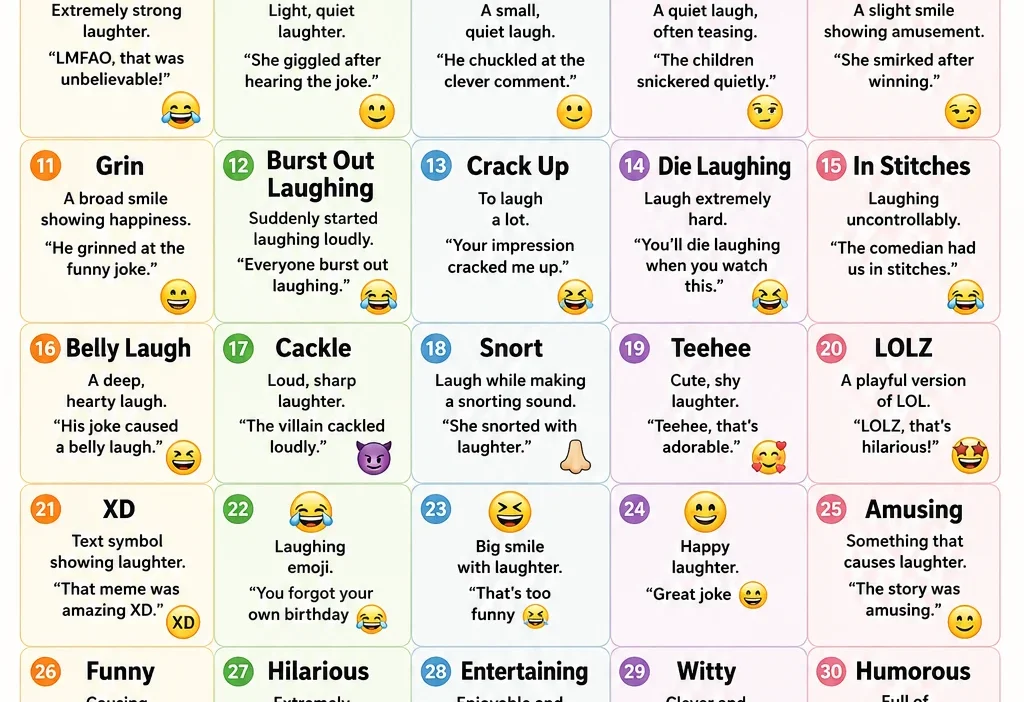
Have you ever wanted to express laughter without typing LOL every time? Learning different LOL synonyms can make your messages, social media posts, stories, and conversations feel more natural and expressive.
if you’re chatting with friends, writing online, or improving your English vocabulary, knowing alternatives to “LOL” helps you communicate more effectively.
In today’s digital world, people use many expressions to show laughter, amusement, or excitement. Some are casual, some are formal, and others are popular in texting or social media.
Understanding these LOL synonyms will help students, ESL learners, writers, and content creators choose the right expression for every situation.
Meaning of “LOL”
What Does LOL Mean?
LOL stands for “Laughing Out Loud.” It is one of the most common internet abbreviations used to show that something is funny or amusing. Although it originally meant someone was laughing loudly, today many people use it simply to show they found something entertaining, even if they are only smiling.
Example:
“That joke was hilarious, LOL!”
Tone: Casual, friendly, and informal.
Best Used In:
- Text messages
- Social media
- Online chats
- Friendly emails
- Gaming conversations
It is generally not suitable for formal writing, academic papers, or professional business communication.
30 Best LOL Synonyms
1. Haha
Meaning: A simple way to show laughter.
Example: “Haha, that was a good one!”
Best Usage Context: Everyday conversations and texting.
2. Hahaha
Meaning: Stronger laughter than “haha.”
Example: “Hahaha! I can’t stop laughing.”
Best Usage Context: Funny chats with friends.
3. Hehe
Meaning: Soft or playful laughter.
Example: “Hehe, I knew you’d say that.”
Best Usage Context: Cute or playful conversations.
4. LMAO
Meaning: Laughing extremely hard.
Example: “That video had me LMAO.”
Best Usage Context: Casual internet slang.
5. ROFL
Meaning: Rolling on the floor laughing.
Example: “Your story made me ROFL.”
Best Usage Context: Very funny situations online.
6. LMFAO
Meaning: Extremely strong laughter.
Example: “LMFAO, that was unbelievable!”
Best Usage Context: Informal chats only.
7. Giggle
Meaning: Light, quiet laughter.
Example: “She giggled after hearing the joke.”
Best Usage Context: Writing and storytelling.
8. Chuckle
Meaning: A small, quiet laugh.
Example: “He chuckled at the clever comment.”
Best Usage Context: Books and professional writing.
9. Snicker
Meaning: A quiet laugh, often teasing.
Example: “The children snickered quietly.”
Best Usage Context: Describing hidden laughter.
10. Smirk
Meaning: A slight smile showing amusement.
Example: “She smirked after winning.”
Best Usage Context: Fiction and descriptions.
11. Grin
Meaning: A broad smile showing happiness.
Example: “He grinned at the funny joke.”
Best Usage Context: General writing.
12. Burst Out Laughing
Meaning: Suddenly started laughing loudly.
Example: “Everyone burst out laughing.”
Best Usage Context: Storytelling.
13. Crack Up
Meaning: To laugh a lot.
Example: “Your impression cracked me up.”
Best Usage Context: Informal English.
14. Die Laughing
Meaning: Laugh extremely hard.
Example: “You’ll die laughing when you watch this.”
Best Usage Context: Casual speech.
15. In Stitches
Meaning: Laughing uncontrollably.
Example: “The comedian had us in stitches.”
Best Usage Context: Describing hilarious moments.
16. Belly Laugh
Meaning: A deep, hearty laugh.
Example: “His joke caused a belly laugh.”
Best Usage Context: Storytelling.
17. Cackle
Meaning: Loud, sharp laughter.
Example: “The villain cackled loudly.”
Best Usage Context: Fiction and descriptions.
18. Snort
Meaning: Laugh while making a snorting sound.
Example: “She snorted with laughter.”
Best Usage Context: Casual writing.
19. Teehee
Meaning: Cute, shy laughter.
Example: “Teehee, that’s adorable.”
Best Usage Context: Informal online chats.
20. LOLZ
Meaning: A playful version of LOL.
Example: “LOLZ, that’s hilarious!”
Best Usage Context: Internet culture.
21. XD
Meaning: Text symbol showing laughter.
Example: “That meme was amazing XD.”
Best Usage Context: Gaming and online chats.
22. 😂
Meaning: Laughing emoji.
Example: “You forgot your own birthday 😂”
Best Usage Context: Social media and messaging.
23. 😆
Meaning: Big smile with laughter.
Example: “That’s too funny 😆”
Best Usage Context: Casual texting.
24. 😄
Meaning: Happy laughter.
Example: “Great joke 😄”
Best Usage Context: Friendly conversations.
25. Amusing
Meaning: Something that causes laughter.
Example: “The story was amusing.”
Best Usage Context: Formal writing.
26. Funny
Meaning: Causing laughter.
Example: “That movie was funny.”
Best Usage Context: Everyday English.
27. Hilarious
Meaning: Extremely funny.
Example: “His performance was hilarious.”
Best Usage Context: Reviews and conversations.
28. Entertaining
Meaning: Enjoyable and amusing.
Example: “The show was entertaining.”
Best Usage Context: Reviews.
29. Witty
Meaning: Clever and funny.
Example: “She made a witty comment.”
Best Usage Context: Professional writing.
30. Humorous
Meaning: Full of humor.
Example: “He has a humorous personality.”
Best Usage Context: Formal and academic writing.
Comparison Guide: When to Use Different LOL Synonyms
Quick Comparison Table
| Synonym | Meaning | Best For | Formality |
|---|---|---|---|
| LOL | Laughing out loud | Texting | Informal |
| Haha | Basic laughter | Everyday chats | Informal |
| Hahaha | Strong laughter | Friends | Informal |
| Hehe | Playful laugh | Casual chats | Informal |
| LMAO | Very funny | Internet slang | Very Informal |
| ROFL | Extreme laughter | Online chats | Very Informal |
| Giggle | Light laugh | Stories | Neutral |
| Chuckle | Quiet laugh | Writing | Neutral |
| Funny | Causes laughter | Everyday English | Neutral |
| Hilarious | Extremely funny | Reviews | Neutral |
| Humorous | Full of humor | Academic writing | Formal |
| Witty | Clever humor | Professional writing | Formal |
| Amusing | Pleasantly funny | Articles | Formal |
| Belly Laugh | Deep laughter | Storytelling | Informal |
| Crack Up | Laugh a lot | Casual speech | Informal |
How to Choose the Right Synonym
For Casual Text Messages
Use:
- LOL
- Haha
- Hahaha
- Hehe
- 😂
- 😆
- XD
These expressions sound natural in conversations with friends and family.
For Social Media
Choose:
- LOL
- LMAO
- ROFL
- 😂
- LOLZ
These are popular on platforms like Instagram, TikTok, X, and Facebook.
For Stories and Creative Writing
Good choices include:
- Chuckle
- Giggle
- Burst Out Laughing
- Belly Laugh
- Cackle
- Snort
These words help readers imagine how a character laughs.
For School and Academic Writing
Use:
- Humorous
- Amusing
- Witty
- Funny
- Entertaining
These are more appropriate than internet slang.
For Professional Writing
Choose:
- Amusing
- Humorous
- Witty
- Entertaining
Avoid using LOL, LMAO, or ROFL in business emails or formal documents.
Why Learning LOL Synonyms Is Helpful
Using different LOL synonyms makes your English richer and more expressive. Instead of repeating the same word, you can match your expression to the situation. Writers create more engaging stories, students improve their vocabulary, ESL learners understand online conversations better, and content creators produce more natural content.
The right synonym also helps communicate the exact type of laughter, whether it is a quiet chuckle, playful giggle, or uncontrollable burst of laughter.
Common Mistakes to Avoid
- Using LOL in formal emails or academic assignments.
- Using LMAO or LMFAO in professional settings.
- Confusing giggle with chuckle—a giggle is usually lighter and more playful.
- Overusing internet slang in serious writing.
- Choosing extreme expressions like ROFL when something is only mildly funny.
Conclusion
Learning different LOL synonyms is an easy way to improve your English vocabulary and make your communication more engaging.
if you’re texting friends, writing stories, creating social media content, or studying English as a second language, using the right expression can better match your tone and audience.
From simple choices like haha and giggle to stronger expressions such as LMAO, ROFL, and belly laugh, every synonym has its own meaning and best use.
By understanding these differences, you’ll sound more natural, avoid repetition, and communicate with greater confidence.

Liam Henry is a content author at Synonymed, specializing in vocabulary enrichment and synonym guides. He creates clear, engaging resources that help learners improve English word knowledge and language fluency.