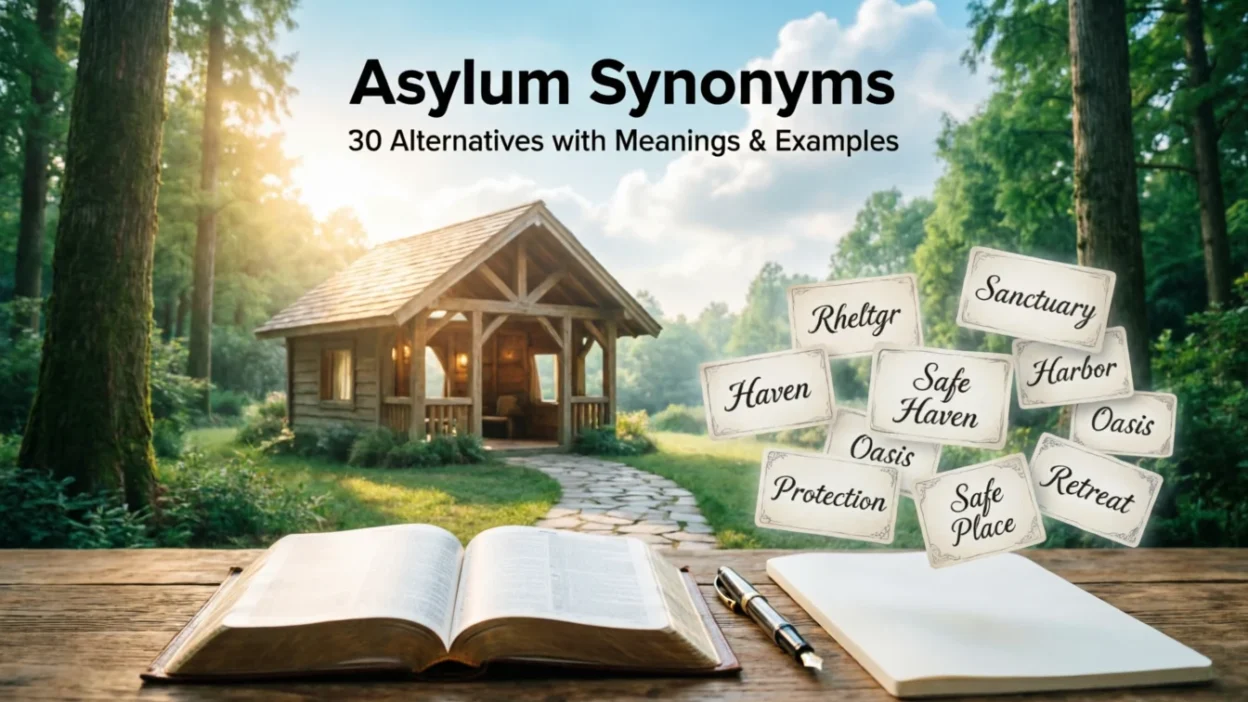
The word asylum has several meanings depending on the context. It can refer to a safe place where someone receives protection, a shelter or refuge, or legal protection granted to people fleeing danger or persecution.
Because the word is used in legal, historical, literary, and everyday English, learning asylum synonyms can help you choose the most accurate word for your writing.
Whether you’re a student, an ESL learner, a writer, or a content creator, expanding your vocabulary with asylum synonyms allows you to write more naturally and avoid repeating the same word.
Some alternatives sound formal, while others are better suited for casual conversation or creative writing.
This guide explains each synonym in simple English with meanings, examples, and usage tips.
What Does “Asylum” Mean?
The word asylum generally means a place of safety, protection, or shelter. It can also refer to legal protection offered by a country to someone escaping war, violence, or persecution. Historically, the word was also used for institutions that cared for people with mental illnesses, though this meaning is now less common and often replaced by more respectful terms.
Common Uses of “Asylum”
- A safe place from danger
- Legal protection for refugees
- Shelter during emergencies
- Historical mental health institutions
Example:
The family sought asylum after fleeing their home country.
30 Asylum Synonyms
1. Refuge
Meaning: A safe place that protects people from danger.
Example: The travelers found refuge during the storm.
Best Usage: Safety, emergencies, humanitarian writing.
2. Shelter
Meaning: A place that gives protection from harm or bad weather.
Example: The shelter welcomed homeless families.
Best Usage: Everyday English, disasters.
3. Sanctuary
Meaning: A peaceful place offering safety and protection.
Example: The wildlife sanctuary protects endangered animals.
Best Usage: Religious, environmental, and legal contexts.
4. Haven
Meaning: A peaceful and secure place.
Example: The small village became a haven for artists.
Best Usage: Literary and descriptive writing.
5. Safe Haven
Meaning: A place where people are protected from danger.
Example: The country became a safe haven for refugees.
Best Usage: News and humanitarian topics.
6. Protection
Meaning: The act of keeping someone safe.
Example: Children deserve protection from harm.
Best Usage: General writing.
7. Safety
Meaning: Freedom from danger.
Example: Everyone deserves safety and security.
Best Usage: Everyday English.
8. Retreat
Meaning: A place where someone goes for peace or escape.
Example: The cabin became his peaceful retreat.
Best Usage: Personal and literary writing.
9. Harbor
Meaning: A place of shelter or protection.
Example: The island offered harbor to sailors.
Best Usage: Figurative and historical writing.
10. Oasis
Meaning: A peaceful place among difficult surroundings.
Example: The park was an oasis in the busy city.
Best Usage: Descriptive writing.
11. Hideaway
Meaning: A secret or quiet place to stay safely.
Example: The cabin served as a hideaway.
Best Usage: Informal and creative writing.
12. Retreat Center
Meaning: A place for rest and relaxation.
Example: They spent the weekend at a retreat center.
Best Usage: Wellness and travel.
13. Safe House
Meaning: A secure location for protection.
Example: Witnesses stayed in a safe house.
Best Usage: Security and legal contexts.
14. Refugee Shelter
Meaning: A place for displaced people.
Example: The refugee shelter provided food and beds.
Best Usage: Humanitarian writing.
15. Sanctuary Home
Meaning: A protected place to live.
Example: The organization opened a sanctuary home.
Best Usage: Charities and nonprofits.
16. Harborage
Meaning: Shelter or protection.
Example: The cave offered harborage during the storm.
Best Usage: Formal or literary writing.
17. Cover
Meaning: Protection from danger.
Example: The soldiers took cover behind the wall.
Best Usage: Military and action writing.
18. Refugee Camp
Meaning: Temporary housing for displaced people.
Example: Many families lived in the refugee camp.
Best Usage: International news.
19. Shelter Home
Meaning: A home offering temporary safety.
Example: The shelter home helped abused women.
Best Usage: Social services.
20. Hospice
Meaning: A place providing compassionate care.
Example: She volunteered at a local hospice.
Best Usage: Healthcare.
21. Safe Place
Meaning: Somewhere free from danger.
Example: Every child needs a safe place.
Best Usage: Everyday English.
22. Protection Center
Meaning: A facility offering security and care.
Example: Victims were taken to the protection center.
Best Usage: Social work.
23. Escape
Meaning: A way or place to get away from danger.
Example: The mountains offered an escape from city life.
Best Usage: Informal and literary writing.
24. Preservation
Meaning: Protection from damage or harm.
Example: The preservation of history is important.
Best Usage: Academic and environmental writing.
25. Care Facility
Meaning: A place that provides care and support.
Example: The care facility helped elderly residents.
Best Usage: Healthcare.
26. Residence
Meaning: A place where someone lives.
Example: The residence welcomed new arrivals.
Best Usage: Formal writing.
27. Home
Meaning: A place where someone feels safe and comfortable.
Example: Their new home brought peace.
Best Usage: Everyday English.
28. Protection Zone
Meaning: An area kept safe from danger.
Example: The aid workers established a protection zone.
Best Usage: Emergency planning.
29. Safe Refuge
Meaning: A secure place to escape danger.
Example: The church became a safe refuge.
Best Usage: Inspirational writing.
30. Secure Shelter
Meaning: A protected place to stay.
Example: Families found secure shelter after the flood.
Best Usage: Disaster relief.
Comparison Guide: When to Use Different Asylum Synonyms
| Synonym | Best For | Tone |
|---|---|---|
| Refuge | General safety | Neutral |
| Shelter | Emergency situations | Everyday |
| Sanctuary | Protection and peace | Formal |
| Haven | Peaceful locations | Literary |
| Safe Haven | Refugees and legal topics | Professional |
| Harbor | Historical writing | Literary |
| Oasis | Calm environments | Descriptive |
| Safe House | Security | Technical |
| Home | Comfort and belonging | Casual |
| Retreat | Relaxation | Positive |
| Hospice | Medical care | Compassionate |
| Care Facility | Healthcare | Professional |
| Refugee Shelter | Humanitarian work | Formal |
| Safe Refuge | Protection | Inspirational |
| Secure Shelter | Disaster relief | Practical |
How to Choose the Right Synonym
For Legal or Immigration Contexts
Use:
- Refuge
- Safe Haven
- Sanctuary
- Refugee Shelter
- Safe Refuge
These words are commonly used when discussing asylum seekers, refugees, and humanitarian protection.
For Everyday Conversation
Use:
- Shelter
- Home
- Safe Place
- Protection
- Safety
These are simple, clear, and easy for ESL learners to understand.
For Creative and Literary Writing
Use:
- Haven
- Harbor
- Oasis
- Retreat
- Hideaway
These synonyms create vivid imagery and emotional impact.
For Healthcare and Support Services
Use:
- Hospice
- Care Facility
- Shelter Home
- Sanctuary Home
- Protection Center
These terms describe places that provide care, assistance, and safety.
For Emergency or Disaster Situations
Use:
- Shelter
- Secure Shelter
- Protection Zone
- Refuge
- Safe Haven
These are commonly used in news reports and emergency planning.
Why Learn Asylum Synonyms?
Knowing different asylum synonyms improves both your vocabulary and your writing. Instead of repeating one word, you can choose the synonym that best matches the situation, tone, and audience.
Benefits include:
- Better English vocabulary
- More natural writing
- Improved academic assignments
- Stronger creative storytelling
- Clearer communication
- Better SEO content with varied language
For ESL learners, understanding these alternatives also makes reading books, news articles, and legal texts much easier.
Conclusion
Learning asylum synonyms helps you express ideas about safety, protection, shelter, and refuge with greater accuracy. While refuge, shelter, and sanctuary are among the most common alternatives, each synonym has its own tone and best use.
By understanding these subtle differences, you can improve your writing, expand your vocabulary, and communicate more effectively in academic, professional, and everyday English.

Liam Henry is a content author at Synonymed, specializing in vocabulary enrichment and synonym guides. He creates clear, engaging resources that help learners improve English word knowledge and language fluency.