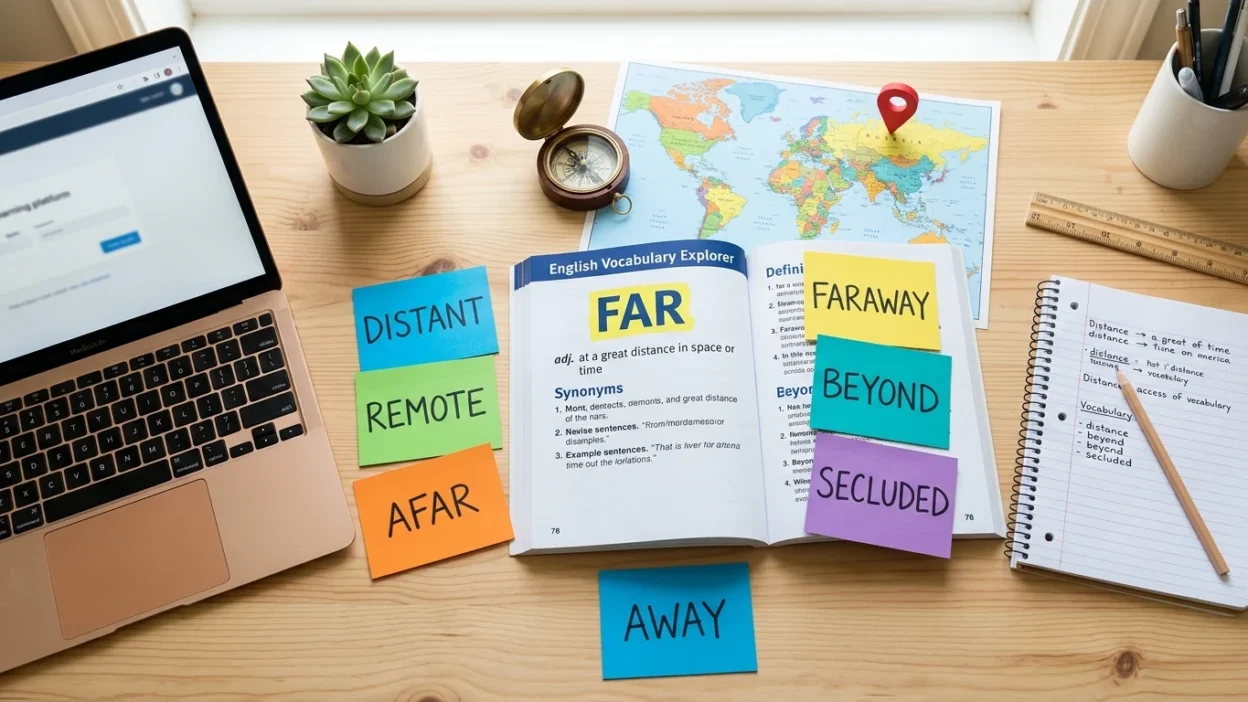
The word far is one of the most commonly used words in English.
It usually describes a long distance between people, places, objects, or even ideas.
If you’re talking about a city that’s miles away or saying someone is “far better” at something, this simple word appears in everyday conversations and writing.
Learning far synonyms can help students, ESL learners, writers, and content creators expand their vocabulary and avoid repeating the same word.
Choosing the right synonym also makes your writing more natural, engaging, and precise because different situations call for different words.
What Does “Far” Mean?
Meaning of Far
The word far means a long distance away in space, time, or degree. It can describe physical distance, a large difference, or something that extends beyond a certain point.
Examples:
- The nearest supermarket is far from my house.
- Her performance was far better than expected.
- We have come far since last year.
Depending on the context, words like distant, remote, or faraway may be better choices.
30 Far Synonyms with Meanings, Examples, and Usage
1. Distant
Meaning: Located a long way away.
Example: We could see distant mountains.
Best Usage Context: Physical places and scenery.
2. Remote
Meaning: Far from towns or busy areas.
Example: They lived in a remote village.
Best Usage Context: Locations and geography.
3. Faraway
Meaning: Very far from where you are.
Example: She dreamed of visiting faraway countries.
Best Usage Context: Travel and storytelling.
4. Removed
Meaning: Separated by distance or situation.
Example: The cabin was removed from the main road.
Best Usage Context: Formal writing.
5. Isolated
Meaning: Far away and alone.
Example: The island remained isolated.
Best Usage Context: Geography and communities.
6. Outlying
Meaning: Located away from the center.
Example: We visited the outlying villages.
Best Usage Context: Cities and regions.
7. Away
Meaning: At another place.
Example: She lives far away now.
Best Usage Context: Everyday conversation.
8. Afar
Meaning: From a great distance.
Example: We watched the fireworks from afar.
Best Usage Context: Literary and descriptive writing.
9. Beyond
Meaning: On the farther side of something.
Example: The mountains lay beyond the river.
Best Usage Context: Directions and descriptions.
10. Extensive
Meaning: Covering a large area.
Example: The forest is extensive.
Best Usage Context: Geography and reports.
11. Wide
Meaning: Spreading over a large distance.
Example: The road is wide and long.
Best Usage Context: General descriptions.
12. Broad
Meaning: Covering a large area.
Example: A broad valley stretched before us.
Best Usage Context: Landscapes.
13. Lengthy
Meaning: Extending for a long distance or time.
Example: It was a lengthy journey.
Best Usage Context: Travel and time.
14. Long-Distance
Meaning: Covering a great distance.
Example: They are in a long-distance relationship.
Best Usage Context: Relationships and travel.
15. Secluded
Meaning: Quiet and far from other places.
Example: They found a secluded beach.
Best Usage Context: Nature and vacations.
16. Hidden
Meaning: Difficult to find or far from view.
Example: The hidden cabin was peaceful.
Best Usage Context: Descriptive writing.
17. Off the Beaten Path
Meaning: Far from popular places.
Example: We explored villages off the beaten path.
Best Usage Context: Travel blogs.
18. Out of the Way
Meaning: Far from busy areas.
Example: The restaurant is out of the way.
Best Usage Context: Everyday English.
19. Deep
Meaning: Located well inside an area.
Example: The campsite was deep in the forest.
Best Usage Context: Nature descriptions.
20. Extreme
Meaning: At the furthest point.
Example: They reached the extreme edge of the island.
Best Usage Context: Geography.
21. Outer
Meaning: On the outside or farther edge.
Example: The outer villages were quiet.
Best Usage Context: Locations.
22. Peripheral
Meaning: Away from the center.
Example: Development reached peripheral neighborhoods.
Best Usage Context: Academic and business writing.
23. Detached
Meaning: Separate and distant.
Example: The garage is detached from the house.
Best Usage Context: Buildings and relationships.
24. Apart
Meaning: Separated by distance.
Example: The two towns are miles apart.
Best Usage Context: Everyday English.
25. Yonder
Meaning: At some distance over there.
Example: Look at the house yonder.
Best Usage Context: Literary or old-fashioned English.
26. Abroad
Meaning: In another country.
Example: She studied abroad.
Best Usage Context: Travel and education.
27. Over There
Meaning: At a distant place.
Example: My backpack is over there.
Best Usage Context: Casual speech.
28. Farthest
Meaning: At the greatest distance.
Example: Australia is one of the farthest destinations.
Best Usage Context: Comparisons.
29. Furthest
Meaning: Most distant in place or degree.
Example: He walked the furthest.
Best Usage Context: British English and comparisons.
30. Miles Away
Meaning: Very far in distance or attention.
Example: The airport is miles away.
Best Usage Context: Informal conversation.
Comparison Guide
When to Use Different Far Synonyms
| Synonym | Best For | Tone |
|---|---|---|
| Distant | Places and objects | Neutral |
| Remote | Rural locations | Neutral |
| Faraway | Stories and travel | Descriptive |
| Afar | Literature | Formal |
| Beyond | Directions | Neutral |
| Secluded | Quiet places | Positive |
| Out of the Way | Everyday speech | Informal |
| Peripheral | Academic writing | Formal |
| Farthest | Physical distance | Neutral |
| Furthest | Distance or degree | Neutral |
How to Choose the Right Synonym
For Everyday Conversation
Use:
- Away
- Apart
- Over There
- Miles Away
- Out of the Way
These are common and easy to understand.
For Formal Writing
Use:
- Remote
- Distant
- Peripheral
- Removed
- Extensive
These work well in essays, reports, and academic writing.
For Travel Writing
Use:
- Faraway
- Secluded
- Hidden
- Off the Beaten Path
- Abroad
These create vivid and engaging travel descriptions.
For Creative Writing
Use:
- Afar
- Yonder
- Beyond
- Deep
- Outer
These words add imagery and style to stories and poems.
Why Learning Far Synonyms Matters
Using different synonyms for far helps you express ideas more accurately and naturally. Instead of repeating the same word, you can choose a synonym that better matches the distance, tone, or situation.
A richer vocabulary also improves essays, creative writing, blog posts, and everyday conversations.
Common Mistakes to Avoid
Confusing “Farther” and “Further”
- Farther usually refers to physical distance.
- Further often refers to additional information or figurative distance.
Example:
- We walked farther than yesterday.
- Let me explain further.
Using Formal Words in Casual Speech
Words like peripheral or removed may sound unnatural in everyday conversations. Use simpler alternatives like away or faraway instead.
Ignoring Context
Choose a synonym based on the situation. Remote fits a village, while afar is more common in literary writing.
Conclusion
Learning far synonyms is an easy way to strengthen your English vocabulary and improve your communication skills. While far is a useful everyday word, alternatives such as distant, remote, afar, secluded, and faraway can make your writing more precise and engaging.
By understanding each synonym’s meaning, example, and best usage context, you’ll know exactly which word fits your sentence. Practice using these alternatives in your writing and conversations to sound more fluent and confident.

Liam Henry is a content author at Synonymed, specializing in vocabulary enrichment and synonym guides. He creates clear, engaging resources that help learners improve English word knowledge and language fluency.