Pumpkins are one of the most recognizable fruits in the world. They are closely with autum, Thanksgiving, cooking, , and gardening.
However, many students, writers, and English learners search for pumpkin synonyms to improve their vocabulary or find better words for different writing situations.
The truth is that there are very words that are exact synonyms for because it is the name of a specific type of fruit. Still, there are many related words, names, , and context-based substitutes that can be used depending on what you are writing.
Learning these alternatives will help you write more naturally, avoid repetition, and expand your English vocabulary.
Meaning of “Pumpkin”
What Does Pumpkin Mean?
A pumpkin is a large, round fruit with a hard orange shell, soft flesh inside, and many seeds. It belongs to the squash family and is commonly used in cooking, baking, decoration, and farming.
People often use the word pumpkin in different contexts:
- Cooking (pumpkin pie, pumpkin soup)
- Gardening (growing pumpkins)
- Halloween decorations
- Agriculture
- Literature and storytelling
- As an affectionate nickname (“Hello, pumpkin!”)
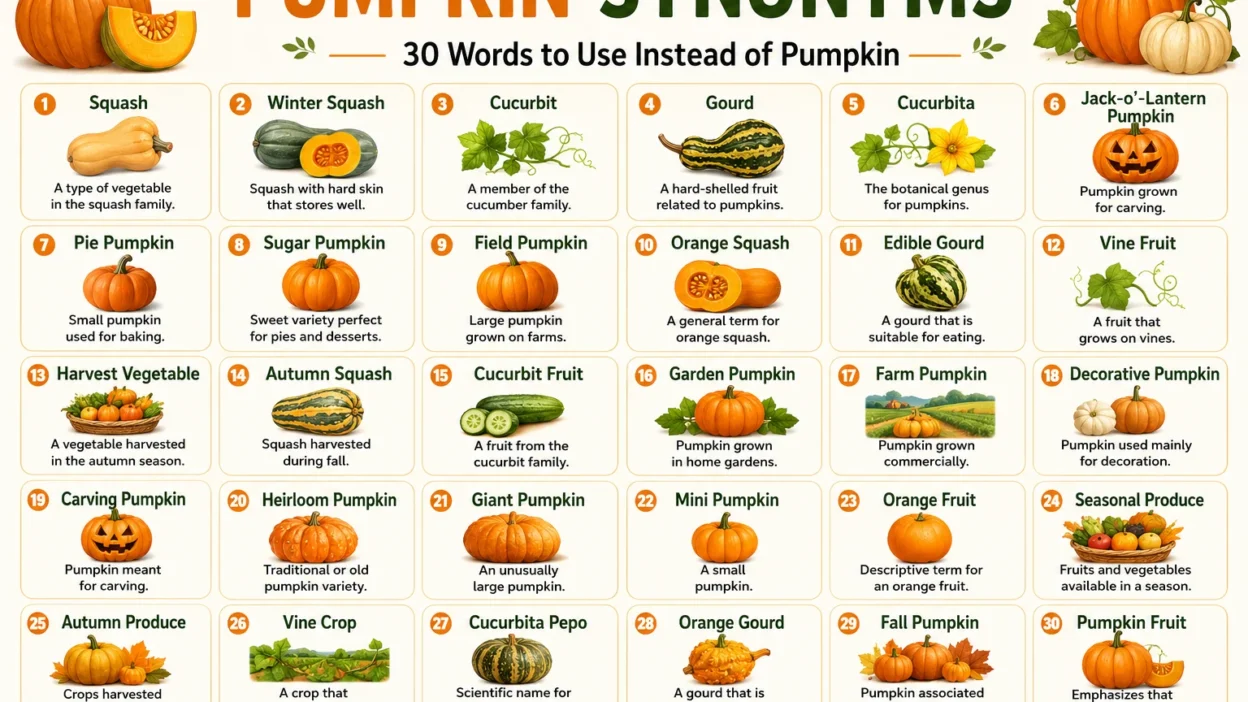
30 Pumpkin Synonyms and Related Words
1. Squash
Meaning: A plant or fruit from the squash family.
Example: We harvested several squash from the garden.
Best Usage Context: General gardening and cooking.
2. Winter Squash
Meaning: A squash variety with a hard outer skin.
Example: Winter squash can be stored for several months.
Best Usage Context: Agriculture and recipes.
3. Cucurbit
Meaning: A member of the cucumber and squash family.
Example: Pumpkin is a popular cucurbit grown worldwide.
Best Usage Context: Scientific writing.
4. Gourd
Meaning: A hard-shelled fruit related to pumpkins.
Example: Decorative gourds filled the market stalls.
Best Usage Context: Gardening and decoration.
5. Cucurbita
Meaning: The scientific genus that includes pumpkins.
Example: Cucurbita species are cultivated globally.
Best Usage Context: Botanical discussions.
6. Jack-o’-Lantern Pumpkin
Meaning: A pumpkin grown mainly for carving.
Example: We bought a jack-o’-lantern pumpkin for Halloween.
Best Usage Context: Seasonal events.
7. Pie Pumpkin
Meaning: A small pumpkin used for baking.
Example: Pie pumpkins make sweeter desserts.
Best Usage Context: Cooking.
8. Sugar Pumpkin
Meaning: A sweet variety of pumpkin.
Example: Sugar pumpkins are ideal for pies.
Best Usage Context: Baking.
9. Field Pumpkin
Meaning: A large pumpkin grown on farms.
Example: Farmers planted hundreds of field pumpkins.
Best Usage Context: Agriculture.
10. Orange Squash
Meaning: A descriptive name for an orange squash.
Example: The orange squash looked ready to harvest.
Best Usage Context: Informal descriptions.
11. Edible Gourd
Meaning: A gourd suitable for eating.
Example: The edible gourd was added to the soup.
Best Usage Context: Cooking.
12. Vine Fruit
Meaning: A fruit that grows on vines.
Example: Pumpkin is a vine fruit.
Best Usage Context: Gardening.
13. Harvest Vegetable
Meaning: A seasonal crop often harvested in autumn.
Example: The harvest vegetable was sold at the market.
Best Usage Context: Seasonal writing.
14. Autumn Squash
Meaning: A squash harvested during fall.
Example: Autumn squash is popular in October.
Best Usage Context: Seasonal articles.
15. Cucurbit Fruit
Meaning: A fruit from the cucurbit family.
Example: Pumpkin is a common cucurbit fruit.
Best Usage Context: Educational writing.
16. Garden Pumpkin
Meaning: A pumpkin grown in home gardens.
Example: Our garden pumpkin weighed ten kilograms.
Best Usage Context: Gardening.
17. Farm Pumpkin
Meaning: A pumpkin grown commercially.
Example: Farm pumpkins were shipped nationwide.
Best Usage Context: Agriculture.
18. Decorative Pumpkin
Meaning: A pumpkin mainly used as decoration.
Example: Decorative pumpkins decorated the porch.
Best Usage Context: Home décor.
19. Carving Pumpkin
Meaning: A pumpkin meant for carving.
Example: The carving pumpkin had a smooth surface.
Best Usage Context: Halloween.
20. Heirloom Pumpkin
Meaning: A traditional pumpkin variety.
Example: Heirloom pumpkins come in many colors.
Best Usage Context: Gardening.
21. Giant Pumpkin
Meaning: An unusually large pumpkin.
Example: The giant pumpkin won first prize.
Best Usage Context: Competitions.
22. Mini Pumpkin
Meaning: A small pumpkin.
Example: Mini pumpkins made perfect table decorations.
Best Usage Context: Decorating.
23. Orange Fruit
Meaning: A descriptive phrase for an orange-colored fruit.
Example: The orange fruit stood out in the field.
Best Usage Context: Descriptive writing.
24. Seasonal Produce
Meaning: Fruits and vegetables available during a season.
Example: Pumpkins are popular seasonal produce.
Best Usage Context: Food blogs.
25. Autumn Produce
Meaning: Crops harvested in autumn.
Example: Autumn produce includes pumpkins and apples.
Best Usage Context: Seasonal content.
26. Vine Crop
Meaning: A crop that grows on vines.
Example: Pumpkin is a well-known vine crop.
Best Usage Context: Farming.
27. Cucurbita Pepo
Meaning: The scientific name for many pumpkin varieties.
Example: Cucurbita pepo includes several pumpkin types.
Best Usage Context: Scientific articles.
28. Orange Gourd
Meaning: A descriptive term for an orange-colored gourd.
Example: The orange gourd brightened the garden.
Best Usage Context: Creative writing.
29. Fall Pumpkin
Meaning: A pumpkin associated with autumn.
Example: Every fall pumpkin looked fresh from the farm.
Best Usage Context: Seasonal blogs.
30. Pumpkin Fruit
Meaning: A descriptive phrase emphasizing that pumpkins are fruits.
Example: The pumpkin fruit contains edible seeds.
Best Usage Context: Educational content.
Comparison Guide
When Should You Use Different Pumpkin Synonyms?
| Word | Best Used For | Formality |
|---|---|---|
| Pumpkin | Everyday English | Casual |
| Squash | Cooking, gardening | Neutral |
| Gourd | Decoration, gardening | Neutral |
| Cucurbit | Scientific writing | Formal |
| Cucurbita | Botany | Formal |
| Pie Pumpkin | Recipes | Casual |
| Sugar Pumpkin | Baking | Casual |
| Carving Pumpkin | Halloween | Casual |
| Decorative Pumpkin | Home décor | Neutral |
| Giant Pumpkin | Competitions | Neutral |
| Mini Pumpkin | Crafts and decoration | Casual |
| Vine Crop | Agriculture | Formal |
How to Choose the Right Synonym
Use for Everyday Conversation
Choose:
- Pumpkin
- Squash
- Gourd
- Mini Pumpkin
These words sound natural in daily English.
Use for Cooking and Recipes
Choose:
- Pie Pumpkin
- Sugar Pumpkin
- Winter Squash
- Edible Gourd
These are common in food blogs and cookbooks.
Use for Scientific or Educational Writing
Choose:
- Cucurbita
- Cucurbit
- Cucurbita Pepo
- Cucurbit Fruit
These terms are accurate for biology and agriculture.
Use for Halloween and Autumn
Choose:
- Jack-o’-Lantern Pumpkin
- Carving Pumpkin
- Decorative Pumpkin
- Fall Pumpkin
- Autumn Squash
These fit seasonal articles and festive content.
Use for Farming and Gardening
Choose:
- Farm Pumpkin
- Garden Pumpkin
- Field Pumpkin
- Vine Crop
These are suitable for agriculture and gardening discussions.
Are There True Synonyms for Pumpkin?
Unlike words such as “happy” or “big,” pumpkin has very few true synonyms because it refers to a specific fruit. Most alternatives are either:
- Related botanical terms
- Different pumpkin varieties
- Scientific names
- Descriptive phrases
- Context-based alternatives
That is why choosing the correct word depends on what you are writing rather than replacing pumpkin in every sentence.
Why Learn Pumpkin Synonyms?
Learning pumpkin synonyms helps you:
- Expand your English vocabulary.
- Write more naturally without repeating the same word.
- Understand gardening and botanical terminology.
- Improve essays, blogs, and creative writing.
- Communicate more clearly in different situations.
For ESL learners and students, knowing these alternatives also makes reading books, recipes, and educational articles much easier.
Conclusion
Although pumpkin has only a few exact synonyms, many related words and descriptive alternatives can be used depending on the context
. Words such as squash, gourd, winter squash, cucurbit, and Cucurbita are excellent choices in gardening, cooking, scientific writing, and seasonal content.
By understanding when each word works best, you can improve your vocabulary, make your writing more engaging, and communicate with greater confidence.