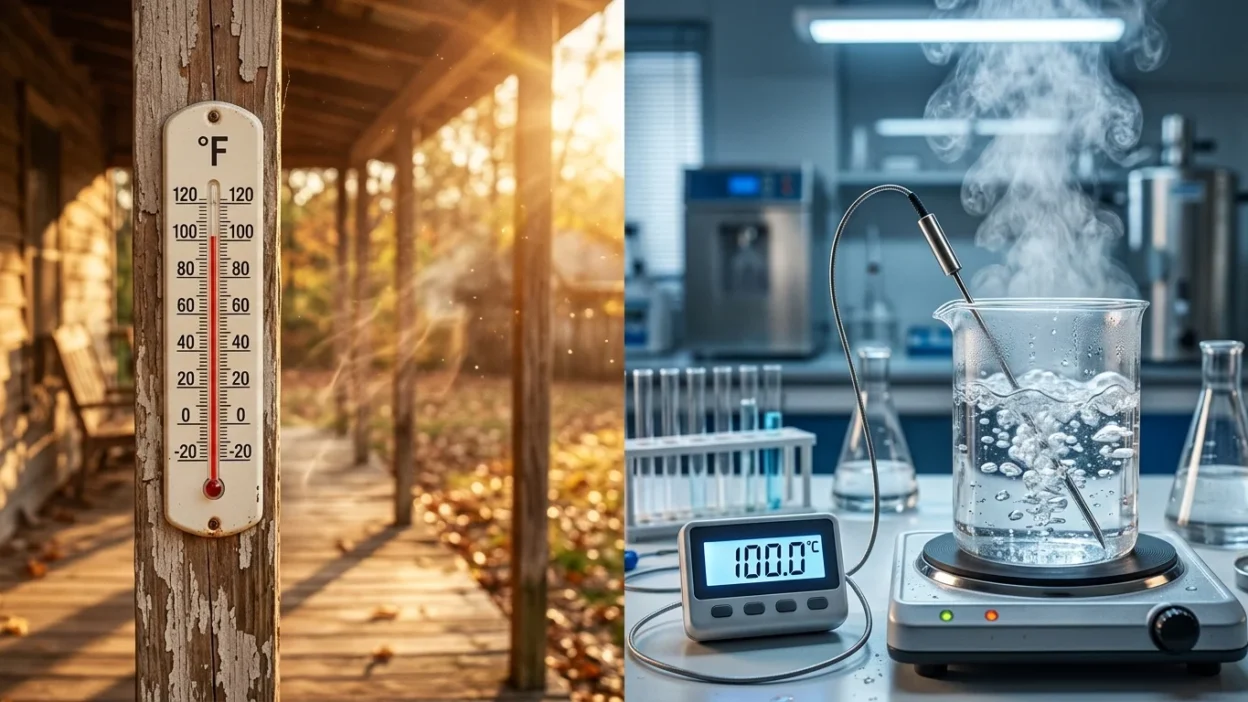
Fahrenheit vs Celsius is a common question for students, travelers, science learners, and anyone who checks the weather in different countries.
Both are temperature scales used to measure how hot or cold something is, but they use different numbers for the same temperature.
Understanding the difference helps you read weather forecasts, set an oven, check body temperature, and understand scientific information more easily.
The main difference between Fahrenheit and Celsius is their reference points.
On the Celsius scale, water freezes at 0°C and boils at 100°C under standard atmospheric pressure. On the Fahrenheit scale, water freezes at 32°F and boils at 212°F under the same conditions.
Celsius is widely used around the world, while Fahrenheit is commonly used for everyday temperatures in the United States.
Although the numbers look different, both scales describe the same physical temperature.
Once you learn a few key values and a simple conversion formula, switching between Fahrenheit and Celsius becomes much easier.
Quick Answer: Fahrenheit vs Celsius
Fahrenheit (°F) and Celsius (°C) are two temperature scales. Celsius sets water’s freezing and boiling points at 0°C and 100°C, while Fahrenheit uses 32°F and 212°F. Celsius is common in most countries and scientific work, whereas Fahrenheit is used for everyday temperatures in the United States. Both measure temperature accurately.
Why Do People Confuse Fahrenheit and Celsius?
People often confuse Fahrenheit and Celsius because both measure the same thing but use different numerical scales. For example, a weather forecast of 30°C describes a much hotter day than 30°F.
The confusion usually comes from three main differences:
- Different reference points: Water freezes at 0°C but at 32°F.
- Different scale intervals: A change of 1°C equals a change of 1.8°F.
- Different everyday conventions: People may be more familiar with one scale because of where they live or study.
Another reason is that temperature numbers cannot be compared directly without considering their units. A temperature of 20°C equals 68°F, so the two numbers describe exactly the same temperature.
What Is Fahrenheit?
Fahrenheit is a temperature scale represented by the symbol °F. It is commonly used for weather forecasts, home thermostats, and everyday temperature measurements in the United States.
On the Fahrenheit scale:
- Water freezes at 32°F.
- Water boils at 212°F.
- Normal human body temperature is often around 98.6°F, although individual readings vary.
- A comfortable room temperature may be around 68–72°F, depending on personal preference.
The Fahrenheit scale places 180 degrees between the freezing and boiling points of water.
Where Is Fahrenheit Used?
Fahrenheit is primarily used for everyday temperature reporting in the United States and some US-associated contexts. People may also encounter it in older documents, product instructions, recipes, and international weather reports.
For example, if a US weather forecast predicts 86°F, it means the temperature is approximately 30°C.
What Is Celsius?
Celsius is a temperature scale represented by the symbol °C. It is used in most countries for everyday temperatures and is widely used in education, medicine, weather reporting, and scientific applications.
On the Celsius scale:
- Water freezes at 0°C.
- Water boils at 100°C.
- A temperature of 20°C equals 68°F.
- A temperature of 37°C equals 98.6°F.
The Celsius scale has 100 degrees between the freezing and boiling points of water under standard atmospheric pressure.
Where Is Celsius Used?
Celsius is the standard everyday temperature scale in most countries, including the United Kingdom, Canada, Australia, Pakistan, and much of Europe and Asia. Scientific work commonly uses Celsius alongside the SI temperature unit, kelvin.
For example, a weather forecast of 35°C indicates a very hot day. The same temperature is 95°F.
Fahrenheit vs Celsius: Key Differences at a Glance
| Feature | Fahrenheit (°F) | Celsius (°C) |
|---|---|---|
| Freezing point of water | 32°F | 0°C |
| Boiling point of water | 212°F | 100°C |
| Normal body temperature reference | About 98.6°F | About 37°C |
| Common everyday use | United States | Most countries |
| Degrees between water’s freezing and boiling points | 180 | 100 |
| Common scientific use | Some applications and contexts | Widely used |
| Temperature conversion | °C × 9/5 + 32 | (°F − 32) × 5/9 |
Note: Water’s freezing and boiling points in this table assume standard atmospheric pressure. Boiling temperature changes with pressure, and human body temperature varies from person to person.
When Should You Use Fahrenheit or Celsius?
The best scale depends on your location, purpose, and the instructions you need to follow.
When Should You Use Fahrenheit?
Use Fahrenheit when:
- Checking everyday weather forecasts in the United States.
- Adjusting a thermostat that displays °F.
- Following an American recipe that specifies oven temperatures in Fahrenheit.
- Reading a product manual that gives temperature limits in °F.
Example: If a US weather app says it will be 77°F, you can expect a mild, warm day. That temperature equals 25°C.
When Should You Use Celsius?
Use Celsius when:
- Checking weather forecasts in most countries.
- Following recipes that specify temperatures in °C.
- Studying science or learning about heat and temperature.
- Reading temperature measurements in schools and laboratories that use Celsius.
Example: If the temperature is 25°C, it equals 77°F and is generally considered pleasantly warm.
Which Temperature Scale Is Better?
Neither scale is inherently more accurate than the other. Fahrenheit and Celsius can both express temperature precisely when used correctly. Celsius is convenient for scientific education and international communication, while Fahrenheit is familiar for everyday weather and household temperatures in the United States.
15 Practical Examples of Fahrenheit vs Celsius
These examples help you connect common temperatures with real-life situations.
| Fahrenheit | Celsius | Example |
|---|---|---|
| -40°F | -40°C | The two scales meet at this temperature |
| 0°F | -17.8°C | Very cold winter weather |
| 14°F | -10°C | Freezing winter conditions |
| 32°F | 0°C | Water freezes |
| 50°F | 10°C | Cool weather |
| 59°F | 15°C | Mild, cool conditions |
| 68°F | 20°C | Comfortable indoor temperature for many people |
| 77°F | 25°C | Warm weather |
| 86°F | 30°C | Hot weather |
| 95°F | 35°C | Very hot weather |
| 98.6°F | 37°C | Traditional reference for normal body temperature |
| 104°F | 40°C | Very high body temperature if measured as a person’s temperature |
| 122°F | 50°C | Extremely hot conditions |
| 212°F | 100°C | Water boils at standard atmospheric pressure |
| 350°F | 176.7°C | Common oven temperature in some recipes |
Weather descriptions are approximate and depend on humidity, wind, sunlight, and personal comfort. Body temperature must be interpreted in context, including the person’s age, measurement method, and symptoms.
How Do You Convert Fahrenheit to Celsius?
To convert Fahrenheit to Celsius, subtract 32 from the Fahrenheit temperature and multiply the result by 5/9.
Formula:
°C = (°F − 32) × 5/9
Example: Convert 86°F to Celsius.
- Subtract 32 from 86: 86 − 32 = 54.
- Multiply 54 by 5/9: 54 × 5/9 = 30.
Therefore, 86°F = 30°C.
How Do You Convert Celsius to Fahrenheit?
To convert Celsius to Fahrenheit, multiply the Celsius temperature by 9/5 and add 32.
Formula:
°F = (°C × 9/5) + 32
Example: Convert 25°C to Fahrenheit.
- Multiply 25 by 9/5: 25 × 9/5 = 45.
- Add 32: 45 + 32 = 77.
Therefore, 25°C = 77°F.
Common Mistakes When Comparing Fahrenheit and Celsius
Even simple temperature conversions can cause confusion. Avoid these common mistakes.
1. Comparing the Numbers Without Checking the Units
A reading of 40°F is cold, while 40°C is very hot. Always check whether the temperature is Fahrenheit or Celsius.
2. Forgetting to Add or Subtract 32
The two scales have different zero points. Simply multiplying by 9/5 or 5/9 is not enough for converting an actual temperature.
3. Confusing Temperature With Temperature Change
A change of 1°C equals a change of 1.8°F. However, converting a temperature requires accounting for the 32-degree offset.
For example, 10°C equals 50°F, but a temperature increase of 10°C is equivalent to an increase of 18°F.
4. Assuming Water Always Boils at 100°C
Water boils at approximately 100°C at standard atmospheric pressure. At higher altitudes, where atmospheric pressure is lower, water boils at a lower temperature.
5. Treating 37°C as the Exact Normal Body Temperature for Everyone
Body temperature varies with the person, time of day, activity, age, and measurement method. A reading around 37°C is a traditional reference, not a universal exact value.
What Is an Easy Memory Trick for Fahrenheit vs Celsius?
Use these simple reference points to remember the difference:
- 0°C = 32°F: Water freezes.
- 20°C = 68°F: A comfortably mild temperature for many people.
- 30°C = 86°F: A hot day.
- 100°C = 212°F: Water boils at standard atmospheric pressure.
For a quick mental estimate, double the Celsius temperature and add 30 to get an approximate Fahrenheit value.
For example, 20°C × 2 + 30 = 70°F. The exact answer is 68°F, so the shortcut is close but not precise.
For the reverse estimate, subtract 30 from Fahrenheit and divide by 2. This is a rough mental shortcut, not an exact conversion formula.
Fahrenheit vs Celsius in American and British English
The difference between American and British English is mainly about everyday usage rather than vocabulary.
American English: Fahrenheit is commonly used for weather forecasts and everyday temperature discussions. People might say, “It’s 80 degrees today,” meaning 80°F when the context is clear.
British English: Celsius is the usual scale for weather forecasts and everyday temperatures. Someone might say, “It’s 25 degrees today,” meaning 25°C.
Both countries use Celsius in scientific and technical settings. Fahrenheit may still appear in certain British contexts, including historical information and some specialized applications.
When communicating with an international audience, include the unit symbol. Writing “The temperature is 25°C (77°F)” prevents confusion.
What Are Some Words Similar to Fahrenheit and Celsius?
Several related terms help explain temperature and measurement.
- Temperature: A measure of how hot or cold something is.
- Degree: A unit used to express a temperature on scales such as Celsius and Fahrenheit.
- Kelvin: The SI base unit of thermodynamic temperature, represented by K without a degree symbol.
- Thermometer: An instrument used to measure temperature.
- Heat: Energy transferred because of a temperature difference.
- Freezing point: The temperature at which a substance changes from liquid to solid under specified conditions.
- Boiling point: The temperature at which a liquid boils under a given pressure.
- Temperature conversion: The process of expressing the same temperature using a different scale.
These words are related, but they do not all mean the same thing. For example, temperature describes a physical property, while heat refers to energy transferred between systems.
Final Verdict: Fahrenheit vs Celsius
Fahrenheit and Celsius are two different ways to measure the same physical quantity: temperature. The main distinction is how each scale assigns numbers to reference points.
Celsius is widely used around the world and is especially common in science and education. Fahrenheit is familiar for everyday temperature measurements in the United States.
Remember the most useful reference points: 0°C equals 32°F, 20°C equals 68°F, and 100°C equals 212°F at standard atmospheric pressure. These values make everyday temperature comparisons easier.
If you need an exact answer, use the conversion formula rather than relying on mental estimates.
Frequently Asked Questions
1. Is Fahrenheit hotter than Celsius?
Neither scale is inherently hotter than the other. The number depends on the scale being used. For example, 100°F is approximately 37.8°C, while 100°C is 212°F.
2. What is 20°C in Fahrenheit?
20°C equals 68°F. This is often considered a comfortable indoor temperature, although personal preferences vary.
3. What is 30°C in Fahrenheit?
30°C equals 86°F. This temperature is generally considered hot for everyday weather.
4. Why does the United States use Fahrenheit?
Fahrenheit became established in the United States through historical measurement practices and continued everyday use. Although Celsius is widely used internationally and in science, Fahrenheit remains familiar for US weather reports, home thermostats, and other daily applications.
5. Which is used more worldwide, Fahrenheit or Celsius?
Celsius is used more widely for everyday temperature measurements worldwide. Fahrenheit remains especially common in the United States.
6. At what temperature are Fahrenheit and Celsius equal?
Fahrenheit and Celsius are equal at -40 degrees. Therefore, -40°F = -40°C.
7. Is Celsius more accurate than Fahrenheit?
No. Neither scale is inherently more accurate. Both can measure temperature with comparable precision when suitable instruments and appropriate measurement methods are used.
8. What is the fastest way to convert Fahrenheit to Celsius?
For an exact conversion, subtract 32 from the Fahrenheit temperature and multiply by 5/9. For a rough mental estimate, subtract 30 and divide by 2, keeping in mind that the shortcut is not exact.
Remember This
- Celsius: Water freezes at 0°C and boils at 100°C under standard atmospheric pressure.
- Fahrenheit: Water freezes at 32°F and boils at 212°F under the same conditions.
- Convert to Celsius: Subtract 32, then multiply by 5/9.
- Convert to Fahrenheit: Multiply by 9/5, then add 32.
- Quick reference: 20°C = 68°F and 30°C = 86°F.
- Key fact: Both scales measure the same physical temperature.
Conclusion
Understanding Fahrenheit vs Celsius makes everyday life easier, especially when checking international weather forecasts, following recipes, studying science, or traveling abroad. Although the numbers differ, both scales describe the same temperature. Learning their freezing and boiling points gives you a useful starting point for comparing readings accurately.
For everyday use, remember a few familiar temperatures and practice the conversion formulas when precision matters. Celsius is the common choice in most countries, while Fahrenheit remains widely used in the United States. Once you understand the reference points and the simple relationship between the scales, you can switch between them confidently.